



GRANVILLE, Stanley Lewin
| Service Number: | 588 |
|---|---|
| Enlisted: | Not yet discovered |
| Last Rank: | Private |
| Last Unit: | 11th Machine Gun Company |
| Born: | Brisbane, Queensland, Australia, 22 September 1892 |
| Home Town: | Brisbane, Queensland |
| Schooling: | Not yet discovered |
| Occupation: | Wood turner |
| Died: | Brisbane, Queensland, Australia, 16 September 1976, aged 83 years, cause of death not yet discovered |
| Cemetery: | Not yet discovered |
| Memorials: |
World War 1 Service
| 11 May 1917: | Involvement Private, 588, 11th Machine Gun Company, --- :embarkation_roll: roll_number: '21' embarkation_place: Melbourne embarkation_ship: HMAT Ascanius embarkation_ship_number: A11 public_note: '' | |
|---|---|---|
| 11 May 1917: | Embarked Private, 588, 11th Machine Gun Company, HMAT Ascanius, Melbourne |
Grandad's stories
As a boy, I often asked Grandad about his experiences in the war. The most moving was the story of how he was almost killed 1918. This occurred on the 21st or 22nd August, by which time the Australians had advanced some 10 kilometres to the Somme river. His unit was positioned in a high position overlooking the town of Bray sur Somme. An enemy counterattack left 6 killed, 18 wounded and 2 missing from the Company.
On this occasion, he narrowly escaped death. The Lewis machine gun had two operators, one who fired the gun and the other “number two” who fed in the bullets. Grandad was acting as number two when the machine gun breech jammed and he left the foxhole to get a spare part from the trench behind. Just after leaving the foxhole, a shell landed close by killing his partner and leaving Grandad riddled with shrapnel and missing part of a finger. Grandad was sent to hospital at Rouen and a few days later invalided to Beauford hospital at Bristol.
Submitted 8 January 2026 by Paul Granville
Biography contributed by Paul Granville
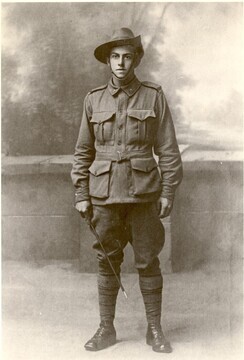
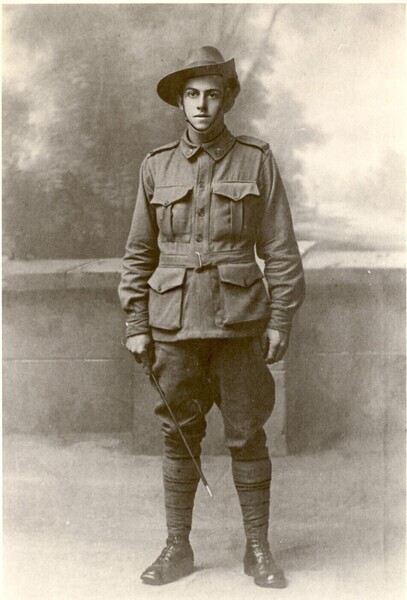
Stanley Lewin Granville was born in Brisbane on the 22nd September, 1892. Stan was an amateur athlete who competed successfully in cross-country running. He completed an apprenticeship as a wood turner. Stan married Emily Johnson on the 28th of December 1915, but she died during childbirth in the Lady Bowen Hospital in July 1916 from eclampsia, a complication of pregnancy. She was only 19 years old. A few months later he joined the 1st AIF along with his brother Robin Alfred ('Alf').
Stan joined up on the 18th of October 1916 and served for 2½ years in the 11th Machine Gun Company. It was later renamed the 3rd Machine Gun Battalion and became part of the 3rd Division.
Before being accepted by the army, Stan had to have an operation for a varicose vein in the testicle, a difficult operation at the time. He was sent to Tasmania for the operation, and had to sign an indemnity to the Commonwealth. He embarked in Melbourne in May 1917 as part of the 9th reinforcements to the Company, and travelled on the “Ascanius”.
Stan joined the unit in France in December 1917. He had many stories. Once his brother Alf, who was a messenger, and Stan both had leave and took off on Alf’s motorcycle hoping to get to Paris in the time available. This was going to be difficult due to the crowded roads. They had the idea of Stan carrying a large, important looking envelope and as a result their motorcycle was waived through repeatedly as it was assumed that they were carrying an important dispatch!
Stan was wounded the first time at Villiers-Bretonneux on the 26th May along with 12 others in his Company when the unit was hit with heavy high explosive and “yellow cross” gas shell fire. Grandad believed that he owed his life on this occasion to the fact that he was left for dead and picked up by some passing French soldiers later when he showed signs of life. He ended up in a French hospital, and the French were more advanced at that stage in treating the effects of this insidious chemical.
He rejoined the unit on the 21st July 1918. This was just before a major Allied counterattack, which took place early in August. This offensive later became known as “The Battle of Amiens”. Stand was wounded a second time on the 21st or 22nd August.
On this occasion, he narrowly escaped death. The Lewis machine gun had two operators, one who fired the gun and the other “number two” who fed in the bullets. Stan was acting as number two when the machine gun breech jammed and he left the foxhole to get a spare part from the trench behind. Just after leaving the foxhole, a shell landed close by killing his partner and leaving Stan riddled with shrapnel and missing part of a finger. This time Stan was sent to hospital at Rouen and a few days later invalided to Beauford hospital at Bristol.
Stan finally left for home on board the “Demosthenes” on the 16th January 1919. In the meantime he had been fined a fortnight’s pay for being absent without leave over the New Year period. This was to visit relatives who lived in the country.
Stan suffered from his wartime experiences all his life with trips to a Sanatorium at Tambourine Mountain during the 1920s, permanent heart problems and the effects of remaining shrapnel.
He married Olive Patten in 1920. They purchased a large ½ acre block on Waterton Street at Annerley and built their family home. Their first child died young but they had three more who led successful full lives.
Stan had a very successful career in the timber industry. He never missed an Anzac Day when he marched and caught up with his life long cobbers from the war. Stan passed away in 1976 just before his 84th birthday.

Click images to start slideshow.