








GOLDSTONE, Aaron
| Service Number: | 887 |
|---|---|
| Enlisted: | 20 March 1916, An original member of C Company |
| Last Rank: | Lance Corporal |
| Last Unit: | 37th Infantry Battalion |
| Born: | Abbotsford, Victoria, Australia, September 1892 |
| Home Town: | Collingwood, Yarra, Victoria |
| Schooling: | Collingwood State School, Victoria, Australia |
| Occupation: | Manufacturer |
| Died: | Killed in action, Belgium, 8 June 1917 |
| Cemetery: |
No known grave - "Known Unto God" Menin Gate Memorial, Ypres, Flanders, Belgium |
| Memorials: | Australian War Memorial Roll of Honour, Collingwood Cambridge Street State School Roll of Honor, Victorian Jewish War Memorial, Ypres (Menin Gate) Memorial |
World War 1 Service
| 20 Mar 1916: | Enlisted AIF WW1, Private, 887, 37th Infantry Battalion, An original member of C Company | |
|---|---|---|
| 3 Jun 1916: | Involvement Lance Corporal, 887, 37th Infantry Battalion, --- :embarkation_roll: roll_number: '17' embarkation_place: Melbourne embarkation_ship: HMAT Persic embarkation_ship_number: A34 public_note: '' | |
| 3 Jun 1916: | Embarked Lance Corporal, 887, 37th Infantry Battalion, HMAT Persic, Melbourne | |
| 8 Jun 1917: | Involvement 887, 37th Infantry Battalion, --- :awm_ww1_roll_of_honour_import: awm_service_number: 887 awm_unit: 37th Australian Infantry Battalion awm_rank: Lance Sergeant awm_died_date: 1917-06-08 |
Help us honour Aaron Goldstone's service by contributing information, stories, and images so that they can be preserved for future generations.
Add my storyBiography contributed by Stephen Brooks
Aaron Goldstone was the son of Harris and Rachel Goldstone, of Fitzroy, Victoria. He was an original member of the 37th Battalion.
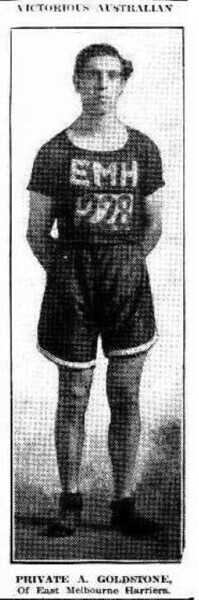
Aaron was an exceptional runner before he enlisted. He was a member of the East Melbourne Harriers and was a winner of the Australian Junior Championship in long distance running. When in England during late 1916, he won the Divisional Championships, over a mile, turned out again and was second in the four-mile cross-country. This was 45 minutes after his first win. He wrote home and stated “They picked the best Australian runners on the Salisbury Plains, and sent them to run at Epsom, starting from the racecourse, in the Southern Counties Championship.” The Australians ran fairly well, considering the little training they had. The team (12 men) won fourth prize for a team that had never won a military championship. The distance was six miles, and Goldstone was the first Australian home.
Aaron Goldstone was sent to France with his Battalion on 22 November 1916. He was admitted to 10th Field Ambulance, 1 January 1917 (accidental self-inflicted gunshot wound, right hand and arm), which he wrote about in a long letter home.
COLLINGWOOD ATHLETE DESCRIBES NARROW ESCAPES.
"Mrs. R. Goldstone, of 45 Derby street, Collingwood, has received two interesting letters from her son, Sergeant Aaron Goldstone, from a base hospital in France. The first is dated January 15, and from it the following extracts are taken: — "Just a few lines to let you know I am getting along all right. I sent you a cablegram, so there is no need to get anxious over me. I suppose you will be curious to know how it happened, so here goes. On New Year's Eve and New Year's Day, I, with four other men, were at a bombing post in an isolated position. We had sent out raiding parties from our right and left sectors, and I was expecting a return raid on my part of the line. The Huns were sending rifle bombs and heavy stuff into our lines, and that made me anxious. About six o'clock in the morning, I heard our wires ring, and decided to send a -flare light up. I had the pistol all-ready loaded, but broke it open to make sure; but before I could close it was struck and exploded. The shell of the flare fired back and hit me in the palm of the right hand, doing a little damage, but not injuring my fingers. I put it down to a shot striking the pistol, but the look-out said it was a rifle bomb. Anyhow, I consider that I am a lucky fellow, as the pistol saved my body. But I have been extremely lucky right throughout. A shell landed ten yards from me the day before, but it failed to explode. Another time I was shaving, and a number of men were around me, shaving, too, when a couple of shells came over and took six of us; so, you will see that I am one of the comebacks. We get plenty of good food and clothing. You would not recognise me with a woollen head-dress, a steel helmet on top, a leather coat, a vest of bombs around me, and big boots that will keep any man warm and dry. I am writing this letter with my left hand, and it has taken me a long time." In the second letter, on January-21, he says: — "Just a line to let you know all is well. I am still in hospital, and my hand is healing slowly but surely. I am able to use my right hand.! But the bandages are bound so tight I cannot move it. Every time I look at it while it is being dressed, I wonder to myself how it missed my fingers. The explosion tore a piece of the palm away, and left two sinews exposed. It is a wonder the shock did not break them. . . I am not allowed to describe the fighting, but we have got old Fritz on tenterhooks. Every time we go over, he runs for his life. I don't think the war will last long. I believe the Germans have had enough. I want you to write to the Amateur Sports Club and let them know how I am getting on. Don't forget to send me The Winner.' I have not had one since I left England."
Aaron died during the Battle of Messines, on 8 June 1917, and in his Red Cross Wounded and Missing file is a statement from a mate who said that he saw him lying dead on the battlefield, hit all over by shrapnel from shellfire. Aaron has no known grave.
His dad wrote a letter to Base Records later in 1917, referring to the fact that he had received his dead son’s binoculars, picked up from the battlefield by 4678 Sgt. R.B. McWhirter 16th Battalion AIF. McWhirter was killed in action during August 1917.



Click images to start slideshow.