







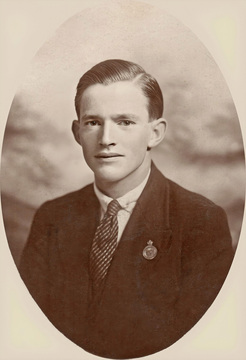
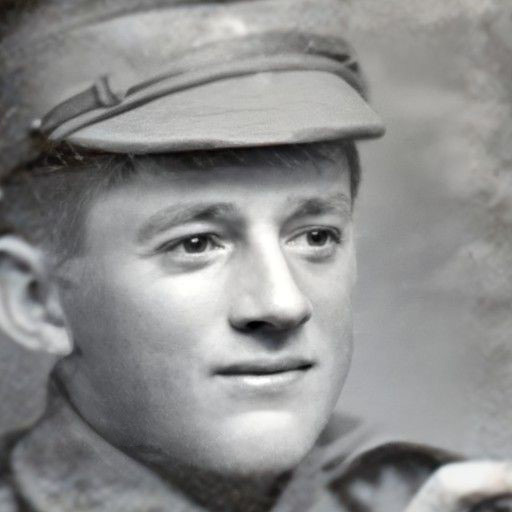
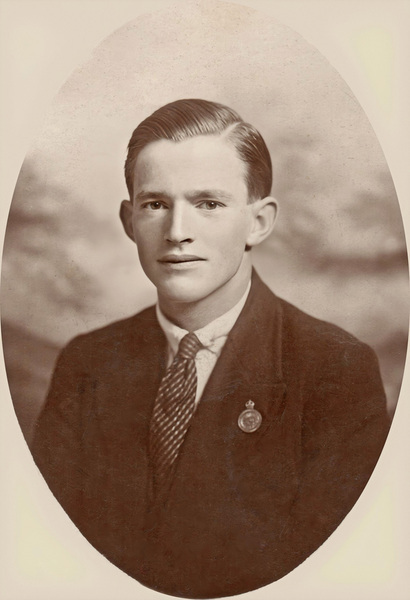
GOUGH, Cecil Vincent
| Service Number: | 7596 |
|---|---|
| Enlisted: | Not yet discovered |
| Last Rank: | Private |
| Last Unit: | 6th Infantry Battalion |
| Born: | Korumburra, Victoria, Australia, 1899 |
| Home Town: | Port Melbourne, Port Phillip, Victoria |
| Schooling: | Not yet discovered |
| Occupation: | Rubber Worker / Boundary Rider |
| Died: | Victoria, Australia, 22 May 1976, cause of death not yet discovered |
| Cemetery: |
Fawkner Memorial Park Cemetery, Victoria BAP-C-433 |
| Memorials: | Numurkah Town Hall Shire of Numurkah Roll of Honor, Numurkah and District War Memorial |
World War 1 Service
| 4 Aug 1917: | Involvement Private, 7596, 6th Infantry Battalion, --- :embarkation_roll: roll_number: '8' embarkation_place: Melbourne embarkation_ship: HMAT Themistocles embarkation_ship_number: A32 public_note: '' | |
|---|---|---|
| 4 Aug 1917: | Embarked Private, 7596, 6th Infantry Battalion, HMAT Themistocles, Melbourne |
PRIVATE CECIL VINCENT GOUGH - WWI Service
PRIVATE CECIL VINCENT GOUGH
Service No. 7596
6th Battalion & 29th Battalion
Australian Imperial Force
A Narrative Biography of His Service
1917–1919
Researched and prepared by
Christopher Robb
Based on the Service Record Held by the National Archives of Australia
Series B2455 – GOUGH C. V.
THE MILITARY SERVICE OF PRIVATE CECIL VINCENT GOUGH (7596)
6th Battalion & 29th Battalion, Australian Imperial Force
1917–1919
Early Life and Enlistment
Private Cecil Vincent Gough enlisted in the Australian Imperial Force on 9 July 1917, joining at the Recruit Depot at Broadmeadows, Victoria. Like many young men who volunteered in the later years of the war, he entered a military system under pressure to rebuild depleted battalions after the heavy fighting of 1916 and 1917. After initial training, he was posted to the 1st Depot Battalion on 31 July 1917, the final staging point before embarkation.
Departure for Overseas Service
On 4 August 1917, Cecil embarked from Melbourne aboard HMAT Themistocles (A32) as part of the 25th Reinforcements for the 6th Battalion. The long voyage carried him across the oceans to the United Kingdom, where he disembarked at Glasgow, Scotland, on 2 October 1917. Glasgow had become a preferred AIF arrival port due to the increased risk of German submarine activity in the English Channel.
Training in England
After disembarking, Cecil travelled south to the AIF training camps on Salisbury Plain. On 10 October 1917, he was posted to the Training Depot at Sutton Veny, one of the major Australian training centres in England. Here he underwent several months of intensive preparation, including musketry, bayonet drill, trench routine, gas instruction, and field exercises designed to ready reinforcements for the Western Front.
During this period, Cecil experienced a painful but not uncommon medical condition affecting uncircumcised soldiers — paraphimosis — brought on by the strenuous physical activity, cold weather, and rough military clothing typical of training life. He was admitted to the Sutton Veny Military Hospital and underwent a minor surgical procedure, including circumcision, before returning to duty in November 1917. It was an uncomfortable episode that added to the physical and emotional strain of preparing for the front, occurring just as he was facing the prospect of joining the fighting in France.
Deployment to the Western Front
Cecil proceeded overseas to France on 3 February 1918, embarking from Southampton. After passing through the usual staging depots, he was officially taken on strength of the 6th Battalion on 10 March 1918. He joined the battalion during a critical period, just as the German Spring Offensive was about to begin.
The 6th Battalion, part of the 2nd Brigade of the 1st Australian Division, was heavily engaged in defensive operations and preparing for the intense fighting that would follow.
Wounded in Action
Cecil’s time with the 6th Battalion was brief and harrowing. On 13 April 1918, he was wounded in action, suffering multiple gunshot wounds to both legs and to his left arm, hand, and thumb. These were serious, multi‑limb injuries that required immediate evacuation.
He was first admitted to a Lines of Communication Hospital in France, but the extent of his wounds meant he could not remain on the Western Front. On 14 April 1918, he was invalided to the United Kingdom, where he was admitted to No. 15 Canadian General Hospital at Taplow — a specialist centre for severe limb injuries, including fractures, nerve damage, and complex wound care.
His treatment continued at the 1st Auxiliary Hospital, and he remained under medical care for more than six weeks. Even after discharge to furlough and a reporting depot in early June, his records still noted ongoing issues with his legs and hand. The physical pain, the uncertainty of recovery, and the knowledge that many wounded men never returned to the front would have weighed heavily on him during this period.
Recovery and Return to Duty
While recuperating in England, Cecil experienced the mixture of relief, restlessness, and frustration common among wounded soldiers. Two brief periods of absence without leave in London in June 1918 reflect the human side of recovery — a young man temporarily removed from the front, navigating pain, boredom, and the temptations of the city.
By August 1918, he had recovered sufficiently to return to active service. He re‑entered France on 22 August 1918 and was shortly afterwards transferred to the 29th Battalion on 23 August 1918, joining a unit heavily engaged in the final Allied offensives of the war.
Final Months of Service
Cecil served with the 29th Battalion during the closing months of the conflict, a period marked by rapid Allied advances and the eventual collapse of German resistance. Although still carrying the effects of his earlier wounds, he returned to duty in time to witness the final push that brought the war to an end.
After the Armistice of 11 November 1918, Cecil continued to experience medical issues, including myalgia — muscular pain and stiffness likely related to his earlier injuries. He was treated at the University War Hospital in Southampton and later at the 3rd Auxiliary Hospital, undergoing further medical processing before being cleared for return home.
Return to Australia
With the war concluded and his earlier wounds still affecting him, Cecil was classified for return to Australia. On 28 March 1919, he embarked for home aboard the Karoo, listed as “invalided”. He was formally discharged on 31 May 1919, bringing his military service to a close.
Legacy
Private Cecil Vincent Gough’s wartime experience reflects the journey of many late‑war Australian reinforcements: rapid enlistment, long training, a short but dangerous period at the front, wounding, recovery, and a return to duty in time to witness the final Allied victories of 1918.
His survival — despite serious wounds to both legs and his left arm — speaks to his resilience and determination. He returned home in 1919, one of the many young Australians whose service shaped the nation’s memory of the Great War.
A Reflection on the service of Private Cecil Vincent Gough,
We are reminded that the story of a soldier is never defined solely by battles fought or wounds sustained, but by the quiet courage with which he faced each step of a most uncertain journey.
Cecil’s war was brief in months but immense in experience.
He endured the strain of training far from home, the discomfort and indignity of illness, the fear and anticipation of the front, and the devastating impact of wounds that marked him for life.
Yet he returned - changed, certainly, but alive - carrying with him the resilience that so many of his generation quietly embodied.
His survival was not guaranteed.
Gunshot wounds to both legs and his left arm could easily have ended his life in France, yet through medical care, determination, and no small measure of luck, he found his way back to England, then to France again, and finally home to Australia.
The legacy he leaves is not only one of service,
but of endurance - of a young man who faced hardship, injury, and uncertainty, and who returned to build a life beyond the war. As I close this account of his service, I honour not only Cecil, but all those who served beside him -
those who returned,
and those who did not.
Submitted 16 February 2026 by Christopher Robb
Click images to start slideshow.