





HOWELL, Charles William
| Service Number: | 608 |
|---|---|
| Enlisted: | 10 November 1914, 2 yrs Territory Forces |
| Last Rank: | Corporal |
| Last Unit: | 4th Machine Gun Battalion |
| Born: | Norfolk, England, January 1891 |
| Home Town: | Brisbane, Queensland |
| Schooling: | Not yet discovered |
| Occupation: | Horticulturist |
| Died: | Petrie, Queensland, Australia, 7 September 1958, cause of death not yet discovered |
| Cemetery: |
Lutwyche Cemetery, Brisbane, Qld Anzac Portion 9 |
| Memorials: |
World War 1 Service
| 10 Nov 1914: | Enlisted AIF WW1, Private, 608, 17th Infantry Battalion, 2 yrs Territory Forces | |
|---|---|---|
| 22 Dec 1914: | Involvement Private, 608, 17th Infantry Battalion, --- :embarkation_roll: roll_number: '11' embarkation_place: Melbourne embarkation_ship: HMAT Ceramic embarkation_ship_number: A40 public_note: '' | |
| 22 Dec 1914: | Embarked Private, 608, 17th Infantry Battalion, HMAT Ceramic, Melbourne | |
| 5 Dec 1918: | Discharged AIF WW1, Corporal, 608, 4th Machine Gun Battalion, 1 MD, medically unfit |
Help us honour Charles William Howell's service by contributing information, stories, and images so that they can be preserved for future generations.
Add my storyBiography contributed by Evan Evans
From Australian Remembrance Army
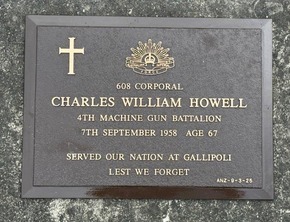
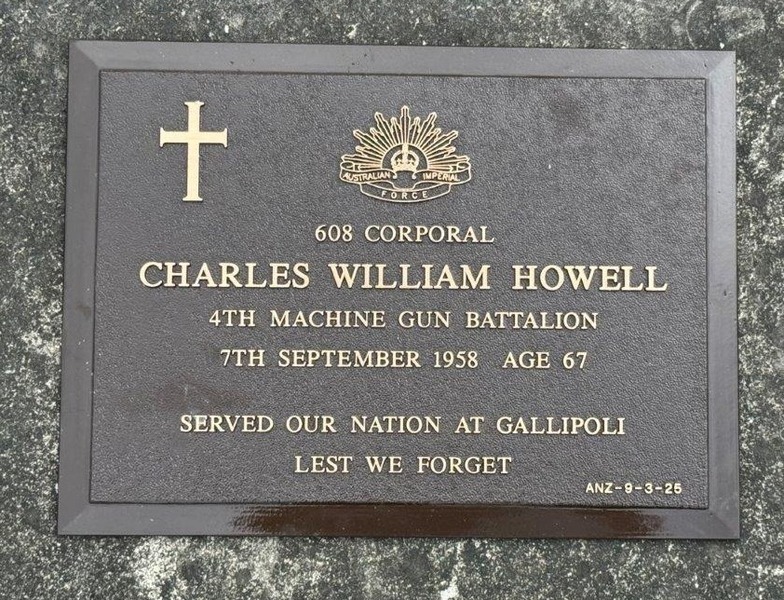
Corporal Charles William Howell (Service No. 608), an Australian World War One veteran, is among almost 800 previously unmarked WWI veterans’ graves in Lutwyche Cemetery we have now marked with a plaque recognising their service for Australia.
We unveiled his plaque in Lutwyche Cemetery on 20 September 2025, along with a further 161 plaques on the previously unmarked graves of Australian World War One veterans:
See Australian Remembrance Army Facebook page
Charles William Howell was born in 1891 in Norfolk, England, to George Howell and Elizabeth Howell (née Smith). On 16 January 1914 he sailed from London to Brisbane aboard the Osterley, giving his occupation as horticulturist. He enlisted in the Australian Imperial Force at Enoggera, Brisbane, on 10 November 1914, stating his age as 23, his trade as labourer, and naming his father as next of kin.
He embarked on 2 December 1914 with the 4th Machine Gun Company, later part of the 4th Machine Gun Battalion. On 12 April 1915 he proceeded to join the Mediterranean Expeditionary Force for operations connected with Gallipoli. After falling ill on 4 September 1915 he was admitted to No. 16 Casualty Clearing Station at ANZAC and evacuated to Malta on the hospital ship Sicilia, where he was treated for an ulcerated ankle until late October. He was transferred to the hospital ship Karoo on 17 October and later returned to Egypt, disembarking at Alexandria on 17 November, with another disembarkation recorded on 29 December 1915.
By 9 March 1916 he was serving at Serapeum in the Suez Canal Zone. He joined the British Expeditionary Force on 1 June 1916 and arrived in France at Marseilles on 9 June. On 12 April 1917 he suffered gunshot wounds to the thigh, leg, side and shoulder, was treated at several hospitals, and was evacuated to England on the hospital ship St George, being admitted to the 3rd London General Hospital on 20 April.
After furlough on 12 June 1917, he reported to the 2nd Command Depot at Weymouth and subsequently moved through AIF training and administrative depots, including the Overseas Training Brigade and the Machine Gun Training Depot. He returned to France on 18 October 1917 via Folkestone, passed through Etaples, and rejoined his unit on 22 October.
He continued service into 1918 and was promoted to Corporal on 18 May. A temporary transfer was recorded on 22 June, followed by his return to England. His record also notes epilepsy, with no onset date stated. On 10 August 1918 he embarked for Australia on HMAT Zealandia, arrived on 23 September, and was discharged on 5 December 1918.
From 1919 onward Howell lived mainly in Brisbane and nearby districts. He worked as a labourer in 1919 and 1921, and by 1925 had become a carpenter. On 13 February 1926 he married Sarah Annie Butcher in Queensland. Through the 1930s and 1940s he lived in suburbs such as Kedron and Nundah while continuing to work as a carpenter. By 1949 and again in 1954 he was living in Petrie, Brisbane, still employed in the same trade.
Corporal Charles William Howell died on 7 September 1958, aged 67, and was buried in Anzac Portion 9, Lutwyche Cemetery, Brisbane.
After decades without recognition at his place of burial, his grave now bears a plaque commemorating his service to Australia — ensuring his name endures among those remembered for their duty and sacrifice. His identity has now been restored.
We have remembered him.
Lest We Forget.
Click images to start slideshow.