







BROWN, George Alexander
| Service Number: | 5652 |
|---|---|
| Enlisted: | 13 January 1916, 4-5 years Artillery |
| Last Rank: | Private |
| Last Unit: | 15th Infantry Battalion |
| Born: | London, Middlesex, England, December 1884 |
| Home Town: | South Brisbane, Brisbane, Queensland |
| Schooling: | Not yet discovered |
| Occupation: | Printer |
| Died: | Brisbane Hospital, Brisbane, Queensland, Australia, 27 October 1956, cause of death not yet discovered |
| Cemetery: |
Lutwyche Cemetery, Brisbane, Qld Anzac Portion 8 |
| Memorials: |
World War 1 Service
| 13 Jan 1916: | Enlisted AIF WW1, Private, 5652, 15th Infantry Battalion, 4-5 years Artillery | |
|---|---|---|
| 4 May 1916: | Involvement Private, 5652, 15th Infantry Battalion, --- :embarkation_roll: roll_number: '11' embarkation_place: Brisbane embarkation_ship: HMAT Seang Choon embarkation_ship_number: A49 public_note: '' | |
| 4 May 1916: | Embarked Private, 5652, 15th Infantry Battalion, HMAT Seang Choon, Brisbane | |
| 20 Aug 1919: | Discharged AIF WW1, Private, 5652, 15th Infantry Battalion, 1st MD |
Help us honour George Alexander Brown's service by contributing information, stories, and images so that they can be preserved for future generations.
Add my storyBiography contributed by Evan Evans
From Australian Remembrance Army
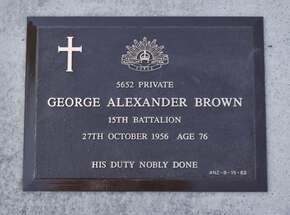
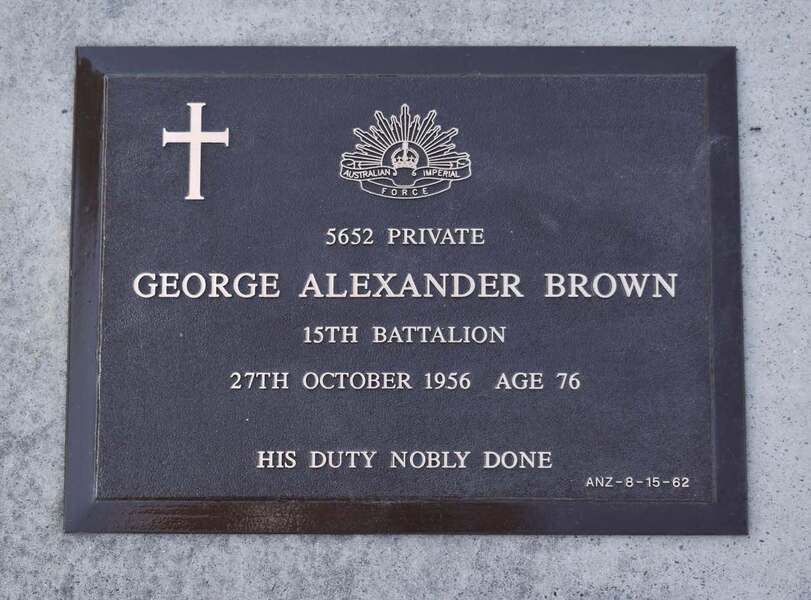
Private George Alexander Brown (Service No. 5652), an Australian World War One veteran, is among almost 800 previously unmarked WWI veterans’ graves in Lutwyche Cemetery we have now marked with plaques in recognition of their service for Australia.
We unveiled his plaque in Lutwyche Cemetery on 23 September 2023, along with a further 300 plaques on the previously unmarked graves of Australian World War One veterans:
See Australian Remembrance Army Facebook page
George Alexander Brown was born in 1880 in London, England, to William Brown and Christina Brown (née Smith). In September 1905 he married Agnes Rahilly in Brisbane. Agnes later became a prominent musical theatre actress, teacher, producer, director and writer. Electoral records from that year show him residing in the Brisbane suburb of Toombul, where his occupation was listed as compositor.
He enlisted in the Australian Imperial Force in Brisbane on 13 January 1916, stating his occupation as printer and nominating his wife, Agnes, as his next of kin. On 4 May 1916 he embarked for overseas service with the 15th Battalion aboard HMAT Seang Choon, departing from Brisbane.
Brown was wounded in action on two occasions. The first occurred in June 1917, when he sustained a gunshot wound to his left forearm. He was hospitalised and later discharged before rejoining his unit. He returned to active service but was wounded again in April 1918, again suffering a gunshot wound to the left forearm. He was admitted to hospital and evacuated to England for further treatment. After recovering, Brown rejoined his battalion in France in late 1918 and served until the end of the war. He returned to Australia aboard the Port Napier in May 1919.
In 1921 George and Agnes founded the Sunshine Kiddies in Brisbane. The juvenile troupe presented variety programmes of musical comedies, revues, pantomimes and specialty acts at concerts, social functions and cinemas. Between 1925 and 1927 they were engaged by Union Theatres to stage pantomimes at the Majestic Theatre as live accompaniments to film screenings, while also undertaking extensive regional and interstate tours.
Between 1925 and 1949 electoral rolls record George and Agnes living in Cordelia Street, South Brisbane, where they operated a private academy of singing, dancing and elocution. Both were listed as dance teachers and were recorded under the surname Rahilly-Brown. By 1956, George was residing at the Eventide Nursing Home, Sandgate, Brisbane.
Private George Alexander Brown died at the Brisbane Hospital on 27 October 1956, aged 76, and was buried in Anzac Portion 8, Lutwyche Cemetery, Brisbane. Agnes had predeceased him, dying in February 1955, and was interred in a family plot at Balmoral Cemetery, Brisbane. The couple had no children.
After decades without recognition at his place of burial, his grave now bears a plaque commemorating his service to Australia — ensuring his name endures among those remembered for their duty and sacrifice. His identity and dignity have now been restored.
We have remembered him.
Lest We Forget
Click images to start slideshow.