







O'LEARY, John Daniel
| Service Number: | 5485 |
|---|---|
| Enlisted: | 29 November 1915 |
| Last Rank: | Private |
| Last Unit: | 15th Infantry Battalion |
| Born: | Muttaburra, Queensland, Australia, 17 August 1885 |
| Home Town: | Hughenden, Flinders, Queensland |
| Schooling: | Not yet discovered |
| Occupation: | Fireman |
| Died: | Brisbane, Queensland, Australia, 1 November 1952, aged 67 years, cause of death not yet discovered |
| Cemetery: |
Lutwyche Cemetery, Brisbane, Qld Monumental Portion 5 |
| Memorials: |
World War 1 Service
| 29 Nov 1915: | Enlisted AIF WW1, Private, 5485, 15th Infantry Battalion | |
|---|---|---|
| 20 Apr 1916: | Involvement Private, 5485, 15th Infantry Battalion, --- :embarkation_roll: roll_number: '11' embarkation_place: Sydney embarkation_ship: SS Hawkes Bay embarkation_ship_number: '' public_note: '' | |
| 20 Apr 1916: | Embarked Private, 5485, 15th Infantry Battalion, SS Hawkes Bay, Sydney | |
| 13 Nov 1919: | Discharged AIF WW1, Private, 5485, 15th Infantry Battalion, 1st MD |
Help us honour John Daniel O'Leary's service by contributing information, stories, and images so that they can be preserved for future generations.
Add my storyBiography contributed by Evan Evans
From Australian Remembrance Army
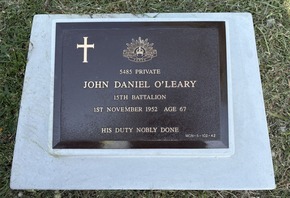
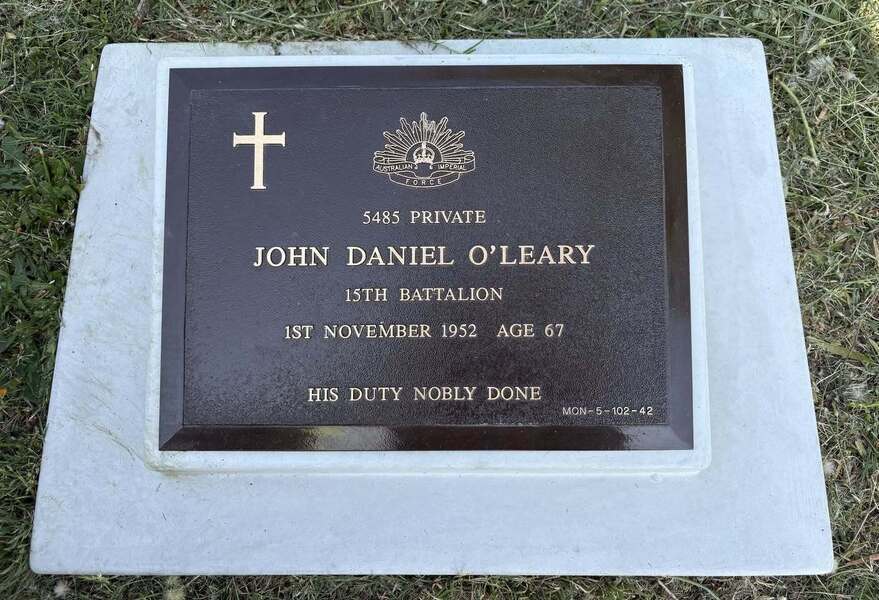
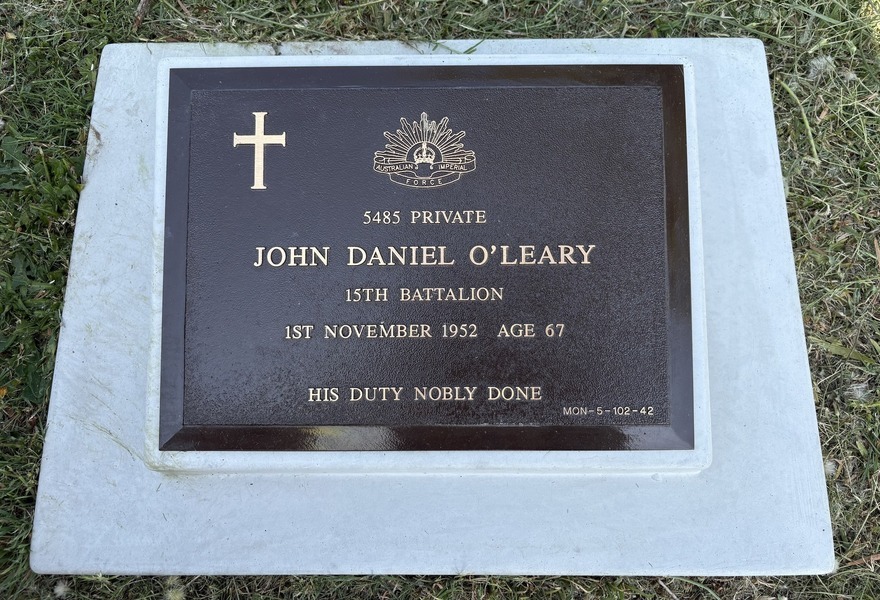
Private John Daniel O’Leary (Service No. 5485), an Australian World War One veteran, is among almost 800 previously unmarked WWI veterans’ graves in Lutwyche Cemetery we have now marked with a plaque recognising their service for Australia.
We unveiled his plaque in Lutwyche Cemetery on 20 September 2025, along with a further 161 plaques on the previously unmarked graves of Australian World War One veterans:
See Australian Remembrance Army Facebook page
John Daniel O’Leary was born on 17 August 1885 at Muttaburra, Queensland, the son of Cornelius O’Leary and Ellen O’Leary (née Handley). He enlisted in the Australian Imperial Force at Charters Towers on 29 November 1915, aged 30, and stated his occupation as fireman. He embarked for overseas service in April 1916, disembarked in Egypt in June, and in July embarked from Alexandria for France, joining the 15th Battalion in the field later that month.
On 8 August 1916, O’Leary was wounded in action in France, sustaining a gunshot wound to his right hand. He was admitted to the 4th General Hospital and later transferred to the convalescent depot at Ghezireh, Egypt, before rejoining his unit in September 1916. In January 1917, he was again hospitalised in France, suffering from mumps, and was transferred to hospital at Rouen. After a further period of recovery, he returned to duty via the Australian divisional base depot at Etaples.
While serving in England in 1917, O’Leary married Kate (also recorded as Kathleen or Katherine) O’Leary (née Young). He formally updated his next-of-kin details with the AIF, changing them from his mother in Western Australia to his wife. Her address was recorded as 128A Rockwell Green, Brixton, supported by a marriage certificate dated 4 August 1917.
In March 1918, O’Leary was hospitalised with scabies but returned to duty later that month. He proceeded on leave in September 1918 and rejoined his unit in October. In February 1919, he was marched out to England in preparation for return to Australia and embarked aboard the transport Port Lincoln in July 1919. He returned to Australia with his wife in August 1919 and was discharged from the Australian Imperial Force in Brisbane in November 1919.
Following his return to civilian life, O’Leary lived in Brisbane and was recorded as working as a labourer. He died in Brisbane on 1 November 1952, aged 67, and was buried in Monumental Portion 5, Lutwyche Cemetery, Brisbane. His wife, Kathleen O’Leary, died on 3 June 1959 aged 71 years and was buried with her late husband two days later. The couple had no children.
In October 1959, the Public Curator’s Office in Brisbane, acting as Executor, Administrator, Trustee and Attorney, wrote to the Officer in Charge, Central Army Records Office, Melbourne, regarding the estate of Kathleen O’Leary. The letter advised that she had died intestate and, as she left no next of kin, John Daniel O’Leary’s two war medals and ribbons would be forwarded to Army Records for disposal.
After decades without recognition at his place of burial, his grave now bears a plaque commemorating his service to Australia — ensuring his name endures among those remembered for their duty and sacrifice.
We have remembered him.
Lest We Forget.
Click images to start slideshow.