






FOOTT, John Lumsden
| Service Number: | 213 |
|---|---|
| Enlisted: | 14 January 1915 |
| Last Rank: | Corporal |
| Last Unit: | 1st Divisional Train |
| Born: | Surat, Queensland, Australia, 28 July 1881 |
| Home Town: | Woollahra, Woollahra, New South Wales |
| Schooling: | Not yet discovered |
| Occupation: | Miner |
| Died: | Mitral insufficiency, anasarca, and cardiac failure, Brisbane Hospital, Brisbane, Queensland, 14 March 1929, aged 47 years |
| Cemetery: |
Lutwyche Cemetery, Brisbane, Qld Monumental Roman Catholic Portion 1 |
| Memorials: |
World War 1 Service
| 14 Jan 1915: | Enlisted AIF WW1, Private, 213, 17th Infantry Battalion | |
|---|---|---|
| 12 May 1915: | Involvement Corporal, 213, 17th Infantry Battalion, --- :embarkation_roll: roll_number: '12' embarkation_place: Sydney embarkation_ship: HMAT Themistocles embarkation_ship_number: A32 public_note: '' | |
| 12 May 1915: | Embarked Corporal, 213, 17th Infantry Battalion, HMAT Themistocles, Sydney | |
| 22 Jul 1919: | Discharged AIF WW1, Corporal, 213, 1st Divisional Train, 1st MD |
Help us honour John Lumsden Foott's service by contributing information, stories, and images so that they can be preserved for future generations.
Add my storyBiography contributed by Evan Evans
From Australian Remembrance Army
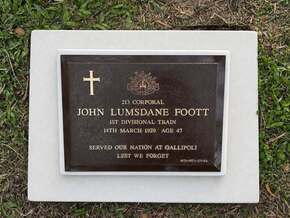
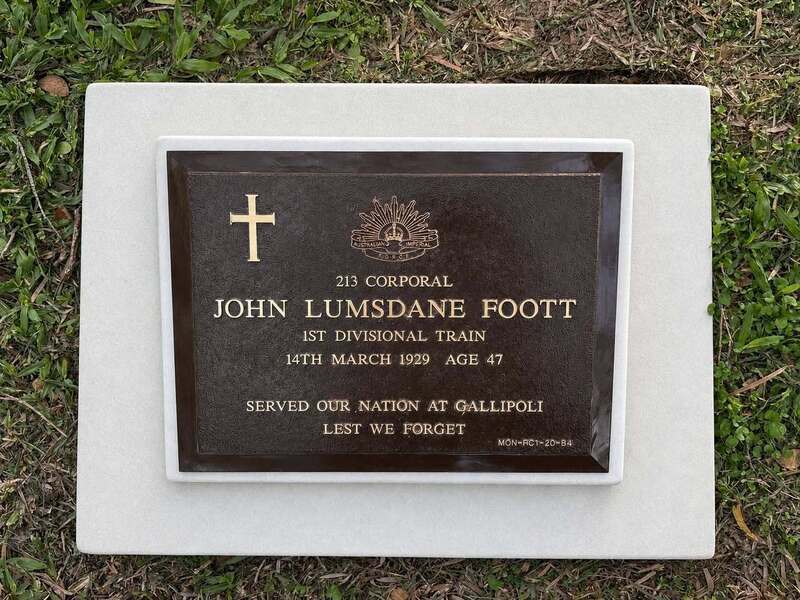
Australian World War One veteran Corporal John Lumsdane Foott (Service No. 213) is among almost 800 previously unmarked WWI veterans’ graves in Lutwyche Cemetery that we have now marked with plaques in recognition of their service to Australia.
We unveiled his plaque in Lutwyche Cemetery on 16 May 2026, along with a further 185 plaques on the previously unmarked graves of Australian World War One veterans:
See Australian Remembrance Army Facebook page
John Lumsden Foott was born on 28 July 1881 at Surat, Queensland, to Henry Lumsdane Foott and Annie Mary Teresa Foott, née Grace. He enlisted in the Australian Imperial Force on 14 January 1915, with the Nominal Roll recording his enlistment date as 16 January 1915. At enlistment, he was single and employed as a miner, and he nominated his brother, James, as his next of kin. Foott embarked from Sydney, New South Wales, on 12 May 1915 aboard HMAT Themistocles.
His service record shows that he joined the Mediterranean Expeditionary Force at Gallipoli on 16 August 1915. Between October and December 1915, he had several short hospital admissions, returning to duty each time. On 7 December 1915, he was transferred to the hospital ship Glenart Castle, and on 11 December 1915, he was admitted to No. 1 Australian Hospital, Heliopolis, with rheumatism. He was discharged to the Overseas Base on 1 January 1916 and returned to duty with the 17th Battalion at Tel-el-Kebir on 19 January 1916.
Foott embarked from Alexandria for the British Expeditionary Force on 17 March 1916 and disembarked at Marseilles on 23 March 1916. He later served through several Army Service Corps and depot postings, and his Nominal Roll records him as a Driver with the 1st Division Train. He was marked for return to Australia on 17 January 1919 and returned from Devonport aboard Cluny Castle on 23 March 1919, arriving from overseas on 22 May 1919. His final medical board recorded no disability or incapacity, and he was discharged as fit on 22 July 1919.
In his 5 January 1929 Repatriation statement, Foott claimed chest trouble and indigestion as due to war service, stating that both had affected him since discharge and that he believed they resulted from gas exposure in France. He said he had been exposed to gas several times but had not been evacuated for it.
Witness statements from January 1929 reported that Foott’s health had declined after discharge, with references to worsening general health, rheumatism, chest complaint, and a bad cough. Dr O. J. Dickinson stated that he first treated Foott on 4 August 1927 for cough, left-sided chest pain, coughing blood, and pleurisy at the right base. A similar attack occurred in August 1928, but no tuberculosis was then found.
Foott was admitted to Brisbane General Hospital on 21 January 1929 with weakness, shortness of breath, swelling of the legs and abdomen, and cough. Hospital reports noted prior severe influenza, followed by bronchitis, oedema, abdominal distension, weight loss, poor appetite, anaemia, respiratory signs, and an X-ray report referring to tuberculosis in both lungs. The recorded diagnoses or impressions included myocarditis, anaemia, possible pulmonary tuberculosis, mitral disease or insufficiency, oedema, and cardiac failure.
Corporal John Lumsdane Foott died at Brisbane Hospital on 14 March 1929, aged 47 years, from mitral insufficiency, anasarca, and cardiac failure. He was buried the following day in Monumental Roman Catholic Portion 1, Lutwyche Cemetery, Brisbane.
His death certificate recorded that he was not married.
After Foott’s death, Repatriation authorities reviewed medical and witness evidence but did not accept his death as due to active service. The Senior Medical Officer found insufficient evidence linking his fatal cardiac condition to his war service.
After almost a century without recognition at his place of burial, his grave now bears a plaque commemorating his service to Australia — ensuring his name endures among those remembered for their duty and sacrifice.
His identity and dignity have now been restored.
We have remembered him.
Lest We Forget
Click images to start slideshow.