








SECCOMBE, Walter Thomas
| Service Number: | 712 |
|---|---|
| Enlisted: | 18 September 1914 |
| Last Rank: | Lance Corporal |
| Last Unit: | 15th Infantry Battalion |
| Born: | Sydney, New South Wales, Australia, date not yet discovered |
| Home Town: | Woodford, Moreton Bay, Queensland |
| Schooling: | Not yet discovered |
| Occupation: | Farmer |
| Died: | Killed in Action, Gallipoli, Turkey, 10 May 1915, age not yet discovered |
| Cemetery: |
No known grave - "Known Unto God" Lone Pine Memorial, Gallipoli Peninsula, Turkey |
| Tree Plaque: |
Woodford Avenue Of Honour
|
| Memorials: | Australian War Memorial Roll of Honour, Woodford Honour Roll |
World War 1 Service
| 18 Sep 1914: | Enlisted AIF WW1, Lance Corporal, 712, 15th Infantry Battalion | |
|---|---|---|
| 22 Dec 1914: | Embarked Lance Corporal, 712, 15th Infantry Battalion, --- :embarkation_roll: roll_number: '11' embarkation_place: Melbourne embarkation_ship: HMAT Ceramic embarkation_ship_number: A40 public_note: '' |
Help us honour Walter Thomas Seccombe's service by contributing information, stories, and images so that they can be preserved for future generations.
Add my storyBiography contributed by Ian Lang
#712 SECCOMBE Walter, Thomas 15th Battalion
Walter Seccombe stated he was born in Sydney NSW. He spent his early life in and around Bega NSW. At some point, Walter and his father moved to Queensland where they took up farming in the Bellthorpe district near Woodford. He was a member of the Stanley River Rifle Club.
Walter went to Brisbane to enlist on 18th September 1914. He stated his age as 29, occupation farmer and named his father, T. Seccombe of Bellthorpe, as his next of kin. Walter reported to the Enoggera Camp where he was drafted into “E” Company of the 15th Infantry Battalion on 19th October 1914. The 15thBattalion was composed of eight companies; six coming from Queensland and two from Tasmania. The Queenslanders were under the command of Lieutenant Colonel James Cannan, a well-known Brisbane businessman and officer of the volunteer defence force. Training was provided by civilian rifle club members at Enoggera and once sufficient recruits had been processed, the battalion embarked on a number of route marches to Sandgate with an overnight bivouac. Cannan was a hard task master and a number of recruits were discharged for being drunk or AWL.
In early December, the battalion travelled by train over several days to Broadmeadows near Melbourne where the Tasmanian companies joined the battalion. A photograph of “E” company, taken at Broadmeadows is held in the Australian War Memorial in which Walter is identified. The 15th joined the other three battalions to form the 4th Brigade of the AIF commanded by Colonel John Monash, who like Cannan was a prominent businessman as well as part time officer in the Citizens Forces. Walter was charged with being absent from camp at Broadmeadows but was only admonished. He was also promoted to the rank of Lance Corporal. The 15th boarded the “Ceramic” in Port Melbourne on 22nd December 1914 and sailed for Egypt, arriving in Alexandria on 3rd February 1915.
The first contingent of the AIF, comprising three brigades, had been in Egypt since December 1914, and had been training as a division. It was decided that the 4th Brigade, upon arrival in Egypt, would join with the New Zealand contingent to create the New Zealand and Australian Division. The 15th marched into the Aerodrome Camp at Heliopolis, a suburb of Cairo and began intensive training for the next two months.
On 14th April 1915, the 15th boarded two troop ships, the “Australind” and the “Seang Bee” at the port city of Alexandria for the voyage to the Greek island of Lemnos. The invasion force of the Mediterranean Expeditionary Force was being assembled at Mudros Harbour on Lemnos in preparation for the assault on the Gallipoli Peninsula. There was insufficient room for all of the Australian and New Zealand force to be billeted on shore and so the late arrivals, such as the 15th Battalion, remained on board the transports while practicing boat and landing drills.
At dawn on the 25th April, the 15th Battalion set sail for the beaches of Gallipoli. Those on board the “Australind” stood off the beach at Cape Helles and observed the British landings there before sailing north to Gaba Tepe where the “Seang Bee” was waiting. The entire battalion was disembarked at Anzac Cove during the night of the 25th/26th April and bivouacked in a gully until dawn when the troops moved up the gully to relieve the exhausted men who had been holding the precarious position at Pope’s Hill since the previous morning. For the next 30 days, the 15th battalion rotated between Shrapnel Gulley and Quinn’s post, named after the Company Commander of “E” Company. During that time, the fighting on the Anzac front was ferocious as the Australians desperately clung to a precarious toe hold and the Turks rushed wave after wave of attackers down upon the invaders with the intention of driving them back into the sea.
Trenches were fought over in hand to hand fighting and, on many occasions, both Turks and Australians occupied different sections of the same trench. On 9th May, “D” and “E” companies of the 15th Battalion were ordered to attack and capture a Turkish trench near Quinn’s post. The attack, albeit at significant cost, was successful however on the following day the Turks counterattacked and the Australians were forced to withdraw, leaving their dead behind. It is most likely that Walter was one of those whose body was left behind. The fierce fighting continued along the line. Nine days later, Lance Corporal Albert Jacka of the 14thBattalion was awarded the first Australian Victoria Cross when his section of trench was overrun. Jacka took on the Turkish attackers shooting seven and bayoneting two.
The casualties on both sides were unsustainable. For the month of May, the 15th Battalion lost 118 killed, 296 wounded and 103 missing; from an original compliment of 980. On 25th May, a cease fire was agreed to which allowed both sides to retrieve and bury their dead; whose bodies were becoming a health hazard. Hostilities resumed at 5:00pm.
Communications from the Gallipoli front were slow and often incomplete or garbled. The AIF Base records office in Melbourne had to rely on cable traffic from which casualty lists were distributed to newspaper offices for publication. A telegram was sent to Walter’s father at Bellthorpe advising that his son was “wounded.” Mr Seccombe made no further enquiries but two of Walter’s sisters wrote independently to Base Records enquiring about the state of their brother; Is his wound serious? What hospital is he in? What is his address?
The standard response from Base Records was to assume that because the cable message “wounded” did not state that the wound was serious, then “it is to be assumed that progress is satisfactory.” The matter was further complicated when an update was provided that Walter was “wounded and missing,” which gave rise to the supposition that Walter may have been a prisoner of war.
In truth, Base Records had no idea what the facts were surrounding Walter and they were reluctant to make enquiries of the authorities in Cairo. The matter was not resolved until a Board of Inquiry was held at Serapeum in Egypt in April 1916 which determined that in the absence of information to the contrary, Walter Seccombe was Killed in Action on 10th May 1915; whereabouts of his remains unknown.
Walter Seccombe is commemorated on the Lone Pine Memorial to the Missing at Gallipoli. His name is near another Woodford man and member of the Stanley River Rifle Club from “E” Company; William Ross. Walter is also commemorated at Woodford with his name included in the Honour Roll and a tree and plaque planted in the Avenue of Honour.
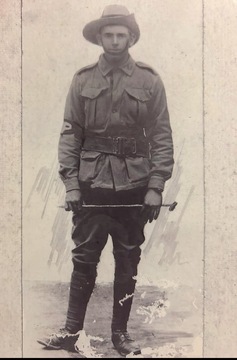
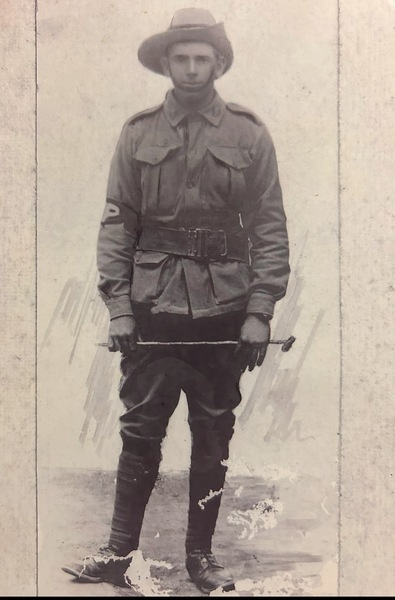
Click images to start slideshow.