







FISHER, William Joseph
| Service Number: | 922 |
|---|---|
| Enlisted: | Not yet discovered |
| Last Rank: | Not yet discovered |
| Last Unit: | Railway Unit (AIF) |
| Born: | Goulburn, New South Wales, Australia, 1882 |
| Home Town: | Not yet discovered |
| Schooling: | Not yet discovered |
| Occupation: | Not yet discovered |
| Died: | Perth, Western Australia., 15 December 1954, cause of death not yet discovered |
| Cemetery: |
Karrakatta Cemetery & Crematorium, Western Australia Rose Gardens, Position 0087 |
| Memorials: |
World War 1 Service
| 29 Jan 1917: | Involvement 922, Railway Unit (AIF), --- :embarkation_roll: roll_number: '6' embarkation_place: Fremantle embarkation_ship: HMAT Miltiades embarkation_ship_number: A28 public_note: '' | |
|---|---|---|
| 29 Jan 1917: | Embarked 922, Railway Unit (AIF), HMAT Miltiades, Fremantle |
Help us honour William Joseph Fisher's service by contributing information, stories, and images so that they can be preserved for future generations.
Add my storyBiography contributed by Geoffrey Gillon
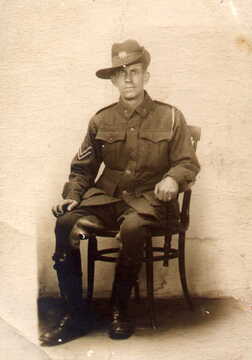
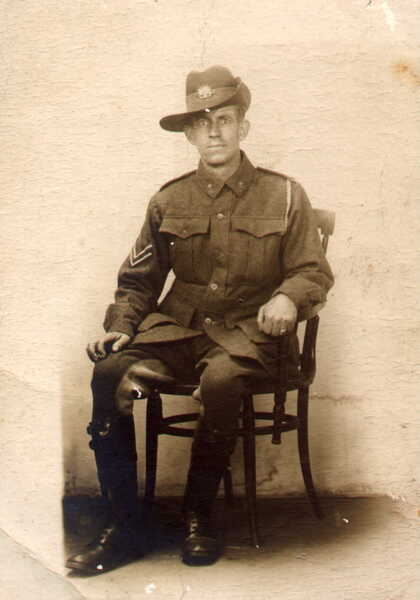
He embarked from Fremantle for active service abroad on 29th January 1917 as part of the Reinforcements and Special Draft to the Railway Unit. He held the rank of 2nd Corporal (Service No. 922) and was a casualty of poisonous gas on a number of occasions resulting in the eventual loss of a lung. The only son to survive the war, he returned home to Australia in 1919 and was discharged medically unfit.
William died aged 72 years. His wife was Frances Ellen [Rudler] Fisher 1893–1960 (m. 1915)
A brother Benjamin fell in the Boer War and two brothers fell in France in the Great War-they were Private Osborne Fisher and Private Walter Stanley Fisher.
They were sons of William and Elizabeth Fisher of Western Australia.
Biography contributed by Kel Fisher
William Joseph Fisher (9 December 1882 – 15 December 1954), known to his family as Joe, was a Western Australian railway employee whose service in the Railway Corps during World War I was defined by technical skill and the heavy toll of family sacrifice.
Early Life and Background
Joe was born in Braidwood, New South Wales, the fourth son of William Fisher and Elizabeth Warwick. In 1896, at the age of 14, he moved to Western Australia with his mother and several siblings to join his father and brother Benjamin, who had already settled in Rockingham. His early working life included a job as a sheep "minder" before he joined the West Australian Government Railways (WAGR), where he progressed from a cleaner to a fireman. In 1912, he married Frances Ellen (Nell) Rudler, and the couple eventually had four children.
Motivation for Enlistment
Joe’s decision to enlist was deeply personal. Although his employment with the WAGR made him exempt from conscription, he volunteered for service on 15 January 1917 at the age of 34. His motivation was the devastating loss his family had already suffered: his brothers Osborne and Walter Stanley had been killed on the same day at Pozières in 1916, and another brother, Benjamin, had been killed during the Boer War in 1901.
War Service: The Railway Corps
Joe was assigned to the 5th Australian Broad Gauge Railway Operating Company (part of the 29th Railway Corps) as a 2nd Corporal (Service No. 922). He embarked from Fremantle on 29 January 1917 aboard the HMAT Miltiades, arriving in England in late March.
His service on the Western Front was both technical and extremely dangerous:
Roles: He served as a fireman and later an engine driver, taking munition trains up to the front lines under constant fire.
Acting Station Master: Because official station masters (sergeants) often remained in the relative safety of the yards, Joe was frequently sent to forward areas like Pottenhook to act as a station master. He described waiting on the points alone, surrounded by batteries of heavy 15-inch guns whose roar was "horrific" and nearly knocked him off his feet.
"The Big Push": On 31 July 1917, Joe witnessed the start of the Third Battle of Ypres (the "Big Push"). His diary records a 16-hour shift under intense bombardment, during which he saw thousands of marching troops and witnessed an Allied aeroplane crash nearby after hitting an observation balloon wire.
Illness and Gassing
Joe’s service was interrupted by severe dysentery in late August 1917, which saw him hospitalised in Boulogne and later sent to a convalescent camp at Trouville until mid-November.
Later in the war, Joe was gassed by the Germans. This injury was severe, requiring treatment in England and ultimately resulting in the permanent loss of one lung. While in France, he also suffered from the emotional strain of the conflict; his diary often mentions his depression at not receiving letters from his wife, Nell, many of which were destroyed en route.
Post-War Life and Legacy:
Joe returned to Australia in 1919. He resumed work with the WAGR as an engine driver, but his war injuries had a lasting impact. In 1929, he failed an eyesight test—likely due to the effects of gas and the strain of service—and was downgraded to a Shed Driver. This necessitated a move to Kalgoorlie, one of many moves the family made before building a permanent home in Mount Lawley in 1934.
In his later years, Joe became very deaf, an affliction attributed to his proximity to heavy artillery during the war. He remained a quiet man whose primary hobbies were playing Whist and Bridge. William Joseph Fisher died of a stroke at the Hollywood Repatriation Hospital on 15 December 1954 and was cremated at Karrakatta Cemetery. He was the only one of the four brothers who served in foreign wars to return home.
Click images to start slideshow.