







JACKSON, Andrew Percy
| Service Number: | 2924 |
|---|---|
| Enlisted: | 21 March 1916 |
| Last Rank: | Private |
| Last Unit: | 41st Infantry Battalion |
| Born: | Gippsland, Victoria, Australia, 20 July 1884 |
| Home Town: | Brisbane, Queensland |
| Schooling: | Not yet discovered |
| Occupation: | Labourer |
| Died: | Hit by car, drunk driver, South Brisbane, Queensland, Australia, 12 June 1948, aged 63 years |
| Cemetery: |
Lutwyche Cemetery, Brisbane, Qld Anzac Portion 7, Lutwyche Cemetery, Brisbane. |
| Memorials: |
World War 1 Service
| 21 Mar 1916: | Enlisted AIF WW1, Private, 2924, 41st Infantry Battalion | |
|---|---|---|
| 23 Dec 1916: | Involvement Private, 2924, 41st Infantry Battalion, --- :embarkation_roll: roll_number: '18' embarkation_place: Sydney embarkation_ship: HMAT Demosthenes embarkation_ship_number: A64 public_note: '' | |
| 23 Dec 1916: | Embarked Private, 2924, 41st Infantry Battalion, HMAT Demosthenes, Sydney | |
| 27 Feb 1919: | Discharged AIF WW1, Private, 2924, 41st Infantry Battalion, 1st MD, Medically Discharged |
Help us honour Andrew Percy Jackson's service by contributing information, stories, and images so that they can be preserved for future generations.
Add my storyBiography contributed by Evan Evans
From Australian Remembrance Army
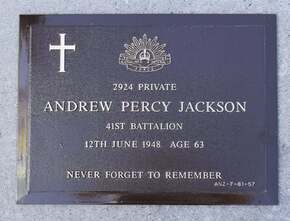
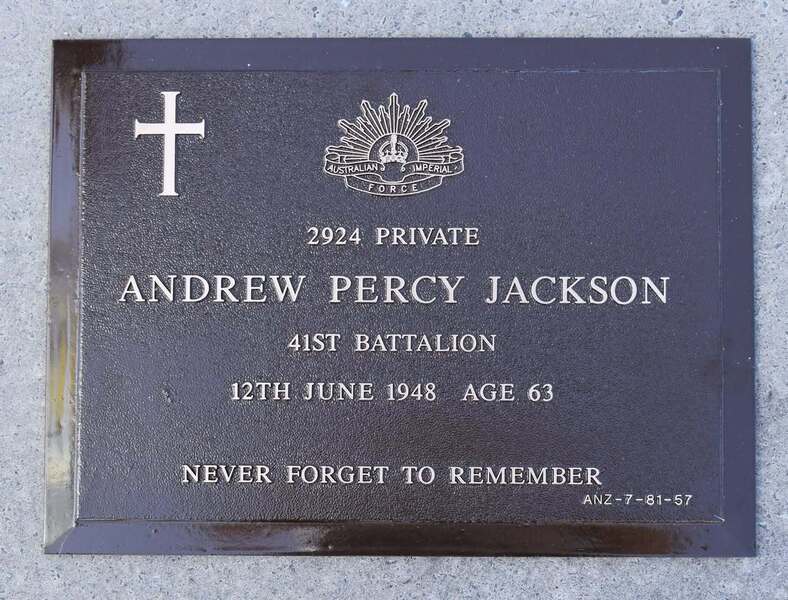
Private Andrew Percy Jackson (Service No. 2924), an Australian World War One veteran, is among almost 800 previously unmarked WWI veterans’ graves in Lutwyche Cemetery we have now marked with a plaque in recognition of their service for Australia.
We unveiled his plaque in Lutwyche Cemetery on 15 April 2023, along with a further 246 plaques on the previously unmarked graves of Australian World War One veterans:
See Australian Remembrance Army Facebook page
Andrew Percy Jackson was born on 20 July 1884 to Alfred Jackson and Theresa Jackson (nee Churchill). He enlisted in the Australian Imperial Force in Brisbane on 21 March 1916, stating his occupation as labourer and naming his sister as his next of kin. On 23 December 1916, he embarked for overseas service with the 41st Battalion, 6th Reinforcements aboard HMAT Demosthenes from Sydney.
Soon after arrival he experienced illness, including influenza, requiring repeated hospitalisation and periods in training and depot camps. Despite these setbacks, he proceeded to France in July 1917 and joined his unit in the field.
While serving on the Western Front, Jackson was wounded in action in August 1917 when he was gassed during operations in France. He was treated at field medical units, casualty clearing stations, and hospitals in Rouen before being evacuated to England. Over the following months he suffered ongoing health problems linked to his war service, including migraines, debility, and repeated respiratory illnesses. He returned to France briefly in early 1918 but was again hospitalised and subsequently evacuated to England with bronchial pneumonia.
Jackson’s health continued to decline, and he spent extended periods in military hospitals and convalescent depots throughout 1918. In late 1918, Andrew Percy Jackson was returned to Australia after being declared medically unfit for further service as a result of gas poisoning, bronchial pneumonia, and general debility sustained during active service, and was discharged from the Australian Imperial Force in February 1919.
Following his return to civilian life, Jackson lived in Brisbane and worked as a labourer. On 12 June 1948, he was fatally injured after being struck by a car in Stanley Street, South Brisbane. Police stated that he stepped off the footpath and was hit by the vehicle. He later died in Brisbane General Hospital and was buried in Anzac Portion 7, Lutwyche Cemetery, Brisbane.
The driver of the vehicle, Harold Boland, president of the Queensland branch of the Australian Workers’ Union, was charged with unlawfully killing Jackson. Evidence indicated that Boland had consumed alcohol but was not found to have driven recklessly. In August 1948, a jury acquitted him of all charges, finding insufficient evidence of negligence.
After decades without recognition at his place of burial, his grave now bears a plaque commemorating his service to Australia — ensuring his name endures among those remembered for their duty and sacrifice. His identity and dignity have now been restored.
We have remembered him.
Lest We Forget.
Click images to start slideshow.