







KELLY, Reginald Neville
| Service Number: | 5600 |
|---|---|
| Enlisted: | 31 March 1916 |
| Last Rank: | Private |
| Last Unit: | 25th Infantry Battalion |
| Born: | Roma, Queensland, Australia, date not yet discovered |
| Home Town: | Esk, Somerset, Queensland |
| Schooling: | Esk State School, Queensland, Australia |
| Occupation: | Sawyer / Labourer |
| Died: | Killed in Action, France, 10 June 1918, age not yet discovered |
| Cemetery: |
Heath Cemetery, Picardie, France |
| Memorials: | Australian War Memorial Roll of Honour, Esk War Memorial |
World War 1 Service
| 31 Mar 1916: | Enlisted AIF WW1, Private, 5600, 25th Infantry Battalion | |
|---|---|---|
| 7 Sep 1916: | Involvement Private, 5600, 25th Infantry Battalion, --- :embarkation_roll: roll_number: '15' embarkation_place: Brisbane embarkation_ship: HMAT Clan McGillivray embarkation_ship_number: A46 public_note: '' | |
| 7 Sep 1916: | Embarked Private, 5600, 25th Infantry Battalion, HMAT Clan McGillivray, Brisbane |
Help us honour Reginald Neville Kelly's service by contributing information, stories, and images so that they can be preserved for future generations.
Add my storyBiography contributed by Ian Lang
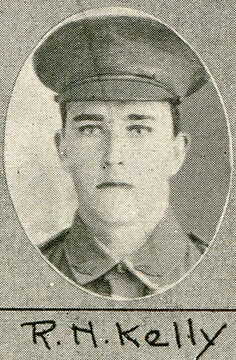
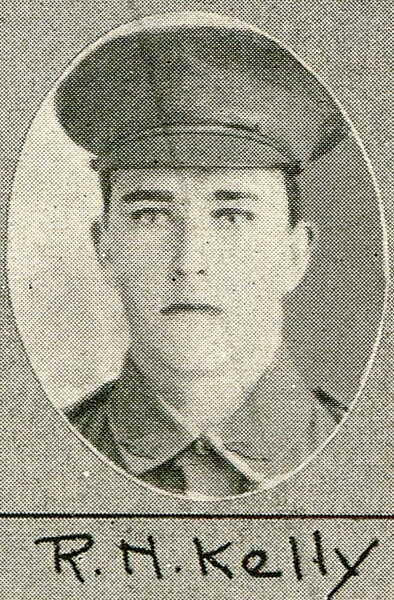
# 5600 KELLY Reginald Neville 25th Battalion
Reg Kelly was the younger of two sons born to Mary and Malachi Kelly at Roma, Queensland. While Reg was still young, the family moved to Esk where Reg attended school. As a young man, Reg worked as a sawyer in one of Lars Andersons’s sawmills at Esk.
Reg presented himself for enlistment in Brisbane on 31st March 1916. He informed the recruiting officer he was 18 years and two months old, a sawyer from Esk. Reg named his mother Mary Kelly of “Alta Mira”, Esk, as his next of kin. He made his way to Bell’s Paddock at Enoggera where he was placed in a depot battalion before being added to the 15th reinforcements of the 25th Battalion; the same battalion that his elder brother Gerald had joined before transferring to the camel corps. On 7th September 1916, the 15th reinforcements embarked on the “Clan McGillivray” in Brisbane for a voyage to England. At around this time, Reg’s father died, leaving Mary Kelly dependant on support from her two soldier sons. Reg allocated 4/- of his daily pay of 5/- to his mother. The reinforcements sailed via South Africa into the Atlantic and did not arrive in Plymouth until 2nd November 1916. From Plymouth, the reinforcements travelled to the 7th Brigade Training Battalion at Rollestone in Wiltshire. Reg proceeded to France in January 1917 and was finally taken on strength by the 25th Battalion, part of the 7th brigade of the 2nd Division AIF, on 20th February.
In the lull in fighting of the 1916/17 winter, the Germans constructed a 150 kilometre long defensive barrier, which the British labelled the Hindenburg Line, some distance to the east of their previous positions astride the Somme. As the German forces began a strategic withdrawal to this new position, the British forces cautiously followed, taking the towns of Bapaume and Noreuil along the way. In March 1917, the 7th Brigade was involved in a major action at Lagnicourt which cost the 25th a total of 42 casualties. This was Reg’s first battle and he came through it unscathed, though perhaps a little shaken.
In April, the 25th went into camp at Acid Drop Camp for two weeks during which time reinforcements were taken on and training continued. It snowed most of the time. While the 7th Brigade was resting, two other brigades of Australian infantry were ordered into an attack against the Hindenburg Line itself at Bullecourt. The battle, which became known as 1st Bullecourt was a complete disaster. The two brigades attacked without artillery support and the enemy wire still intact. The official historian observed that the plan at 1st Bullecourt had as much chance of success as a plan to capture the moon.
A further attempt to breakthrough the Hindenburg defences was planned for the beginning of May involving the 2ndDivision AIF and 14 British divisions along a 16mile front. The bands of barbed wire were dealt with by engineers laying Bangalore Torpedoes (metal tubes packed with explosive and a fuse) under the wire which were fired 24 hours before the attack at 3:45am on 3rd May. The 25th Battalion was in reserve but was quickly sent into the fighting, a company at a time, to shore up gaps in the line as well as carrying supplies of water, ammunition and rations up to the front. The battalion spent three days in the front line, during which no discernible inroads had been made in the Hindenburg defences. 2nd Bullecourt cost the 25th twenty-seven men killed and 136 wounded. The failures at Bullecourt put an end to the disastrous Somme campaign. British attention switched to the Ypres salient in Belgium.
Between May and September, the 25th was relieved of all offensive activity. The battalion moved around from camp to camp between Senlis and Bapaume enjoying periods of leave, brigade and divisional sports and visits to the divisional baths for uniform cleaning and new underwear. The 25th Battalion history records an amusing incident that occurred during a tactical exercise. Two companies were advancing towards their intended objective when a hare broke cover and ran across the line of advance. The men abandoned the battle practice and chased the hare with fixed bayonets. The Commanding Officer didn’t see the funny side of this. During the height of summer, around 100 men from the 25thwere detailed each day to assist the French farmers with the harvest (much of the French agricultural labour force had been conscripted). On 11th September, the holiday atmosphere came to an end with the receipt of orders to board a train for Steenvoorde near the French Belgian border. The 2nd Division was rejoining the war.
The plan for the 3rd Battle of Ypres (most often referred to as Passchendaele) was based on a strategy of “Bite and Hold” in which small strategic gains, supported by overwhelming firepower, would provide a series of stepping stones along the line of the Ypres to Menin Road. The first phase involved driving the enemy off the Messines Ridge, which the Germans had occupied since 1914. This was achieved after heavy fighting and the firing of nineteen underground mines on 7th June 1917. The 2nd Division of the AIF was not part of the Messines battle but their turn would come soon.
On the 11th September, the men of the 2nd Division arrived at Steenvoorde in preparation for an assault on Westhoek Ridge, the high ground that overlooked the main route east from the city of Ypres; the Menin Road. A detailed model of the ground had been constructed with planks suspended over the sand so that officers and NCOs could familiarize themselves with the battlefield and the objectives they were expected to take. The 25th Battalion, in conjunction with the other three battalions of the 7th Brigade were in position at the jumping off tapes by midnight of the 19th September and at 5:40am on the 20th, a massive artillery barrage crashed down on the German positions. As the barrage crept forward, the infantry kept pace, dealing with isolated pill boxes and gun emplacements whose occupants quickly surrendered. The Battle of Menin Road was, by the terms of the time, a great success. The battalions of the two AIF divisions that had taken part at Menin Road were relieved and two other divisions took advantage of the result to push the line even further into Polygon Wood and the approaches to the high ground of Broodseinde Ridge and the villages of Zonnebeke and Passchendaele.
On 4th October, twelve British Divisions, including the 2nd Division attacked Broodseinde Ridge along a thirteen kilometre front. As the 25th Battalion men rose up to follow the creeping barrage up the slope towards Zonnebeke, they encountered German infantry advancing up the reverse slope. Both the British and the Germans had made plans to attack on the same day, and at the same time. The Australians got the better of the encounter. The 25th Battalion advanced to the objective, Zonnebeke railway station, and by 10:00am the position was secure. Broodseinde cost the 25th forty men killed and nearly 200 wounded. One of the wounded was Reg Kelly. Like many of his comrades he was suffering from mustard gas poisoning. Reg was sent to a Field Ambulance and then the 10th Casualty Clearing Station before loaded onto a hospital train. On arrival at the Australian hospital at Boulogne, Reg was assessed as dangerously ill. A telegram informing Mary Kelly of her son’s condition was received at Esk, prompting an urgent request for more information. Reg was evacuated to a hospital in Liverpool, England, where by the 20th October his condition was downgraded to severe. Reg recovered sufficiently to be granted a two-week furlough in February 1918, after which he reported to the convalescent depot at Sutton Veney. While at Sutton Veney, Reg had two partial dental plates fitted.
Reg was not passed fit for active service until May, fully six months from the gas attack. On 22nd May, Reg began the journey back to his battalion, marching in to the battalion lines at Ville sur Ancre on 29th May 1918. A lot had happened on the Western Front during Reg’s absence. The campaign in Belgian Flanders had ground to a halt in the stinking mud of Passchendaele, putting an end to activity for the winter of 1917/18. In the spring of 1918, the Germans had launched a surprise offensive back on the Somme, the scene of so much fighting in 1916. The offensive in three short weeks had advanced to within sight of Amiens and four Australian Divisions had been rushed to the Amiens defensive lines. The German advance was checked at Villers Bretonneux by two Australian Brigades but the enemy was not beaten.
On 1st June 1918, Lieutenant General John Monash took control of all five AIF divisions as Corps Commander. He immediately began to remove troublesome German occupation from positions that overlooked his troops. One trouble spot was at Morlancourt, a ridge positioned in the V at the junction of the Ancre and Somme Rivers. Previous action had brought the Australian line up just short of the crest of the slope with German outposts and trenches just beyond the crest. The task of capturing those outposts and trench lines was given to the 7th Brigade of the 2nd Division. The date set for the attack was fixed for the 10th June and the 25th began to move up into the front line position in time for the heavy bombardment of the artillery and trench mortars. In a departure from convention, dusk was chosen for the time of the attack. At 9:45pm, the men of the 25th rose up from the jumping off trench and moved through a wheat crop into a broad belt of grassland. Almost immediately, German machine guns and rifles opened fire and a number of men were hit, some fatally. Reg Kelly was among those who fell during the advance. He had been back with the 25th less than two weeks and after his six month absence, was probably unknown to the men in his section.
Reg was probably buried in a temporary cemetery near Ville sur Ancre. A few personal possessions were sent to Mary Kelly at Esk; a diary, a metal match box, a prayer book and a broken rosary. Reg’s death left Mary Kelly a lonely widow having lost a husband and two sons in the spate of two years. She was granted a pension of £2/13/9d a fortnight.
Reg’s remains were exhumed when the Imperial War Graves Commission began consolidating isolated burials. He was reinterred in the Heath Cemetery. Mary chose the following inscription for Reg’s headstone: THY MEMORY WILL BE CHERISHED TILL WE SEE THY HEAVENLY FACE.
Click images to start slideshow.