







DE KAM, Frank Jack
| Service Numbers: | 414628, SX16872 |
|---|---|
| Enlisted: | 14 October 1941 |
| Last Rank: | Not yet discovered |
| Last Unit: | 2/1 Australian Corps TPS Ammunition Company |
| Born: | Adelaide, South Australia, 1 January 1917 |
| Home Town: | Not yet discovered |
| Schooling: | Not yet discovered |
| Occupation: | Stockman, Carpenter, Labourer |
| Died: | 29 August 1998, aged 81 years, cause of death not yet discovered, place of death not yet discovered |
| Cemetery: |
Bunurong Memorial Park, Victoria Cremated |
| Memorials: |
World War 2 Service
| 14 Oct 1941: | Involvement 414628 | |
|---|---|---|
| 14 Oct 1941: | Enlisted Brisbane, QLD | |
| 14 Oct 1941: | Enlisted 414628 | |
| 29 Dec 1941: | Discharged | |
| 23 Jan 1942: | Embarked Australian Military Forces (WW2) , SX16872, Army Ordnance Corps AIF | |
| 9 Feb 1946: | Discharged Australian Military Forces (WW2) , 2/1 Australian Corps TPS Ammunition Company |
Help us honour Frank Jack De Kam's service by contributing information, stories, and images so that they can be preserved for future generations.
Add my storyBiography contributed by Trevor Pyatt
Frank Jack de Kam (1917 – 1998)
Service No. 414628 (RAAF) | Service No. SX16872 (A.I.F.)
Royal Australian Air Force – Australian Imperial Force
Born: 1 January 1917, Adelaide, South Australia
Died: 29 August 1998 (aged 81)
Cremation: Bunurong Memorial Park, Victoria – Remains collected by family
Religion: Uniting Church of Australia
Occupation: Stockman, Carpenter, Labourer
Early Life and Family Background
Frank Jack de Kam was born in Adelaide on 1 January 1917, the son of Jacobus de Kam, a Dutch-born migrant who became a naturalised British subject before Frank’s birth, and an Australian-born mother, Nellie May Ah Hee. He grew up in the coastal suburbs of Port Adelaide and Peterhead within a large working-class family that blended Dutch and Australian heritage. He attended Largs Bay Public School, earning his Qualifying Certificate in 1929, and later studied at Le Fevre Peninsula Central School (1930–1932). His education focused on arithmetic, English, drawing and technical subjects. By his early twenties he was working as a stockman in the inland cattle districts of Queensland, boarding at the Oasis Hotel, Cloncurry.
Royal Australian Air Force Service (1940 – 1941)
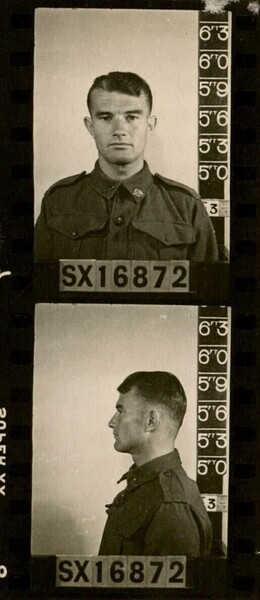
Frank joined the Royal Australian Air Force Reserve on 10 September 1940 at No. 3A Mobile Unit, Cloncurry, taking the Oath of Allegiance under the Air Force Act 1923. He was medically classified A1B/A3B and selected for training as an air crew candidate. On 14 October 1941, he enlisted in the RAAF at Brisbane and was posted to No. 3 Initial Training School (I.T.S.) Sandgate, Queensland as an Aircraftman Class II. He was described as 5 ft 8½ in (173 cm) tall, 139 lb (63 kg), with hazel eyes and brown hair. Despite satisfactory discipline and effort, an assessment ruled him “not likely to become efficient aircrew.” On 29 December 1941 he was administratively discharged under Air Force Regulation 115(t). His record was clear of offences or debts, marking an honourable conclusion to his brief RAAF service.
Australian Imperial Force Service (1942 – 1946)
Undeterred, Frank reenlisted for active duty in the Australian Imperial Force at Adelaide on 23 January 1942, aged 25, listing his trade as carpenter/improver. He was assigned to the Ordnance Corps and later to the 2/1 Australian Ordnance Beach Detachment, a logistics formation supporting amphibious and beachhead operations.
Between 1942 and 1943, he served with Headquarters Base Ammunition Depot, 3 Australian Ordnance Depot (Wallangarra) and related supply units. In March 1943, he was briefly cautioned for overstaying camp limits, his only disciplinary entry in more than four years’ service.
Frank embarked from Cairns on 18 August 1943, landing at Milne Bay, New Guinea, where he was attached to ordnance and ammunition handling duties for forward supply. He later operated through Lae and Finschhafen, providing critical material support to Australian combat units. In 1944 he was hospitalised for malaria, evacuated to Queensland for treatment, and subsequently returned to ordnance duties.
By mid-1945, de Kam had re-embarked at Brisbane aboard H.M. Transport Sea Ray for service in Morotai, later deploying to British North Borneo in support of the Borneo Campaign—Australia’s final offensive in the Pacific. His records show embarkation from Morotai on 11 July 1945 and continued service through to the end of hostilities.
Returning to Australia in early 1946, Frank was processed for discharge at HQ 9 Division A.G. 842 (Victoria). His official discharge date was 11 February 1946, having completed 1,491 days of full-time service, including over 1,460 days overseas. He received War Badge No. 243223 and was assessed medically fit, with residual malaria noted. His conduct throughout was recorded as “good.”
Later Years and Passing
After demobilisation, Frank settled in Victoria, residing at 38 Linda Street, Coburg. His experience in ordnance and mechanical handling likely guided his post-war work in technical or industrial trades. Frank Jack de Kam passed away on 29 August 1998, aged 81. He was cremated at Bunurong Memorial Park, Melbourne, with his ashes collected by family. His listed faith at burial was Christianity – Uniting Church.
Character and Legacy
Frank de Kam’s journey from civilian stockman to dual-service volunteer epitomises quiet determination and loyalty. Though his early RAAF ambitions were curtailed, he re-entered service through the Army, enduring tropical disease, long separations, and hazardous ordnance duties in the Pacific. His service contributed materially to Australia’s logistical success in the New Guinea and Borneo campaigns. Remembered without ceremony but with quiet respect, Frank Jack de Kam represents the steadfast spirit of ordinary men whose reliability sustained the Allied war effort across distant islands and jungles.
Sources
National Archives of Australia:
- RAAF Service File – A9301, 414628
- A.I.F. Service File – B883, SX16872
Bunurong Memorial Park Cemetery Register (Reference 3316B)
Australian War Memorial World War II Nominal Roll entries
Contemporary service and discharge forms, RAAF and A.I.F., 1940–1946
Biograpy by Trevor Pyatt 20/10/2025
Click images to start slideshow.