







GARDINER, Reginald Scott
| Service Number: | 303 |
|---|---|
| Enlisted: | 24 August 1914, Place of Enlistment Melbourne, Victoria. |
| Last Rank: | Lieutenant |
| Last Unit: | Headquarters Staff |
| Born: | Casterton, Victoria, Australia, 22 March 1893 |
| Home Town: | Coburg, Moreland, Victoria |
| Schooling: | Not yet discovered |
| Occupation: | Teacher |
| Died: | Illness, Coburg, Victoria, Australia, 14 November 1922, aged 29 years |
| Cemetery: |
Fawkner Memorial Park Cemetery, Victoria PLOT FMP-MEC-2901 Methodist Section. |
| Memorials: | Coburg Moreland Methodist Church Honour Roll, Parkville Old State College Memorial Windows |
World War 1 Service
| 24 Aug 1914: | Enlisted AIF WW1, Private, 303, 1st District Command HQ, Place of Enlistment Melbourne, Victoria. | |
|---|---|---|
| 22 Oct 1914: | Embarked Private, 303, Headquarters Staff, HMAT Orvieto, Melbourne | |
| 22 Oct 1914: | Involvement Private, 303, Headquarters Staff, --- :embarkation_roll: roll_number: '1' embarkation_place: Melbourne embarkation_ship: HMAT Orvieto embarkation_ship_number: A3 public_note: '' | |
| 1 Mar 1915: | Promoted AIF WW1, Corporal | |
| 24 Jul 1915: | Promoted AIF WW1, Sergeant | |
| 18 Dec 1916: | Promoted AIF WW1, Second Lieutenant | |
| 22 May 1917: | Promoted AIF WW1, Lieutenant | |
| 1 Nov 1917: | Wounded AIF WW1, Lieutenant, Gassed. | |
| 16 Jun 1919: | Discharged AIF WW1, Lieutenant |
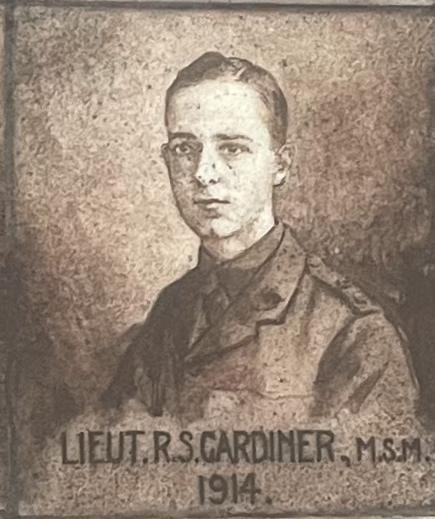
Reginald Scott Gardiner.
Reginald Scott Gardiner was born at Casterton, Victoria in 1893. He was a school teacher before enlisting as a private on 25 August 1914. Gardiner was made a clerk in the Divisional Headquarters, 1st Australian Division and departed Melbourne aboard HMAT Orvieto on 22 October 1914.
Gardiner went first to Egypt, where he was promoted to corporal on 1 March 1915, and then to Gallipoli via Lemnos. He witnessed the landing at Gallipoli on 25 April 1915 from aboard one of the transport ships. Gardiner was promoted to sergeant on 24 July 1915 while serving at Gallipoli. He was transferred to Egypt for duty on 2 October 1915 but re-joined his unit at Gallipoli on 18 October 1915. Gardiner left Gallipoli as part of the evacuation and, on return to Egypt, was transferred to 4 Section Medical, AIF Headquarters on 22 December 1915.
Gardiner left Egypt in June 1915 and was sent to England for officer training which resulted in his commission as a second lieutenant on 18 December 1916. He proceeded to France 16 January 1917 where he joined the 55th Infantry Battalion. According to his service record, Gardiner was "brought to notice of Secretary of State of War for valuable service rendered in connection with the war" on 24 February 1917. He was promoted to the rank of lieutenant on 22 May 1917. While in the 55th Battalion, Gardiner served both as a signalling officer and an intelligence officer. He also spent time between 25 April and 2 August 1918 attached to Headquarters, 14th Australian Infantry Brigade.
Gardiner left England to return to Australia on 25 February 1919. The medical history he provided on arrival in Australia indicated he was feeling fit despite the long war years during which he had suffered from influenza at Gallipoli in 1915 and was gassed in November 1917. He had not been hospitalised on either occasion. His appointment to the Australian Imperial Force terminated on 16 June 1919. Reginald Gardiner died on 14 November 1922.
Submitted 2 June 2022 by Lynette Turner
Biography contributed
Contributed by Heathfield High School
Gardiner was born on the 22nd of March 1893, in the town of Casterton in western Victoria, Australia. He was the fourth son of Alexander and Agnes Montgomery (nee. Wilson) Gardiner. He later grew up in the suburb of Coburg, Melbourne. His father also served in World War 1 (WW1), and was a carpenter during his 50’s. Reginald also had a sister and 3 brothers that additionally served in the war: Enid Victoria; Raymond Aubrey, who was a teacher; Norman Wilson, who was a carpenter like his father; and Claude Montgomery, who worked as a printer in his late teenage years but was unfortunately killed in war. Gardiner was a Methodist, a type of protestant Christianity founded in the 18th century. A majority of Methodists teach that Christ died for all of humanity, not just a limited group. Before the military, Gardiner was also a junior teacher, like his brother, at a school in Yarragon in Gippsland. He taught until the beginning of 1913, then entered the Training College in Carlton, which reflected both his education and sense of responsibility in the community. Unmarried at the time, Gardiner appeared to have been focused on his professional duties and communal lifestyle.
Gardiner later applied to depart from his job, like many other young Australians at the outbreak of the first world war, and chose to enlist into the Australian Imperial Force (AIF) and serve his country. Gardiner enlisted as a private on the 24th of August, 1914 – just weeks after he was declared – showing both initiative and commitment. Soon after enlisting, Gardiner was assigned to work as a clerk in the Divisional Headquarters of the 1st Australian Division. Reginald left Melbourne with the first troop convoy on the 21st of October, 1914. He was on board HMAT A3 Orvieto. There were 16 ships in that convoy, and there were several other Coburg men on board – 70 on HMAT A20 Hororata alone. There were 1400 service personnel onboard the Orvieto, 28 of them from Brunswick and 15 from Coburg. Gardiner was then part of the Army Medical Corps.
Gardiner served in Egypt in 1915, then left to serve in Gallipoli in the same year. He was transferred back to Egypt later that year, but only two weeks later he travelled back to Gallipoli. Gardiner took part in a campaign and evacuation in December 1915, then returned to Egypt once more to continue his service. On the 1st of March 1915, Gardiner was promoted to the rank of corporal. While stationed at Gallipoli, Gardiner was later promoted to the rank of sergeant, on the 24th of July 1915. He then returned to Egypt, where he was assigned to 4 Section Medical at AIF Headquarters. In 1916, Gardiner left Egypt and travelled to England, where he began officer training. His successful completion of the program led to his commission as a second lieutenant on the 18th of December that year. He was soon deployed to the Western Front, arriving in France on the 16th of January 1917, where he joined the 55th Infantry Battalion. While with the Battalion, Gardiner served in dual roles – first as a signalling officer, then as an intelligence officer.
According to his official service records, he was “brought to the notice of the Secretary of State for War for valuable service rendered in connection with the war” on the 24th of February, 1917. On the 22nd of May that year, he was promoted to the rank of lieutenant, continuing his rise through the ranks. It was on the 17th of April when he returned to Australia aboard the transport “Anchises”, and was discharged on the 16th of June. He also spent time between the 25th of April and the 2nd of August 1918 attached to the Headquarters of the 14th Australian Infantry Brigade.
During his time overseas, he wrote multiple letters to his mother about his experiences. One of the letters mentioned how cold the weather was, and how it was almost impossible to stay warm. Many were documents of what happened during his duties and ventures.
War conditions at the time were extremely harsh and dangerous, largely due to the use of trench warfare. Trenches, while offering some protection, were often waterlogged, muddy, and filled with diseases, rodents, and the constant threat of open fire. The war also introduced new and devastating weapons, such as poison gas, further complicating the already miserable living conditions.
Gardiner returned to Australia safely, despite having suffered from influenza at Gallipoli, and being exposed to gas on the Western Front in November 1917. The medical history he provided on arrival in Australia indicated he was feeling fit despite the long war years he endured. Multiple things had changed by the time Gardiner had returned to Australia. The country was marked by economic uncertainty, the psychological toll of mass loss, and widespread grief. Veterans like Gardiner often found the transition to civilian life exceptionally difficult. While little documentation remains regarding Gardiner’s post-war years, his early death suggests that the war left a lasting impact.
On the 14th of November 1922, Gardiner died at just 29 years old. The cause of his death is not stated in public records, but it is quite possible that his wartime exposures contributed to a deterioration in his health. His life, though brief, had been defined by years of dedicated military service. He was buried at Fawkner Memorial Park in Victoria.



Click images to start slideshow.