



MONKS, Mollie Humble
| Service Numbers: | SFX25163, S38435 |
|---|---|
| Enlisted: | 20 June 1942, Adelaide, SA |
| Last Rank: | Lieutenant |
| Last Unit: | Not yet discovered |
| Born: | Mount Barker, South Australia, Australia, 30 June 1915 |
| Home Town: | Littlehampton, Mount Barker, South Australia |
| Schooling: | Saint Scolastica's College for Young Ladies, Mount Barker (now St Francis de Sales) South Australia |
| Occupation: | Nurse |
| Died: | 15 February 2009, aged 93 years, cause of death not yet discovered, place of death not yet discovered |
| Cemetery: |
Centennial Park Cemetery, South Australia Services Family, Shrub Bed 8, Position 109 |
| Memorials: | Littlehampton Honour Roll |
World War 2 Service
| 20 Jun 1942: | Involvement Lieutenant, SFX25163 | |
|---|---|---|
| 20 Jun 1942: | Involvement Lieutenant, S38435 | |
| 20 Jun 1942: | Enlisted Adelaide, SA | |
| 20 Jun 1942: | Enlisted Australian Military Forces (WW2) , Lieutenant, SFX25163 | |
| 20 Sep 1942: | Involvement Transferred to AIF, at the 7th AGH at Keswick, before leaving for the 2/14 Hospital in Townsville in late 1942 | |
| 8 Jan 1947: | Discharged Australian Military Forces (WW2) , Lieutenant, SFX25163 | |
| 8 Jan 1947: | Discharged |
Help us honour Mollie Humble Monks's service by contributing information, stories, and images so that they can be preserved for future generations.
Add my storyBiography contributed by Clare Dorey
Mollie and her twin Margorie were born on 30 June 1915 to parents Percival Monks and Hilda Reynolds. She had four older half siblings, including twins Mona and Doris. She was baptised at St James in Blakiston, as her mother was an Anglican, and they used to visit their maternal grandmother in a big house on the hill nearby. Mollie and Margorie were blessed with a brother Jack in 1918 (below) and then Alan in 1927 and Nancy in 1930. A 1921 fete held in Littlehampton gives an insight into her prominent family’s life. It was opened by Mollie’s grandfather, businessman Henry Appleton Monks, her aunt Gladys sold sweets, and her uncle Alf Monks auctioned the goods remaining. A princess competition brought in quite a lot of revenue, and the result was ‘Mr P Monks' twins in first place winning a box of chocolates’ (unfortunately the paper doesn’t clarify which set of twins won.)
Mollie’s family lived a full life in their local community, with many events centred around the Littlehampton Peace Memorial Institute (below). Her grandfather Henry was the chairman of the trustees when the building was opened on 22 November 1919 by Mrs L Cowan (Robert’s mother). In 1924 Mollie and Margorie performed there at a musical concert, when the hall was full of parents listening to the pupils of Miss Dolly Oborn, which included Bruce Paech and many others. In September 1930 the girls of Littlehampton threw Doris and Mona a surprise 21st birthday party, where guests played games and danced until the small hours of the morning.
Mollie went to Saint Scholastica’s College for Young Ladies in Mount Barker (next page, now St Francis De Sales). In late 1929 she was again in the running for a princess competition. As a petite 5’3” with blue eyes and brown hair she must have been striking. While she didn’t have the honour of being crowned "Queen of St. Scholastica's College", she still received a gold medal and chain and helped the school raise £291.
After Mollie finished school she became a nurse, training at the Royal Adelaide Hospital. By 1935 she was on staff at the Soldiers Memorial Hospital and enjoyed a holiday in Victor Harbour. That March she was a guest at the coming of age of Molly Hunt at the Littlehampton Institute, with John Hunt, Bruce Paech and Gavin Whibley. That October she attended the annual hospital ball with half the town, including Bruce, Molly Hunt, and some Duffields, von Doussas and Stephensons. In 1936 it was Mollie’s turn to celebrate her 21st at the Institute with twin sister Margorie (left). In 1937 the Courier reported that she spent off duty time in Littlehampton with Cora Paech. Her examination results were reported in 1938, and she was included in the 1939 Register of Nurses. That year she attended the Adelaide Hospital annual ball, wearing a white dress and violet velvet sash.
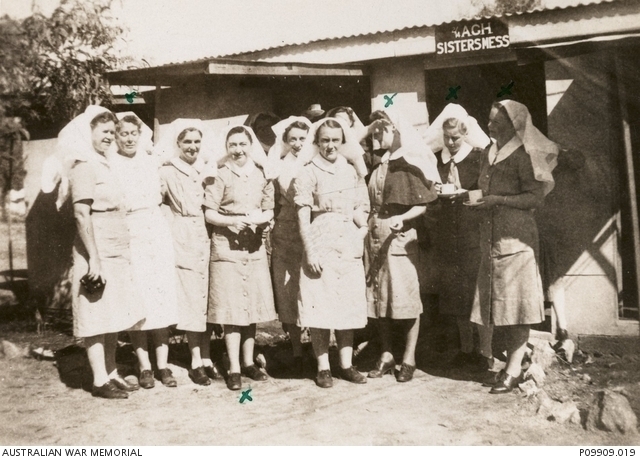
After the war broke out Mollie’s life changed forever. Her brothers and their friends started to enlist and left home to serve overseas, some never to return. After John Hunt enlisted he gave her a blue glass mirror decorated with clouds, with a model of a Baltimore aircraft mounted on it. The wooden base bore a gold RAAF badge and it was etched ‘From John 1940’. They became engaged while he was home on leave in May 1941. He left for the Middle East in June, just after her brother Jack was killed in Syria. Mollie applied to join the CMF soon afterwards. She suffered through the fear of losing John when he went missing for 2 weeks in March 1942. In April her father Percival was in hospital, and she was called up shortly before her 27th birthday, serving from 20/6/42 to 15/9/42 at the new 105 Australian Military Hospital at Daw Park. On 20 September she volunteered to transfer to the AIF and was allotted a new service number. She worked at the 7th AGH in Keswick until late 1942, when she transferred to Townsville to serve at the 2/14 Hospital (above). It was here that she was promoted to Lieutenant on 23 March 1943 and found out about her fiancé John’s death just weeks later.
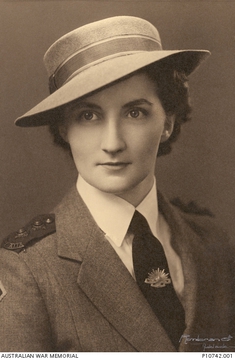
Shortly after Hunt’s death Mollie received an intriguing four-page letter from Lt Sister Mary Hamilton McFarlane (left and below) from the Australian Army Nursing Service. It was written on 19 April 1943, on board the Centaur, the 2/3rd Australian Hospital Ship. Mary mentions being busy with nursing work, night duty, cocktail parties, picnics, sleeping in a deckchair during her time off and waiting to use the one nurse’s shower. She includes news of mutual friends in other units and mentions John, of course without knowing that he had already died. Mary was still on board the Centaur when it was sunk by the Japanese just a few weeks later, and she was one of 268 who were killed. The ship had only been converted and refitted in January, and her red crosses were clearly visible from all angles and illuminated at night. However, at 4.10am on 14 May 1943, while returning to Port Moresby from Sydney, she was torpedoed by an unseen Japanese sub off the coast of Queensland. The Centaur was hit in the portside fuel tank, igniting the fuel and setting the ship on fire. She quickly took on water through the huge hole, rolled and sank within three minutes of impact. Many died immediately in their beds from concussion or perished in the inferno. 268 of the 332 medical personnel and civilians aboard died (including most of the army personnel and all but one of the 12 nurses.) Some made it off the ship but later died of shrapnel wounds, burns or drowning, especially as the speed of its demise prevented the deployment of many lifeboats. Only 64 people were rescued, after spending 36 hours in the water and drifting nearly 20 nautical miles.
The only surviving nurse was Sister Ellen Savage, who was presented with the George Medal for providing medical care, boosting morale, and displaying courage during the wait for rescue. The incident provoked international outrage as a war crime, but Japan denied responsibility, and no one was ever tried for the attack. The wreck of the Centaur was discovered in 2009 near North Stradbroke Island.
In September 1943, Mollie returned to South Australia and the 7th AGH but after some leave returned to the 2/14 AGH in October. She spent some time as a patient there over the next 6 months with conditions such as dengue and furunculosis of her face and nose, probably caused by working in a hot humid environment with a weakened immune system. Each time she was discharged and returned to her duties, but the work was clearly taking its toll. In August she moved to the Women’s Hospital at Redbank, Brisbane. In June 1946 she returned to South Australia and served at the Daw Park Repatriation Hospital. Here she met a patient, Douglas Allenby Wood, who had served as a Lance Sergeant with the 2/8th Battalion in New Guinea. Mollie’s appointment in the AIF was terminated in early January 1947, having served a total of 1664 days.
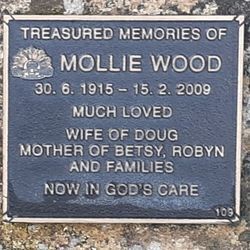
Mollie married Douglas Wood and had two daughters, Betsy and Robyn (right, on a trip to the zoo in the early 1960s). While Jack never came home her youngest brother Alan returned from his time in the navy (which he hated!) Mollie retrained at Queen Elizabeth Hospital and worked at Port Adelaide Casualty Hospital. She was able to do theatre work and midwifery, but husband preferred she not. Mollie nursed until she was 72 and a grandmother. Douglas died in 2001 at 82 and is buried in his hometown of Barabba, north of Adelaide. Her daughter Robyn said that Mollie never forgot her first love and after her husband’s death she put John Hunt’s photo back on her wall. Mollie died in 2009 at 93 and is buried in Centennial Park Cemetery (below) at Pasadena, Mitcham (where her parents Hilda and Percival lie.)
Some of Mollie’s personal artefacts were donated to the Australian War Memorial, including the letter from Sister MacFarlane and the mirror which John Hunt sent her (which unfortunately has not yet been digitised.) Robyn admitted to accidentally breaking the propeller when she played with it as a child. The mirror had hung on Mollie’s wall all her life since receiving John’s gift.

Click images to start slideshow.