








ZUCKER, Harold Walter
| Service Numbers: | SX21526, S17483 |
|---|---|
| Enlisted: | 6 August 1942, Strathalbyn, SA |
| Last Rank: | Corporal |
| Last Unit: | Not yet discovered |
| Born: | Saddleworth, South Australia, Australia , 23 December 1917 |
| Home Town: | Plympton, City of West Torrens, South Australia |
| Schooling: | Not yet discovered |
| Occupation: | Fruit Packer |
| Died: | Illness, South Australia, Australia, 7 June 1947, aged 29 years |
| Cemetery: |
West Terrace Cemetery (General) |
| Memorials: | Australian War Memorial Roll of Honour |
World War 2 Service
| 6 Aug 1942: | Involvement Corporal, SX21526 | |
|---|---|---|
| 6 Aug 1942: | Involvement Corporal, S17483 | |
| 6 Aug 1942: | Enlisted Strathalbyn, SA | |
| 6 Aug 1942: | Enlisted Australian Military Forces (WW2) , Corporal, SX21526 | |
| 26 Nov 1945: | Discharged |
Help us honour Harold Walter Zucker's service by contributing information, stories, and images so that they can be preserved for future generations.
Add my storyBiography contributed by Rod Hutchings
A Tall Ruckman’s Final Siren
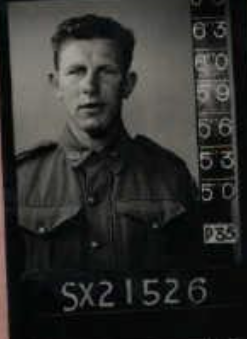
The mud of the Glenelg oval clings to the leather. Harold Zucker leaps, his tall frame dwarfing the pack as he reaches for the ball. He is a fruit packer from Saddleworth , 22 years old and standing six feet and one inch in his socks. Before the war, his world is defined by the rhythm of the harvest at the Dried Fruit Co. on Williams Road and the roar of the SANFL crowds.
He has a fair complexion, blue eyes, and a small scar tucked under the side of his chin.
Harold Walter Zucker was born on 23 December 1917. In civilian life, he spent his days crating summer fruit, his fingers often sticky with apricot juice. On winter Saturdays, he was a formidable ruckman for Sturt, where he played 51 games and kicked 59 goals.
When the war arrived, Zucker did not initially leave the football field. In 1942, during the height of wartime disruptions, he moved to Melbourne and pulled on the brown and gold guernsey for Hawthorn. He played three games in the VFL, wearing the number 28. But the demands of the Australian Military Forces soon took precedence over the game.
Zucker first enlisted in the Militia at Glenelg on 7 August 1940. He served with the 10th Battalion and later the 101st General Hospital. On 6 August 1942, he transitioned to the AIF at Strathalbyn, South Australia.
Promoted to Corporal a week later , he was posted to the 108th Australian Convalescent Depot. In August 1943, Zucker entrained for the Northern Territory. He arrived in the heavy humidity of Darwin, serving with the Australian Army Medical Corps and the 29th Works Company.
The record shows he was a man who understood hygiene and discipline, qualifying at the Field Hygiene and Water Duties Course in Woodside before his northern posting. However, the tropics were unkind. While in the north, Zucker began to suffer from a "protracted illness." His service record notes an evacuation for Paroxysmal Tachycardia, a condition where the heart races uncontrollably.
By the time peace returned in 1945, Zucker was back in South Australia. On 10 September 1945, he married Esma Mary Zucker. He was discharged on 24 November 1945, returning to his home at 57 Main Street, Plympton.
The war was over, but the illness he contracted during his service remained. Harold Walter Zucker died on 7 June 1947 at the age of 29. He is buried at the West Terrace Cemetery in Adelaide.
He is remembered today as one of the ten Hawthorn players who did not survive the war's reach. His name is etched on the Australian War Memorial Roll of Honour, a final record of a life that was once defined by the high leap and the summer harvest.
Lest we forget
Rod Hutchings
Director, Virtual War Memorial Australia
Source Crediting:
National Archives of Australia: B883, SX21526; B883, S17483.
Australian War Memorial: Roll of Honour.Hawthorn Football Club: Official WWII Honour Roll.
Find A Grave: Memorial ID 21615611 (West Terrace Cemetery).
Click images to start slideshow.