



VAN HEYTHUYSEN, Ronald
| Service Number: | SX14524 |
|---|---|
| Enlisted: | 15 September 1941 |
| Last Rank: | Corporal |
| Last Unit: | 2nd/9th Armoured Regiment |
| Born: | Sedan, South Australia, Australia, 11 April 1914 |
| Home Town: | Balhannah, Adelaide Hills, South Australia |
| Schooling: | Not yet discovered |
| Occupation: | Truck Driver |
| Died: | Old age , Glengowrie, South Australia, Australia, 4 November 1994, aged 80 years |
| Cemetery: |
Centennial Park Cemetery, South Australia |
| Memorials: | Balhannah WW2 Roll of Honour |
World War 2 Service
| 15 Sep 1941: | Enlisted Australian Military Forces (WW2) , Private, SX14524, 2nd/9th Armoured Regiment | |
|---|---|---|
| 29 Jul 1943: | Promoted Australian Military Forces (WW2) , Corporal | |
| 25 Feb 1946: | Discharged Australian Military Forces (WW2) , Corporal, SX14524, 2nd/9th Armoured Regiment |
Help us honour Ronald Van Heythuysen's service by contributing information, stories, and images so that they can be preserved for future generations.
Add my storyBiography contributed by Oakbank School
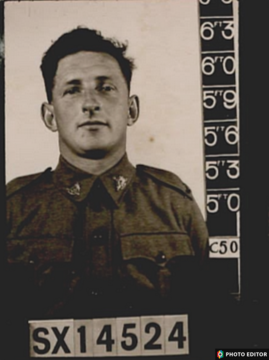
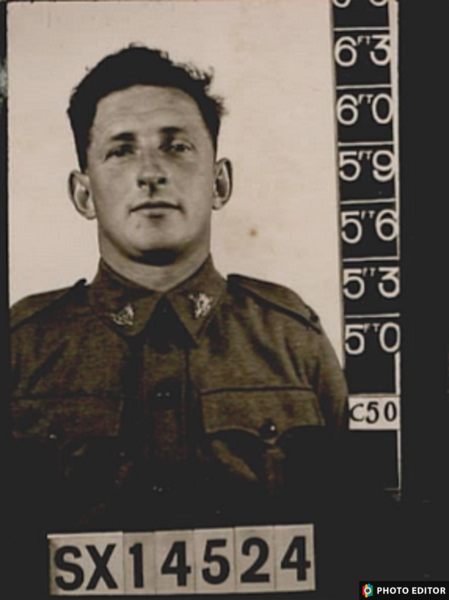
Ronald Van Heythuysen (Figure 1) was born on 11 April 1914 in Sedan, South Australia. His parents, Leopold Van Heythuysen and Susan Elsie Frances Hoad raised ten children in total. Ronald had five sisters, Ethel, Eva, Gwendoline, Elsie, and Doreen, and three brothers, Leopold, Hugh, and Allan. The family later moved from Sedan to Balhannah in the Adelaide Hills, which became Ronald’s hometown.
There isn’t much information about Ronald’s schooling, records show that before the war he worked as a truck driver (National Archives of Australia (NAA), n.d.). This job needed hands on mechanical skills, problem-solving, and resilience, which later helped him when he joined the army.
On 15 September 1941, when he was just 27 years old, Ronald signed up to fight in the Second World War. His enlistment is recorded at Wayville, South Australia, and he was given the service number SX14524 (Figure 3). Since he wasn’t married, he listed his mother, Susan, as his next of kin (VWMA, n.d.). Ronald’s time in the Army started at the Redbank Reinforcement Depot, where he was officially taken on strength. Just two days later, he was moved from the 4th Military District in South Australia to the 3rd Military District in Victoria. This was the beginning of a long and tough journey of training and preparation (NAA, 2025).
By March 1942, Ronald was sent to Puckapunyal in Victoria, which was one of Australia’s main training bases for armoured troops. At Puckapunyal, he trained as a driver-mechanic. This meant he didn’t just learn how to drive tanks and military vehicles, he also had to learn how to fix and maintain them. This job was extremely important because if the vehicles broke down, soldiers couldn’t move forward into battle (NAA, 2025).
The training itself was tough and physically challenging. Ronald had to complete courses in survival skills, fieldcraft, weapons handling, tactics, and all the basics of being a soldier (NAA, 2025). He faced long hours, strict discipline, and constant pressure. In July 1942, he caught influenza and had to spend a few weeks in hospital. He recovered and was discharged back to his unit on August 12th. Not long after, he was sent to Muswellbrook, NSW, where he had special duties, such as helping with supply logistics, working in military camps, and helping to run training schools. These jobs were just as important as fighting because they kept the Army organised and prepared. By 6th September 1942, he had re-joined his unit, continuing preparations for active service (NAA, 2025).
On the 4th of November 1942, Ronald was reassigned to the 2/2 Australian Armoured Brigade Group Ordnance Workshop, his main responsibility was keeping armoured vehicles running. Soon after, he was promoted to Acting Corporal, which meant he was trusted to lead and support other soldiers. This role came with more responsibility, he had to train others and set an example (NAA, 2025).
Between January of 1943 and April 1945, Ronald continued advanced training. He attended a specialised armoured fighting vehicle school (NC 14 TK CLE AFV), where he qualified as a No. 14 Tank Armoured Fighting Vehicle operator. The training was long and demanding, but it prepared Ronald and his regiment for the challenges of war. Even though the 2/9th Armoured Regiment didn’t see much combat until later in the war, they were fully trained for when the time came (NAA, 2025).
In April 1945, Ronald left Australia, sailing from Cairns to the island of Morotai in the Netherlands East Indies. From there, he was sent to Borneo, which is one of the largest islands in the world. At the time, Borneo was really important in the Pacific War because it had valuable resources and airfields that the Allies needed as the war was reaching its final stages (VWMA, n.d.).
Ronald travelled on a Landing Ship Tank, known as LST.51. (Figure 8) These ships were specially built to carry tanks, vehicles, and troops straight onto beaches. They were vital for the Pacific campaign because so many battles happened along coastlines, where soldiers had to land directly in hostile territory (Colton, 2008.) On 31 May 1945, Ronald arrived in Borneo, where he joined the Allied effort to free the island from Japanese
control (AWM, 2010).
Ronald’s regiment supported the 26th Brigade in the Battle of Tarakan during May and June 1945. The main goal of this operation was to capture Tarakan’s oilfields and airfield. The fighting was extremely tough, as the Japanese had been expecting the attack and defended the area heavily. Although the Allies managed to take control of the airfield, it was so badly damaged that it couldn’t be properly used until later in the campaign (Military Wiki, n.d.).
In June 1945, Ronald took part in the Landing at Labuan. This was another important operation, as Australian forces needed to capture the harbour and airfield there. After weeks of heavy bombing and ground fighting, they eventually overcame the Japanese. Once secured, Labuan became a key Allied base for the rest of the war, helping with supply lines and further operations however, the cost was high as 34 Australians were killed in the landing (Handel, 2003).
By August 1945, Japan surrendered, and the war officially ended. However, Ronald’s work didn’t stop there. His regiment, the 2/9th Armoured Regiment, stayed in Borneo after the fighting was over. Their job was to help
rebuild the area, repair infrastructure like roads and buildings, and support the local civilians who had suffered during the occupation. They were also responsible for making sure the surrender of Japanese troops was carried out properly and for finding Allied prisoners of war who had been held in terrible conditions (AWM, 2010). For Ronald, being in Borneo was tough but also important. In total, 9 men from his regiment were killed in action, and 16 more were wounded. Even after the fighting ended, he and the other soldiers helped bring order and hope back to the island, which had been badly affected by the war.
The 2/9th Armoured Regiment came back to Australia in December 1945 and was officially disbanded soon after. Ronald was discharged from the Army on 25 February 1946, after serving for more than four years (NAA, 2025). Ronald went back to South Australia, where he later married Dulcie, and together they built their life after the war. Ronald lived a long life after his time in the Army, passing away peacefully in 1994 aged 80. He was buried next to his wife.
Reference List
Australian Armour (n.d.) 2/9th Armoured Regiment – World War II history. Available at: https://web.archive.org/web/20071007074219/http://www.australian-armour.com/AAR_WW2.html (Accessed: 28 August 2025).
Australian War Memorial (2010) 2/9th Armoured Regiment. Second World War, 1939-1945 units. Available at: https://www.awm.gov.au/units/unit_21556.asp (Accessed: 19 June 2025)
Colton, T. (2008) S-Type Sprecial-Purpose Ships. Shipbuilding History, 12 April. Available at: https://web.archive.org/web/20180305044456/http://www.shipbuildinghistory.com/history/merchantships/wwii/sships.htm (Accessed 19 June 2025)
Family Search (2021) Ronald Wan Heythuysen. Available at: https://ancestors.familysearch.org/en/L2M7-K22/ronald-van-heythuysen-1914-1994 (Accessed: 24 May 2025)
Find a Grave (2021) Ronald Van Heythuysen Memorial Page. Available at: https://www.findagrave.com/memorial/222833337/ronald-van_heythuysen (Accessed: 24 May 2025)
Handel, P. (2003) Dust, Sand & Jungle: A History of Australian Armour During Training and Operations, 1927-1948. Puckapunyal, Victoria: RAAC Memorial and Tank Museum.
Military Wiki (n.d.) 2/9th Armoured Regiment (Australia). Available at: https://military-history.fandom.com/wiki/2/9th_Armoured_Regiment_(Australia (Accessed: 21 June 2025)
National Archives of Australia (2025) Service Record: Ronald Van Heythuysen, B6413273. Availavle at: https://recordsearch.naa.gov.au/SearchNRetrieve/Interface/ViewImage.aspx?B=6413273 (Accessed: 21 June 2025)
Oldnews (2025) Historical Newspapers Online Archive. Available at: https://www.oldnews.com/en/record?record_id=record-11023-19468303 (Accessed: 20 June 2025)
Virtual War Memorial Australia (n.d) Ronald Van Heythuysen – Project Page. Available at: https://vwma.org.au/explore/projects/187593/edit?t=1750061594593 (Accessed: 19 June 2025)
Click images to start slideshow.