







CONDER, Harry Alfred
| Service Number: | SX6171 |
|---|---|
| Enlisted: | 21 June 1940, Wayville, SA |
| Last Rank: | Staff Sergeant |
| Last Unit: | 4 AASTC |
| Born: | Portsmouth, England, 15 November 1904 |
| Home Town: | Port Pirie, Port Pirie City and Dists, South Australia |
| Schooling: | Portsmouth, England |
| Occupation: | Labourer |
| Died: | Poisoning, Gawler Place, Adelaide, South Australia, 25 December 1953, aged 49 years |
| Cemetery: |
Cheltenham Cemetery, South Australia Section F, Drive A, Path 32, Site 313S |
| Memorials: |
World War 2 Service
| 21 Jun 1940: | Involvement SX6171 | |
|---|---|---|
| 21 Jun 1940: | Enlisted Wayville, SA | |
| 21 Jun 1940: | Enlisted Australian Military Forces (WW2) , Staff Sergeant, SX6171 | |
| 14 Aug 1943: | Discharged | |
| 14 Aug 1943: | Discharged Australian Military Forces (WW2) , Staff Sergeant, SX6171, 4 AASTC |
Tragic Life of ‘Barwell Boy’
English born on the 15th November 1904, Harry lived in Portmouth, a port city in Hampshire, England. He was named after his father, Mr H.A. Conder who enlisted to serve in WWI as did two of Harry’s older brothers. All three were killed during that ‘war to end all wars’. Conditions during and afterwards were challenging for many English families to provide nutrition, housing and work.
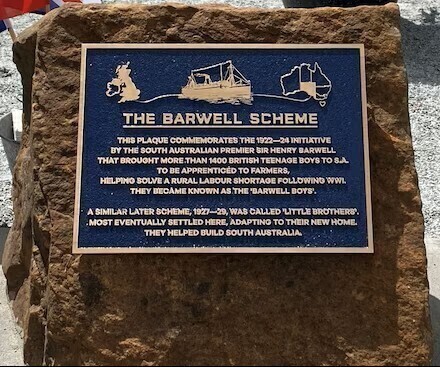
Post-war, in South Australia the Premier, Sir Henry Barwell designed a scheme in 1922 to help local farmers who desperately needed labourers following the huge losses of young men during the war years. The scheme was also designed to assist Britain’s huge unemployment situation, thus creating greater ties with England. Harry’s mother thought this would provide a better opportunity for him and he boarded the Barrabool with 50 other young men under what became known as the ‘Barwell Boys’ scheme. In total, over 1440 mainly teenaged boys were part of the experiment.
In ’22, the Minister of Agriculture, George Laffer, addressed arriving apprentices with the words; “We sent for you to come out and help us to develop the country. We desire you to go on the land and eventually to become producers. If you possess the good old British characteristics of pluck and determination, you are sure to make good. You lads are the type Australia wants. You will be treated like sons. Good luck!’,
Harry arrived in Port Adelaide in October ’23, just prior to his 18th birthday. Captain Wyatt, master of the vessel remarked that "The lads are of a fine type and fairly quiet," adding that “as a class they were about the best batch that had been brought out under the Immigration scheme.” Other civilians who had sailed on the Barrabool agreed that “The Barwell Boys were worthy of the commendation of the Captain.”
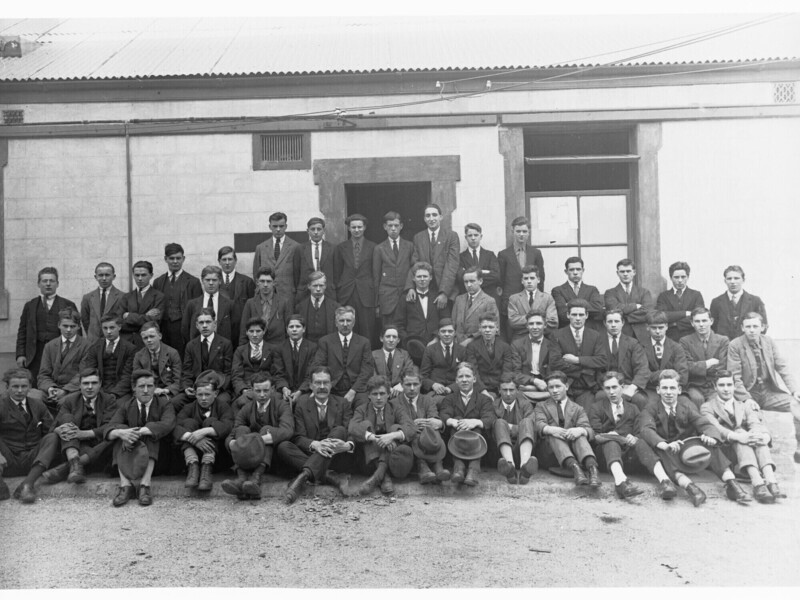
Once disembarked, the ‘Barwell Boys’ gathered at the Kintore Avenue Destitute Asylum. A photo was taken of this group, showing them dressed appropriately for British weather but certainly not for Australian conditions. All had been allotted positions before they had landed. From there, they were apprenticed to a farmer for three years and signed documents outlining this arrangement. Most of the boys were on their way by the afternoon. The Immigration Officer also praised the Boys, saying “It was evident that lads who had the pluck to make the trip from England were possessed of grit, and he felt sure they would 'make good' in Australia. “
He married Julia Veronica on April 1st, 1929, with the family settling at Pirie where their three children were born. Having serving his apprenticeship, from 1930-‘37 the local Port Pirie Council appointed Harry for a variety of positions. The first was as nightman and scavenger (recycler) at £4/10/ per week. By May he was also appointed as Health Inspector with additional pay of £5 per annum and rent-free abode. On weekends Harry was a regular football boundary umpire and was soon working for the Port Pirie Harbours Board.
Harry served in the Militia with the 43rd Battalion at Port Pirie for two years and continued to work as a labourer. His youngest son, Desmond was born in June ’39. However, with the outbreak of WWII, a huge recruitment drive was underway in country areas, including Port Pirie. Harry heeded that call and, aged 35, enlisted at the local Recruiting Office in June ‘40. He was allocated the number SX6171 and placed in the newly formed 2/48th Battalion. Within three months his leadership potential was recognised with rapid promotion to Acting Lance Sergeant.
To support enlistees, the South Australian Railways provided free travel to their homes once a month for members of the Second A.I.F, and Royal Australian Air Force. The local Recorder newspaper listed those who returned home on leave, including Sergeant H. Conder availing themselves of the travel provisions. While on pre-embarkation leave in October, the Recorder reported that ‘Quartermaster-Sgt. H. A. Conder, of the Second A.I.F., was the recipient of a gift of 10/- from the Citizens' Soldiers Reception Committee before he left for Adelaide by train last evening after having spent leave in Pirie. The committee also arranged for a taxi to convey him to the train.’
Harry soon boarded the Stratheden on the 7th November, arriving in the Middle East on the 17th December with the rank of Acting Staff Sergeant. A letter from a fellow Pirie soldier, Private F. Miller, mentioned seeing Harry, commenting that the soldiers were ‘a deeply sun-browned, happy crowd.’ He added “I do not know whether Pirie folk will be able to understand us when we return, for most of us are picking up the 'wog' language. One has to be careful at night, for our boys are doing well with the 'lingo,' and as they are about the same color as the natives it becomes a little confusing at times.”
Harry was part of the Siege of Tobruk over April ’41. Attempting to destroy morale, the troops were bombarded with leaflets urging them to surrender, rather than continue to fight from their dusty rat and fly infested dugouts. The taunts had the opposite effect as the men dug in and quickly adopted the unofficial title of Rats of Tobruk, little knowing this would endure as a highly regarded title. Unfortunately, Harry’s eye condition and perhaps his age, contributed to his medical condition of being assessed as fit for duties ‘other than field formations’.
By the end of ’42 Harry was on his way home to Australia via Freemantle, arriving in time for Christmas and 15 days’ leave before having Special Duties at Springbank. Service in Sydney followed before he was discharged on the 14th August ’43. Over his time serving overseas, Julia had gained employment to support herself and the three children.
Perhaps a culmination of his early life living through bombings on his British hometown, the family losses, followed by his mother’s choice to send him to Australia and the conditions of serving in his own war severely affected Harry. Home life began to unravel for the Army veteran and by June ’44 Julia took Harry to Court to gain maintenance for herself and the children. Harry was alleged to have said "I have been overseas for two years and do not intend now to tie myself down to a wife and family. I want to have a good time." On discharge he claimed he wanted to go to Sydney for a week’s holiday. Rather than return to work for the Harbours Board, Harry had headed to Adelaide to work for Holdens. Harry was accused of “drinking like a fish, gambling, and being unreliable with money." At home, he did the most stupid and idiotic things with his money and then told lies about where he had spent it, leaving all home duties and responsibilities to Julia. Conder was ordered to pay by June 20 for the future maintenance of his wife and children the sum of £3 a week, £3 3/ costs, and 10/ witness fees.
Harry found employment as a storeman, but his life continued to disintegrate as he omitted to furnish income tax returns since his discharge and was taken to court in ‘51. This resulted in a fine of £20 with £2 costs.
In an horrific conclusion to his life, Harry died on Christmas Day ’54 in Gawler Place, Adelaide of poisoning. He was 49 years old. An inquest was inconclusive as to how Harry ingested the poison, with no evidence of it being administered to him unlawfully or that he took it himself.
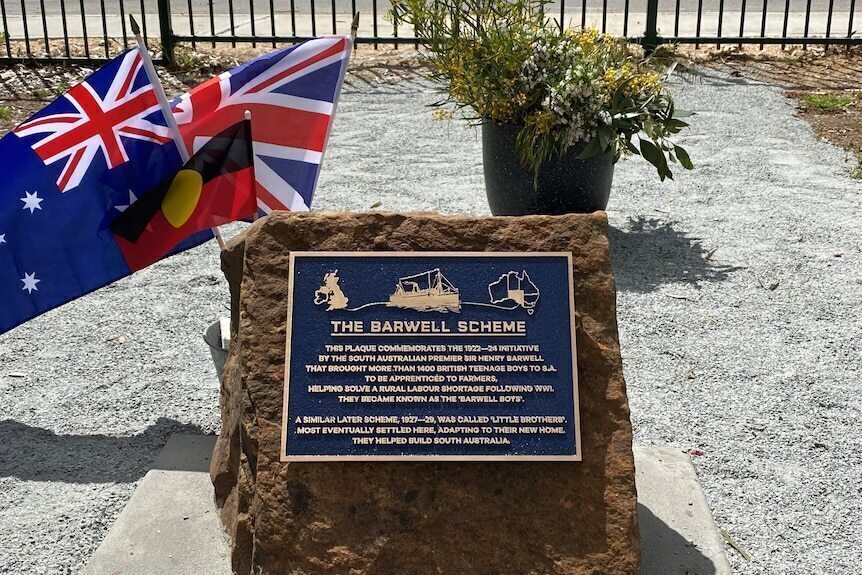
Harry is remembered for his service and by his loving children with a plaque in the Cheltenham Cemetery, Section F, Drive A, Path 32, Site 313S. Harry’s service is also remembered on the Port Pirie Roll of Honour. His life as a ‘Barwell Boy’ is also remembered with a plaque unveiled in October 2022 at Cummins on the Eyre Peninsula, coordinated by descendant Elizabeth Carter. A duplicate is also outside the Migration Museum in Kintore Avenue, where Harry first began life in South Australia.
Julia did not remarry and lived to be 91. She died on the 21st March ’96 and now rests in the Pirie Cemetery Rose Garden.
Researched and written by Kaye Lee, daughter of Bryan Holmes SX8133, 2/48th Battalion.
Submitted 9 March 2026 by Kaye Lee
Biography contributed by Daryl Jones
Son of Mrs. H.A. CONDER of Portsmouth, England. Harry was married with three children and residing at 7 Gertrude Street, Port Pirie when he enlisted in June 1940. Educated in Portsmouth England he was fond of football. In civil life he was employed by the Port Pirie Harbours Board. He saw service in the Middle East, Palestine and Tobruk. His father and two brothers were killed in the Great War.
Man Died From
Poison
An unidentified poison had killed a 48-year-old man, the City Coroner (Mr. T. E. Cleland) found at an inquest yesterday. The inquest was into the death of Harry Alfred Conder, of Green street, St. Morris. He died on December 25 last year in Gawler place, city.
Mr. Cleland said he was unable to say how Conder had ingested the poison, but there was no evidence to suggest that it was administered to him unlawfully or that he took it of his own act.




Click images to start slideshow.