








BOGLE, Charles Stewart
| Service Number: | 427289 |
|---|---|
| Enlisted: | Not yet discovered |
| Last Rank: | Flying Officer |
| Last Unit: | No. 90 Squadron (RAF) |
| Born: | Harvey Western Australia, June 1923 |
| Home Town: | Mount Magnet, Mount Magnet, Western Australia |
| Schooling: | Guildford Grammar School, Western Australia |
| Occupation: | Jackaroo |
| Died: | Flying Battle, Germany, 13 August 1944 |
| Cemetery: |
Becklingen War Cemetery, Germany Becklingen War Cemetery, Luneburg, Germany |
| Memorials: | Australian War Memorial Roll of Honour, International Bomber Command Centre Memorial |
World War 2 Service
| 13 Aug 1944: | Involvement Flying Officer, 427289, No. 90 Squadron (RAF) |
|---|
Help us honour Charles Stewart Bogle's service by contributing information, stories, and images so that they can be preserved for future generations.
Add my storyBiography contributed by Geoff Tilley
Charles Stewart Bogle was born in June 1923 at Harvey, Western Australia, to parents Charles Herman Bogle and Jean Elizabeth Hymus, who were married in August 1922 at Harvey. There were three siblings in the family.
Charles’s family moved to the Mount Magnet area, working as pastoralists at Narndee Station, approximately 80 kilometres north‑east of Paynes Find. He completed his schooling by correspondence from Narndee Station, later attending Saint Ildephonsus College, New Norcia, and then Guildford Grammar School from 1937 to 1938.
When Charles was eight years old, in 1932, his mother—an accomplished horsewoman—was assisting his father, the manager‑owner of Narndee Station, in rounding up livestock when she was struck by lightning during a storm and killed instantly.
Leaving school at sixteen, Charles returned to Narndee Station and later worked as a jackaroo at Billabalong Station near Mullewa. Returning again to Narndee Station, he aspired to become a pilot. To enhance his prospects of enlistment, he learned Morse code from the Postmaster at Mount Magnet.
Charles enlisted in the Royal Australian Air Force (RAAF) in June 1942 at Perth, where he was selected for aircrew training as a pilot. He trained at various schools from late 1942 to mid‑1943, holding the rank of Sergeant, and was awarded his Flying Badge in May 1943. His instructors rated him as an average student and noted his proficiency on Tiger Moth, Oxford, and Anson aircraft.
In July 1943, Charles embarked for overseas service from Melbourne, Victoria, arriving in England in August 1943. He continued his training there, becoming proficient on the twin‑engine Wellington bomber. He completed his pilot training on four‑engine heavy bombers—the Short Stirling and the Avro Lancaster—in February 1944. His instructor’s remarks were:
“Average, generally sound although flying needs improvement – lacking polish. Suitable Captain with experience.”
In June 1944, he was commissioned as a Flying Officer and attached to No. 90 Squadron RAF, a Bomber Command squadron operating the Avro Lancaster from Tuddenham Airfield, Suffolk.
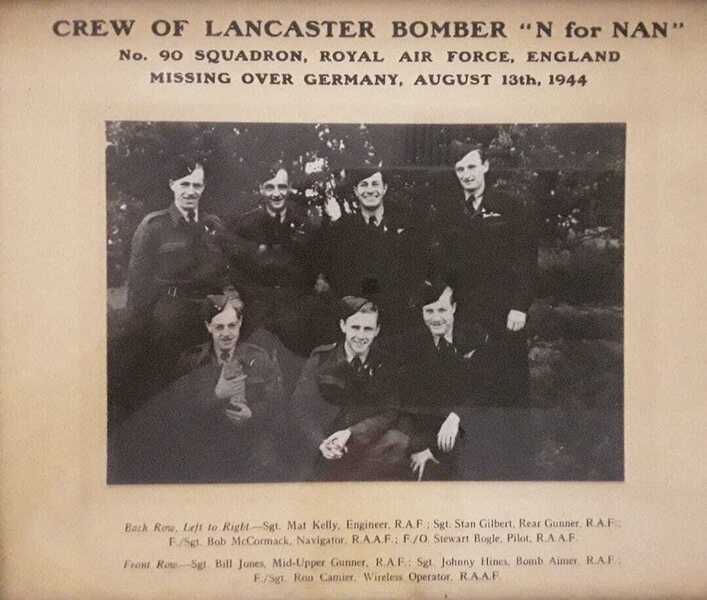
On Saturday 12 August 1944 at 9:46 pm, Charles, as pilot‑in‑command, took off from RAF Tuddenham in an Avro Lancaster III “N for Nan” for a bombing raid on Braunschweig, Germany.
At approximately 1:15 am on 13 August, the four‑engine bomber approached Bergen from the northwest, diving steeply in flames before crashing into a forest near Becklingen. The wreckage was scattered over a large area and burned for approximately five hours.
It was presumed that the bomber had jettisoned its bombs before the crash, as there were no reports of anti‑aircraft flak, and it is believed the aircraft was attacked by a night fighter. The bodies of six crew members were recovered from the aircraft, with a seventh found several hundred metres away. A partially opened parachute was located near this crew member, indicating he had attempted to bail out at low altitude.
All the crew members’ bodies were taken to Bergen and buried in the town cemetery.
Flying Officer Charles Stewart Bogle, service number 427289, RAAF, attached to No. 90 Squadron RAF, was killed in action on 13 August 1944 during flying operations over Germany. He was 21 years of age.
Charles and the other members of his crew were later reinterred in Becklingen War Cemetery, Lüneburg, Germany, where they are remembered with honour.
Two of his crew were also Australian: Flight Sergeant Robert Browning McCormack, Navigator, and Flight Sergeant Ronald Sutton Camier, Wireless Operator.
Click images to start slideshow.