








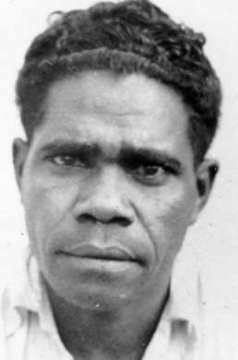
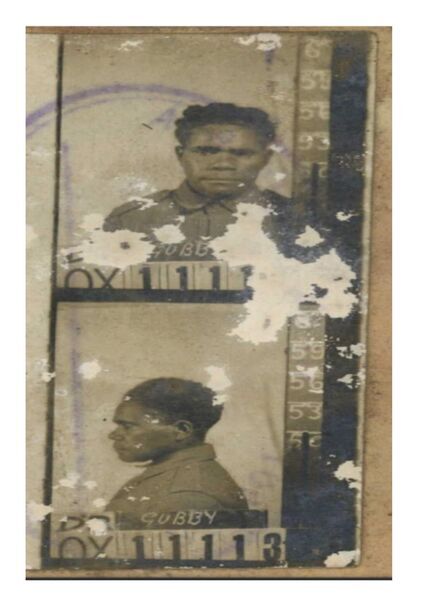
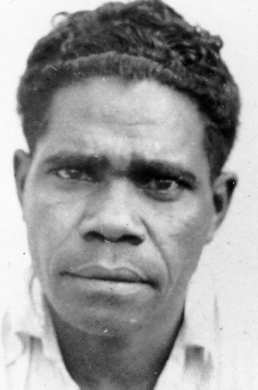
CUBBY, George Edward
| Service Number: | QX11113 |
|---|---|
| Enlisted: | 11 July 1940 |
| Last Rank: | Private |
| Last Unit: | 2nd/26th Infantry Battalion |
| Born: | Toomelah Aboriginal Station near Boggabilla, New South Wales, Australia, 10 May 1913 |
| Home Town: | Boggabilla, Moree Plains, New South Wales |
| Schooling: | Not yet discovered |
| Occupation: | Labourer |
| Died: | Illness, Thailand, 17 December 1943, aged 30 years |
| Cemetery: |
Kanchanaburi War Cemetery 1 B 71 |
| Memorials: | Australian War Memorial Roll of Honour, Ballarat Australian Ex-Prisoners of War Memorial |
World War 2 Service
| 3 Sep 1939: | Involvement Private, QX11113 | |
|---|---|---|
| 11 Jul 1940: | Enlisted | |
| 11 Jul 1940: | Enlisted Australian Military Forces (WW2) , Private, QX11113, 2nd/26th Infantry Battalion, Warwick, Qld. | |
| 17 Dec 1943: | Discharged |
Help us honour George Edward Cubby's service by contributing information, stories, and images so that they can be preserved for future generations.
Add my storyBiography contributed by Faithe Jones
Son of Charles and Kate Cubby, of Boggabilla, Queensland, Australia.
"BLESSED ARE THE DEAD WHICH DIED IN THE LORD" REV. 14:13
Two Aboriginal Brothers
Answer Call To Arms
Two full-blooded, aboriginal brothers—Bert and George Cubby— were in the A.I.F. draft which left Warwick yesterday. The men are from Toomelah Aboriginal Station, near Boggabilla, and came to Warwick with a party formed in Goondiwindi. In the last war aboriginal enlistments were numerous, and officers and comrades, spoke highly of their work, particularly in the Palestine campaign. The majority were born horsemen, and their natural ability as trackers, their inborn sense of direction, their keen-sightedness and hardiness made them invaluable, as scouts in desert warfare. Bert Cubby is 37 and his brother 27. Aboriginal men from Boggabilla fought in the last war, and they intend to play their part in the present conflict. In newspapers recently they saw photographs of men of their own race who joined the A.I.F., and decided that they also were needed in the Army.
George Cubby was born in 1913, and his older brother Bert was ten years older, born in 1903. They both worked as Labourers prior to enlisting.
The brothers were attached to the 2/26 Battalion, but Bert battled illness throughout his time in the Army and was ultimately discharged as medically unfit in 1941.
George embarked for Singapore in August 1941. Following the entry of Japan to the war he served in Malaya before being wounded in action on 29 January and evacuated to hospital in Singapore.
He rejoined his unit on 9 February but was taken as a Prisoner of War on 15 February 1942 as Singapore fell to Japan.
In April 1943 he joined F Force, a large group of prisoners sent by train from Singapore to Thailand to work on the Thai-Burma railway. Hopes that they would have better conditions outside of the Changi prison camp were quickly dashed as they found atrocious conditions in their new base, with hundreds already having died from cholera on route.
F Force faced hellish conditions as they worked on the railway through 1943. The work in involved heavy labour in extreme heat with little food and rest. Disease was rampant from cholera, malaria and other tropical diseases, with many kept alive thanks to the tireless work of fellow prisoners who worked as doctors and medical staff in makeshift hospitals.
By November F Force began returning to Singapore but George Cubby was not amongst their number. He died from malaria on 17 December 1943 aged 30.
He is buried at Kanchanaburi War Cemetery in Thailand.
His brother Bert survived the war, dying aged 62 in 1965 at Mungindi Hospital.
Click images to start slideshow.