








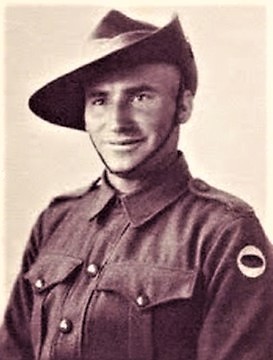
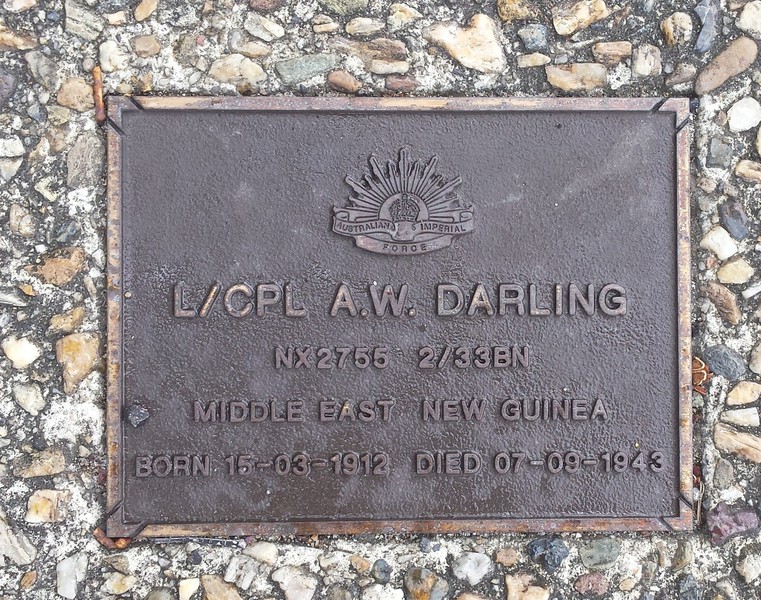
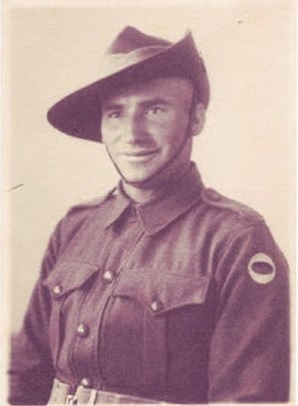
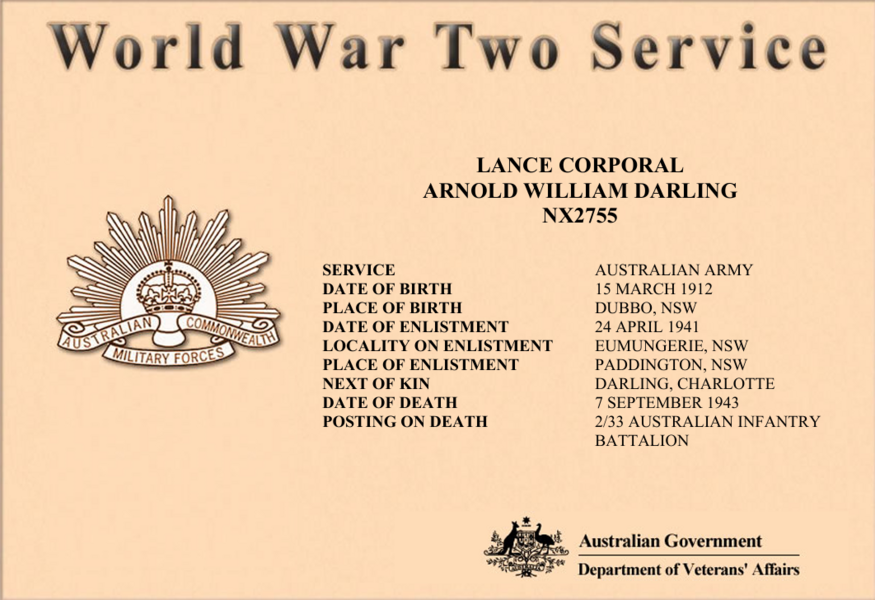
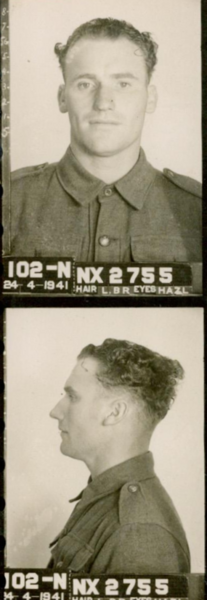
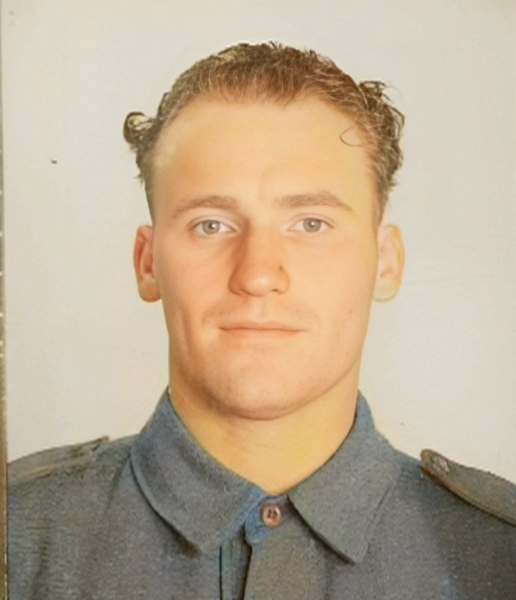
DARLING, Arnold William
| Service Number: | NX2755 |
|---|---|
| Enlisted: | 25 June 1940, Caulfield, Victoria |
| Last Rank: | Lance Corporal |
| Last Unit: | 2nd/33rd Infantry Battalion |
| Born: | Dubbo, New South Wales, Australia, 15 March 1912 |
| Home Town: | Eumungerie, Dubbo Municipality, New South Wales |
| Schooling: | Not yet discovered |
| Occupation: | Share Farmer |
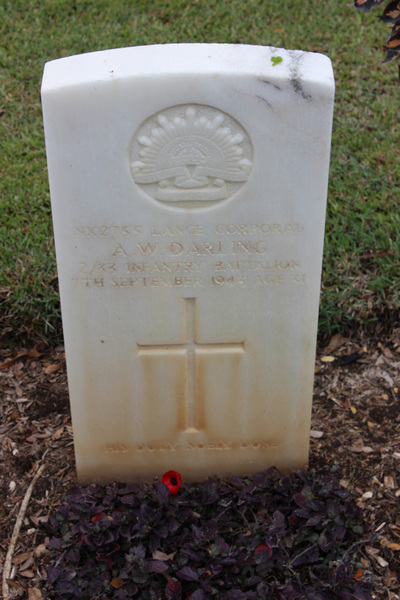
| Died: | Accidental, New Guinea, 7 September 1943, aged 31 years |
| Cemetery: |
Port Moresby (Bomana) War Cemetery, Papua New Guinea CWGC Grave No: Section C. Plot 1. Row E. Grave 6. Inscription: "HIS DUTY NOBLY DONE". |
| Memorials: | Australian War Memorial Roll of Honour, Dubbo Memorial Drive & Rose Garden, Eumungerie - Coboco RSL Memorial, Eumungerie Mogriguy Soldiers WW2 Roll of Honour |
World War 2 Service
| 25 Jun 1940: | Enlisted Private, NX2755, Caulfield, Victoria | |
|---|---|---|
| 24 Apr 1941: | Enlisted Australian Military Forces (WW2) , Lance Corporal, NX2755, 2nd/33rd Infantry Battalion | |
| 7 Sep 1943: | Involvement Lance Corporal, NX2755, 2nd/33rd Infantry Battalion |
Tragedy strikes 2nd/33rd Battalion in Townsville while awaiting troop lift flight to Nadzab
The 2nd/33rd returned to Port Moresby in late July in preparation for the operations capture Lae, in New Guinea. On 7 September, while it waited near Jackson's Airfield at '7Mile' near Moresby to be flown to Nadzab, via Tsili Tsili, a fully fuelled and 'bombed up' US B-24 Liberator bomber crashed on take off among the trucks carrying the battalion. Sixty men, mainly from D Company, were killed and 92 injured. This represented a third of the battalion's fatal casualties for the entire war.
The remnants of the battalion were flown to Nadzab on 8 September and subsequently participated in the advance on Lae, which fell on 16 September.
Submitted 7 September 2017 by Steve Larkins
Biography contributed by Stephen Bonald
On Tuesday, September 7th, 1943, at Jackson Field in Port Moresby, New Guinea, a B-24D Liberator bomber from the 403rd Bomber Squadron, 43rd Bombing Group USAAF, crashed during take-off, likely due to pilot disorientation in the dark. The aircraft hit trees and slammed into a convoy of trucks carrying over 130 soldiers from D Company, 2/33 Infantry Battalion of the Australian Army, who were waiting to board C-47 transport planes to move to the front lines. The bomber’s 500-pound bombs and 2,800 gallons of fuel exploded, killing 15 Australian soldiers and severely injuring 47 more, who later died. Another 90 soldiers were wounded but survived, and all 11 crew members aboard the bomber were killed. Lance Corporal Arnold William Darling was one of these 15 soldier killed at the crash site.

Click images to start slideshow.