








JOHNSTON, Arthur Maxwell
| Service Number: | 404784 |
|---|---|
| Enlisted: | 8 November 1940 |
| Last Rank: | Flight Sergeant |
| Last Unit: | Not yet discovered |
| Born: | Mt. Molloy, Queensland, Australia, 9 March 1915 |
| Home Town: | Mount Molloy, Tablelands, Queensland |
| Schooling: | Cairns Technical College, Cairns, Queensland, Australia |
| Occupation: | Sawmill Manager |
| Died: | Flying Battle, Germany, 3 July 1942, aged 27 years |
| Cemetery: |
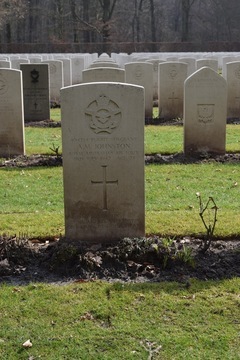
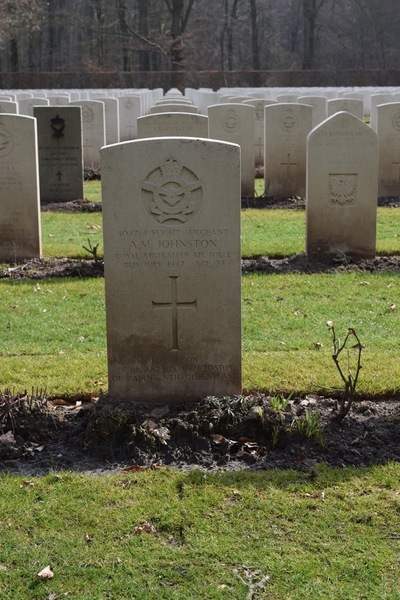
Reichswald Forest War Cemetery, Germany Plot 15. Row B. Collective Grave 9-18. |
| Memorials: | Australian War Memorial Roll of Honour, International Bomber Command Centre Memorial |
World War 2 Service
| 3 Sep 1939: | Involvement Flight Sergeant, 404784 | |
|---|---|---|
| 8 Nov 1940: | Enlisted Royal Australian Air Force, Flight Sergeant, 404784 |
Arthur Maxwell Johnston Story
Arthur “Maxwell” Johnston, known as Max, was born on 9 March 1915 at Mareeba Hospital, Mount Molloy, Queensland, to J.M. Johnston and Annie Jane Johnston. He was one of five children: Harry, Lily, Arthur Maxwell, Olga, and George Rex (“Rex”). The Johnston family were prominent in the Mount Molloy district through their pioneering efforts and sawmilling enterprise. J.M. Johnston’s contribution to the region is acknowledged at the Mount Molloy Historical Site and commemorated by a plaque at the Stratford Library grounds.
Max had a very privileged upbringing receiving quality education (Cairns High) and recognised for his athletic ability, excelling in rugby league, cricket, and sailing. It is sailing particularly of these sports where Max shined as he could build his own sailboat using the family’s timber mill and access to the best resources.
Although he worked in the family sawmill, his ambition was always of greater sacrifice and selfless service. Despite his mother’s wish that her sons remain in reserved occupations within the timber industry, Max enlisted in the Royal Australian Air Force on 8 November 1940 in Brisbane. It should be noted that Max did not have to enlist as Timber Industry Employees had dispensation from enlisting.
After training in Canada, where he qualified as a pilot on Lancaster bombers, Flight Sergeant Arthur Maxwell Johnston was deployed to England in No. 460 Squadron, Royal Australian Air Force. The squadron, operating initially with Wellington bombers, became one of the most active in Bomber Command, flying the greatest number of missions and dropping the heaviest bomb tonnage of any Australian squadron, while also sustaining the highest losses. During this period, Bomber Command policy was altered in response to the heavy casualties sustained, extending the number of operational flights required for leave from 25 to 30 missions.
Max regularly wrote to his family, often describing the significant losses suffered by his squadron. In one of his final letters (note this was received after his passing), he advised that he had completed his required 30 missions and had been granted leave, Max was however asked to undertake one additional flight. In that same letter, he expressed concern that his squadron was being decimated and acknowledged the possibility that he might not survive, noting that this could be his last communication home. Max, unfortunately accepted his 31st mission and never returned home.
On that tragic mission dated 3 July 1942, Max’s Wellington bomber was shot down over Germany. Whilst, members of the crew managed to parachute to safety, he attempted to keep control of the aircraft, believing that his rear gunner remained trapped on board. Max did not jump from the plane as his crew had and was unable to land the hit bomber.
The Johnston family received a telegram that Max was missing in action, later confirmed as dead. His service and sacrifice remain a testament to the commitment and courage of Australians who served in Bomber Command, and his memory is preserved by his family, his name at the Australian War Memorial and crash site of the Wellington.
Max was a true war hero who in the moment of adversity put others above himself.
Lest We Forget.
Submitted 29 September 2025 by Brandon Lawton
Biography contributed by David Barlow
Wellington Z1381 of 460SQN was shot down 3 July 1942 at Kressendorf (Lingen), Germany with 3 crewmen killed - Sergeant Darryl Downing 407709 RAAF / Flight Sergeant Arthur Maxwell Johnston 404784 RAAF / Sergeant William James Taylor 407775 RAAF
Survivors were Sergeant David August Radke 405139 RAAF POW - discharged 1945 / Sergeant William Gerald Reed DCM 402479 RAAF POW - discharged 1946
Sergeant Maxwell Joseph Andrew Wyllie 405001 RAAF was killed in an escape attempt in April 1943

Click images to start slideshow.