








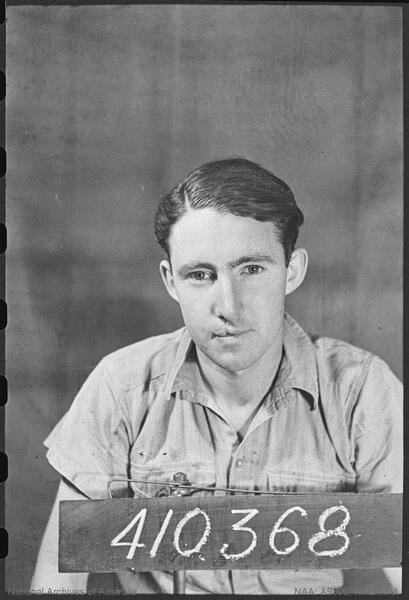
NASH, James Alexander
| Service Number: | 410368 |
|---|---|
| Enlisted: | 6 December 1941 |
| Last Rank: | Pilot Officer |
| Last Unit: | No. 6 Squadron (RAAF) |
| Born: | Carlton Victoria Australia , 10 January 1923 |
| Home Town: | Auburn, Boroondara, Victoria |
| Schooling: | Not yet discovered |
| Occupation: | Cutter |
| Died: | Flying Battle, New Britain Pacific Islands, New Britain, Pacific Islands, 28 March 1944, aged 21 years |
| Cemetery: |
No known grave - "Known Unto God" Rabaul Memorial Rabaul Papua New Guinea - Panel 35, Rabaul Memorial, Rabaul, East New Britain, Papua New Guinea |
| Memorials: | Australian War Memorial Roll of Honour, Rabaul Memorial |
World War 2 Service
| 3 Sep 1939: | Involvement Pilot Officer, 410368 | |
|---|---|---|
| 6 Dec 1941: | Enlisted Royal Australian Air Force, Aircraftman 2 (WW2), 410368, No. 1 Initial Training School Somers | |
| 6 Dec 1941: | Enlisted Royal Australian Air Force, Pilot Officer, 410368 | |
| 17 Sep 1942: | Promoted Royal Australian Air Force, Sergeant | |
| 18 Dec 1942: | Involvement Royal Australian Air Force, Sergeant, 410368, No. 14 Squadron (RAAF), Air War SW Pacific 1941-45 | |
| 1 May 1943: | Promoted Royal Australian Air Force, Flight Sergeant | |
| 25 Sep 1943: | Involvement Royal Australian Air Force, Flight Sergeant, 410368, No. 6 Squadron (RAAF), Air War SW Pacific 1941-45 | |
| 29 Feb 1944: | Honoured Distinguished Flying Medal, Air War SW Pacific 1941-45 | |
| 1 Mar 1944: | Promoted Royal Australian Air Force, Pilot Officer |
Help us honour James Alexander Nash's service by contributing information, stories, and images so that they can be preserved for future generations.
Add my storyBiography contributed by Graham Padget
ROYAL AUSTRALIAN AIR FORCE
HONOURS AND AWARDS.
DISTINGUISHED FLYING MEDAL
NO. 410368. FLIGHT SERGEANT JAMES ALEXANDER NASH
CITATION.
Flight Sergeant NASH has served as a wireless operator airgunner in operations for more than twelve months and has completed 573 operational hours including 116 sorties and 14 strikes. He has at all times shown outstanding skill, courage and devotion to duty.
While on patrol early in January the Beaufort aircraft of which he was a member of the crew developed engine trouble. Immediately he became aware of this fact, on his own initiative he got in contact with his base by R/T and with great coolness for the next nine minutes he maintained control until the aircraft made an emergency landing in the sea. He continued to pass position reports and only left his post and joined the rest of the crew when the water reached his W/T set. As the aircraft sank quickly and the dinghy did not function, it was undoubtedly due to his coolness and efficiency in giving an accurate position that the air sea rescue organisation was able to find and rescue the five members of the crew who were swimming in the sea.
Transcribed un-edited from the Citation document in the Service Record of Pilot Officer James Alexander Nash.
Biography contributed by Rod Hutchings
A Hawthorn premiership player and a DFM recipient. He packed a lot of life into 21 years.
A mother stands on the manicured lawn of Government House in Melbourne.
The Governor-General holds out a small, silver medal. Myra Nash is grieving.
The medal is the Distinguished Flying Medal, and the son who should be wearing it is not there . He is James Alexander Nash, known to his family and the Auburn community as Alex.
Before the war, Alex was a nineteen-year-old cutter and process worker in the industrial heart of Melbourne . He was small in stature—standing 5 feet 5 inches and weighing just 135 pounds—but he possessed the agility that defined a local footballing dynasty. His father, Stanley, was a committeeman for the Hawthorn Football Club, and the family lived in the shadow of Glenferrie Oval.
In 1941, Alex was a half-back flanker for the Hawthorn Colts . He was a premiership player in a side that offered a rare glimmer of success for the "Mayblooms". On 06/12/1941, just twenty-four hours before the attack on Pearl Harbor, he left the football field for the recruiting centre.
He trained as a Wireless Operator and Air Gunner (WAG), a role that demanded technical precision inside the cramped, humid hull of a Bristol Beaufort. He returned home once more on leave in August 1942 to play a single senior game against Collingwood at Victoria Park, wearing jersey number 20 . It was his only senior appearance.
His war was defined by nine minutes in the Solomon Sea on 17/01/1944. When his aircraft, "Old Faithful," suffered engine failure and ditched into the water, Alex did not scramble for the exit . He remained at his radio set as the sea flooded the fuselage. On his own initiative, he transmitted accurate position reports until the water reached his equipment. His cool efficiency allowed a Catalina rescue flight to find the five-man crew four hours later.
Alex was commissioned as a Pilot Officer shortly after. On 28/03/1944, during a strafing raid against Japanese positions at Jacquinot Bay, his Beaufort was seen to bank into a steep turn after being hit by anti-aircraft fire. It crashed into the sea in poor light and failing weather.
Alex was never found. He was one of ten Hawthorn senior players killed during the war. Decades later, in 1987, his brother B.R. Nash was still writing to the Air Force to ensure their elderly mother had the full set of Alex’s service medals . Today, his name is inscribed on the Rabaul (Bita Paka) Memorial.
Rod Hutchings
Director, Virtual War Memorial Australia


Click images to start slideshow.