








PARTON, Horace Arnold
| Service Numbers: | 3980, 10706 |
|---|---|
| Enlisted: | 7 July 1915 |
| Last Rank: | Warrant Officer |
| Last Unit: | 1st Australian Convalescent Depot (AIF) |
| Born: | Richmond, Victoria, Australia, 14 September 1892 |
| Home Town: | South Yarra, Melbourne, Victoria |
| Schooling: | Not yet discovered |
| Occupation: | Accountant |
| Died: | Illness, Melbourne, Victoria, Australia , 29 December 1943, aged 51 years |
| Cemetery: |
Springvale War Cemetery, Melbourne, Victoria |
| Memorials: | Australian War Memorial Roll of Honour |
World War 1 Service
| 7 Jul 1915: | Enlisted AIF WW1, Private, 3980, 5th Infantry Battalion | |
|---|---|---|
| 23 Nov 1915: | Involvement Private, 3980, 5th Infantry Battalion, --- :embarkation_roll: roll_number: '8' embarkation_place: Melbourne embarkation_ship: HMAT Ceramic embarkation_ship_number: A40 public_note: '' | |
| 23 Nov 1915: | Embarked Private, 3980, 5th Infantry Battalion, HMAT Ceramic, Melbourne | |
| 6 Mar 1917: | Promoted AIF WW1, Lance Corporal, 5th Infantry Battalion | |
| 26 Aug 1918: | Wounded AIF WW1, Lance Corporal, 3980, 5th Infantry Battalion, "The Last Hundred Days", Gassed | |
| 20 Aug 1919: | Discharged AIF WW1, Lance Corporal, 3980, 1st Australian Convalescent Depot (AIF), 3rd MD - gassed |
World War 2 Service
| 3 Sep 1939: | Involvement Warrant Officer, 10706 | |
|---|---|---|
| 27 Jun 1940: | Involvement Royal Australian Air Force, Warrant Officer, 10706 | |
| 27 Jun 1940: | Enlisted Royal Australian Air Force, Warrant Officer, 10706 | |
| Date unknown: | Discharged Royal Australian Air Force, Warrant Officer, 10706 |
Help us honour Horace Arnold Parton's service by contributing information, stories, and images so that they can be preserved for future generations.
Add my storyBiography contributed by Evan Evans
How We Served shared a post.
The final resting place for; - 3980 and 10706 Warrant Officer Horace Arnold Parton of Richmond and Bentleigh, Victoria had been employed as an accountant when he enlisted for War Service on the 7th of July 1915, and was allocated to reinforcements for the 5th Battalion 1st AIF.
Horace was embarked for Egypt and further training, departing Australia on the 23rd of November, and having been taken on strength with his Battalion, was embarked for France where he arrived on the 30th of March 1916.
Serving as a Signaller, Horace’s service in the trenches, aside a short bout of sickness, would be continuous until he was granted Leave to England on the 20th of February 1918. Having returned to his Unit in the field, Horace was evacuated sick suffering from influenza on the 8tn of June, and following hospitalisation and then convalescence, he returned was returned to the trenches on the 27th of June.
On the of 26th of August, Horace was evacuated wounded suffering from gas, and again hospitalised, he was sent to the 2nd Australian Convalescent Depot at Havre, where he was retained until the end of the War.
Horace was sent back to England on the 22nd of February 1919, from where he would begin his repatriation back to Australia on the 30th of March. Arriving back in Australia on the 12th of May, Horace received his official discharge from the 1st AIF for his re-entry into civilian life on the 20th of August 1919.
With the start of a second World War, Horace, now employed as a clerk, presented himself for service with the Royal Australian Air Force on the 27th of June 1940, and after being accepted he was mustered as a clerk with RAAF Headquarters Melbourne.
Horace’s service would be uninterrupted, until he was evacuated due to illness to the 6th Royal Australian Air Force Hospital on the 9th of November 1943. Horace was still in hospital when he succumbed to cerebral thromboses on the 29th of December 1943. Horace was aged 52 at the time of his death.
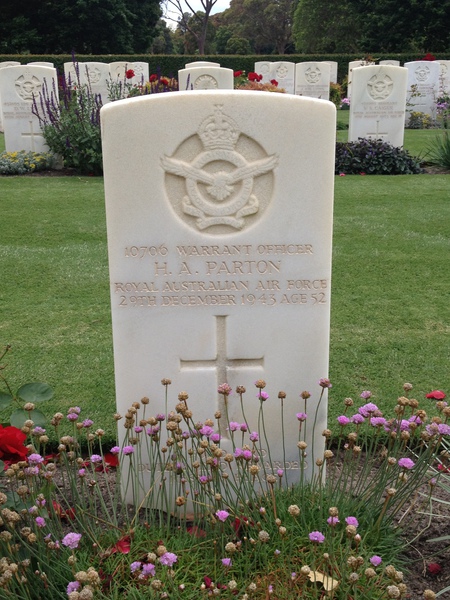
Following his passing, whilst in the service of the RAAF, Warrant Officer Horace Parton, a veteran of two world wars, was formally laid to rest within Springvale War Cemetery, Victoria.
Biography contributed
Accountant, soldier, mate: the quiet service of Horace Arnold Parton
In an age that often celebrated rank and decoration, Horace Arnold Parton represented something rarer and more enduring. He was an ordinary Australian who answered his country’s call twice, not for glory, but because he believed it was his duty.
Born in Richmond in September 1892, Horace grew up in industrial Melbourne, the son of George and Euphemia Parton. He trained as an accountant, a profession that suited his careful, methodical nature. Numbers were his trade, precision his habit. Yet when war came in 1915, he put down his pen and stepped into line with thousands of others.
On 7 July 1915, Horace Arnold Parton enlisted in the Australian Imperial Force. He was allocated service number 3980 and posted to the 5th Battalion. Standing beside him that day was another recruit, William Pinkerton, service number 3981. The two men would remain bound by friendship for the next 28 years.
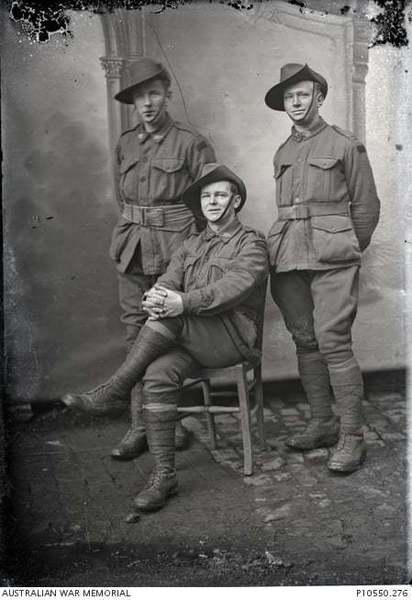
Parton served on the Western Front as an infantry signaller, a role that demanded courage as well as skill. Laying and repairing telephone cables under fire was dangerous work. Communications meant command, and command meant survival. He saw his first major action at Pozières in July 1916, one of the most brutal battles endured by Australian troops in France. In January 1917, he was photographed at Vignacourt, a quiet moment captured amid the grinding routine of war.
In August 1918, near the end of the conflict, Horace was gassed in action. Like many survivors, he carried the effects of that wound for the rest of his life. He was discharged in August 1919 and returned to civilian work, resuming his career as an accountant.
The interwar years were marked by family and loss. Horace married Elsie and the couple settled at 6 Holland Grove, Caulfield. They raised four sons, Rodney, Barry, Anthony and Trevor. Anthony died young, a grief that Horace bore quietly, as he bore most things. His sister Vera remained part of his close family circle.
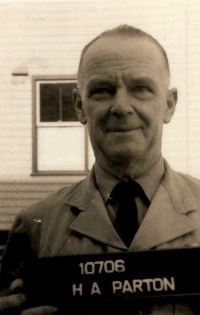
When war came again in 1940, Horace was 47 years old. Many men of his age had already given all they could. Horace volunteered once more, this time for the Royal Australian Air Force. Mustered as a clerk with the rank of Warrant Officer, service number 10706, he became one of the “retreads”, First World War veterans who returned to uniform to release younger men for combat.
His second war was fought behind desks rather than parapets. Stationed at RAAF Headquarters in Melbourne, Horace worked in administration, logistics and personnel management. These were unglamorous tasks, but they were essential, particularly during 1942 when the threat of Japanese invasion loomed large. Colleagues remembered him as steady and fatherly, a man whose calm presence reassured those around him. He had seen panic before and knew how to hold it at bay.
Those who knew him best called him “Hap”. The nickname came from his initials, Horace Arnold Parton, but it also hinted at a quietly cheerful disposition. It suggested resilience and an understated humour, the sort that helped men endure the trenches and the long aftermath of war.
No one understood Hap better than his closest friend, William Pinkerton. Pinkerton had served beside him in the 5th Battalion and later won the Military Medal. Yet when Horace died in December 1943 at Heidelberg, it was not medals that Pinkerton remembered. He placed a notice in the paper that read simply, “In memory of a true pal. One of the best.”
Those words tell us more than any service record. They speak of loyalty, shared hardship and trust. They tell us that Horace Arnold Parton was a man others depended upon, in war and in peace.
He died on 29 December 1943, still in uniform, his heart finally giving out after years of strain and service. He was survived by his wife Elsie and his sons. He left no monuments and sought no recognition.
In preserving his story, we preserve something essential about Australia’s wartime generation. Horace Arnold Parton was not famous. He was faithful. An accountant and a soldier, a family man and a veteran, a true pal. In the words of the man who knew him best, he was “one of the best.”
Lest we forget
Rod Hutchings
Australian Peacekeeper and Peacemaker Veterans’ Association Ltd




Click images to start slideshow.