








FISHER, Benjamin
| Service Number: | 335 |
|---|---|
| Enlisted: | Not yet discovered |
| Last Rank: | Private |
| Last Unit: | 6th Western Australian Mounted Infantry |
| Born: | Murrumburrah, New South Wales, Australia, 19 August 1880 |
| Home Town: | Rockingham, Rockingham, Western Australia |
| Schooling: | Not yet discovered |
| Occupation: | Labourer |
| Died: | Killed in Action, Brakpan, Mpumalanga, South Africa, 15 May 1901, aged 20 years |
| Cemetery: |
Old Middelburg Municipal Cemetery, Mpumalanga, South Africa Initially buried in the field, body exhumed sometime during early-mid 20th century and interred at Middelburg Cemetery |
| Memorials: | Australian War Memorial Roll of Honour, Kings Park Western Australia Boer War Memorial |
Boer War Service
| 1 Oct 1899: | Involvement Australian and Colonial Military Forces - Boer War Contingents, Private, 335 | |
|---|---|---|
| 1 Oct 1899: | Involvement Private, 335, 6 Mounted Infantry Contingent | |
| 10 Apr 1901: | Embarked Australian and Colonial Military Forces - Boer War Contingents, Private, 335, 6th Western Australian Mounted Infantry | |
| 15 May 1901: | Discharged Australian and Colonial Military Forces - Boer War Contingents, Private, 335, 6th Western Australian Mounted Infantry, Killed in Action. |
Help us honour Benjamin Fisher's service by contributing information, stories, and images so that they can be preserved for future generations.
Add my storyBiography contributed by Geoffrey Gillon
His brothers, Osborne Fisher and Walter Stanley Fisher fell in WWI, and another brother, William Joseph Fisher-b 1882 also served.
William embarked from Fremantle for active service abroad on 29th January 1917 as part of the Reinforcements and Special Draft to the Railway Unit. He held the rank of 2nd Corporal (Service No. 922) and was a casualty of poisonous gas on a number of occasions resulting in the eventual loss of a lung. The only son to survive the war, he returned home to Australia in 1919 and was discharged medically unfit.
William died aged 72 years. His wife was Frances Ellen [Rudler] Fisher
They were sons of William and Elizabeth Fisher of Western Australia.
Biography contributed by Kel Fisher
Benjamin Fisher (19 August 1880 – 15 May 1901) was a New South Wales-born labourer who became the first member of his family to die in military service, falling in action just weeks after arriving in South Africa during the Boer War.
Early Life and Migration
Benjamin was born in Murrumburrah, New South Wales, the third son of William Fisher and Elizabeth Warwick. In 1896, at the age of 15, he migrated to Western Australia with his father to escape the economic depression in the eastern states. They settled in Rockingham, where Benjamin worked as a labourer for Millar’s Karri and Jarrah Timber Company.
In the small community of Rockingham, Benjamin was highly active; he and two friends were instrumental in encouraging the construction of the local hall. He was a talented musician who played the accordion and tin whistle for local social gatherings. He was also a member of the Church of England Temperance Society, having signed an "Abstaining Declaration" in 1895.
Military Enlistment and Training
In January 1901, at the age of 20, Benjamin volunteered for service in the Sixth Western Australian Mounted Infantry (W.A.M.I.). He was assigned the service number 335 and the rank of Private.
He underwent rigorous training at Karrakatta Camp, where recruits were tested for their ability to "ride and shoot" to meet the demands of guerrilla warfare in the Transvaal. His letters home described the strict military routine, including the difficulty of hand-pumping thousands of gallons of water daily and the five-second "shower bath" regulations. Despite the discipline, Benjamin wrote to his mother that he was "as happy as a kid with a new toy" to be serving.
The Voyage and Arrival in Africa
Benjamin embarked from Fremantle on 10 April 1901 aboard the troopship Ulstermore. During the 19-day voyage across the Indian Ocean, he wrote of seeing whales and albatrosses, though he also recorded the grim reality of the trip, noting the deaths of one horse and two men at sea.
The Ulstermore arrived in Durban, Natal, on 29 April 1901. Benjamin and his unit entrained for the interior, reaching Middelburg by early May, where they joined Major-General Walter Kitchener's Column. Benjamin was struck by the "jolly hilly" country and the novelty of his surroundings, concluding his final letter with "best love from Ben" only days before his death.
War Service and Death at Brakpan
Benjamin’s combat service lasted only one week. On 15 May 1901 (though some military dispatches suggest the action occurred on the 16th), his unit was ordered to clear Boer farmhouses and destroy supplies at Brakpan (also known as Grobelaar Recht).
The engagement unfolded as follows:
The Ambush: After clearing a farm, the unit reached a "spruit" (stream) where they were ambushed by a Boer force of approximately 200 to 400 men hidden in the scrub and farm buildings.
The Action: Benjamin was part of the division holding the right flank under Lieutenant Frederick Bell. After heavy firing, the right flank was "driven in," forcing a tactical retirement.
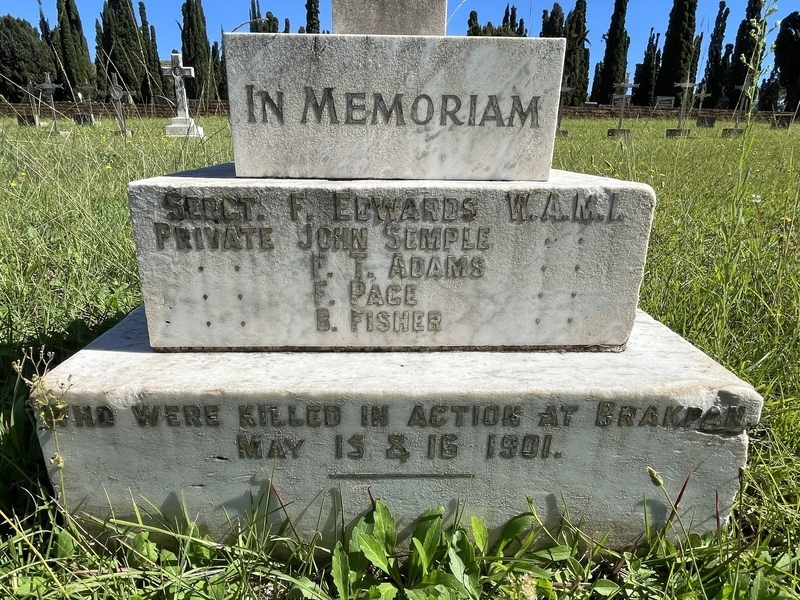
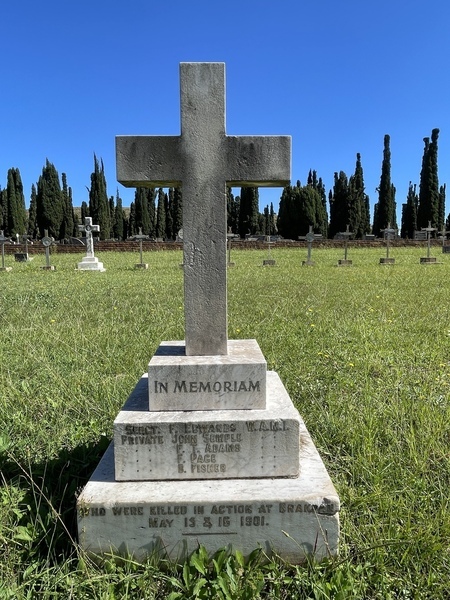
Fatality: During this retreat, Benjamin was wounded in the chest and killed in action. He was one of five men from the 6th W.A.M.I. killed that day.
Proximity to Heroism: His death occurred in the same immediate area where Lieutenant Bell performed the rescue of a dismounted man under fire that resulted in Bell receiving the Victoria Cross.
Burial and Memorials
Benjamin was buried the following morning with full military honours, and a wooden cross was erected over the graves of the fallen with their names inscribed. He is interred in the Middelburg Old Municipal Cemetery in Mpumalanga, South Africa.
His family in Rockingham preserved his memory through several living memorials:
The Date Palm: Benjamin planted date stones outside the family chimney before leaving; they grew into a large palm tree that was later protected by the local Roads Board as a memorial.
Commemorative Trees: Two pine trees were planted in front of the Rockingham hall in his memory, though they were eventually destroyed for local development.
Family Impact: His death was a primary motivator for his brother Joe Fisher to enlist in World War I. His mother, Elizabeth, continued to include Benjamin in memorial notices alongside his brothers Osborne and Stanley (killed in 1916) for decades, stating her love for her "boys" never altered.




Click images to start slideshow.