



ISUA, Carolas
| Other Name: | Isua, Carolus |
|---|---|
| Service Number: | Q85421 |
| Enlisted: | 21 September 1942, Enlisted on Saibai Island aged 20 years. Next of Kin (Father) Isua Nawai, Saibai Is., Torres Strait. |
| Last Rank: | Private |
| Last Unit: | Torres Strait Light Infantry Battalion |
| Born: | Saibai, Torres Strait Island - Queensland, Australia, 16 December 1921 |
| Home Town: | Saibai Island, Torres Strait, Queensland |
| Schooling: | Saibai Island Primary School, Queensland, Australia |
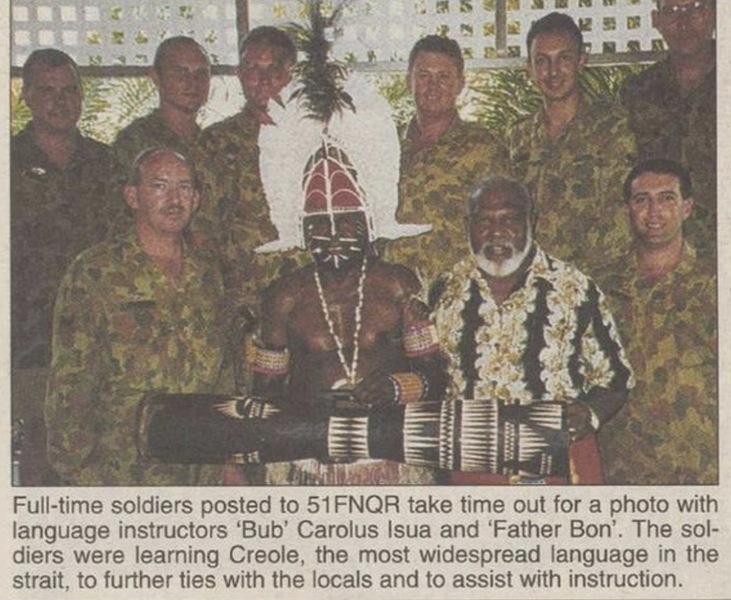
| Occupation: | Torres Strait Cultural Custodian and Dancer, Trochus, Beche‑de‑mer and Pearl Diver, Church Deacon, Honorary Superintendent at Queensland Police Force, Parole and Probation Officer |
| Died: | 1 September 2003, aged 81 years, cause of death not yet discovered, place of death not yet discovered |
| Cemetery: |
Thursday Island Cemetery |
| Memorials: | Thursday Island Torres Strait Light Infantry & RSL Memorial |
World War 2 Service
| 21 Sep 1942: | Enlisted Australian Military Forces (WW2) , Q85421, Enlisted on Saibai Island aged 20 years. Next of Kin (Father) Isua Nawai, Saibai Is., Torres Strait. | |
|---|---|---|
| 17 Jun 1946: | Discharged Australian Military Forces (WW2) , Private, Q85421, Torres Strait Light Infantry Battalion |
Help us honour Carolas Isua's service by contributing information, stories, and images so that they can be preserved for future generations.
Add my storyBiography contributed by Cassie Horsley
CAROLUS ISUA
MY LIFE
"Ngau Igililnga"
by John Singe
Part 1
Published on 13 May 1988
On December 16, 1921 at Mauba village, Carolus Isua was born. He was the seventh of ten children. His mother's name was Bukau and his father Isua Nawia, is also known as "inurau kuthaumabayg", or "the last of the dark age people".
Isua Nawia had a hole through his nose and was a leader among the Saibai koedhal augadalgal (ie. Saibai crocodile god people). It seems inconceivable then that his son Carolus, after only five years schooling and from such truly humble beginnings should have achieved so much.
It is my privilege to be allowed to tell the remarkable story of a remarkable Torres Strait Islander. However this is also the story of change in the Torres Strait and in the lives of all its peoples.
Carolus went to Saibai Primary School and completed grade 5. His teacher was Philli Passi of Murray Island. Passi and his family are held in high regard by Saibai people for they learned to speak Kalaw Kawaw Ya (ie. Top Western Language) as well as their own Eastern Language. Straight out of school, still so young that he wasn't shaving, Carolus worked on the lugger "Menibu" under the Saibai captain Tabuai Zaum. The "Menibu" was working Wapa Reef for bech-de-mer. A station had been established on a sand spit called Kagar at Salbai's eastern tip. The slugs were boiled and smoked here and the crews rested between trips.
Later the "Menibu" moved down to Mabuiag to search for pearlshell. The crew of about a dozen dived for shell using swimming glasses. The shell was brought in to Thursday Island to be sold.
One morning in 1937 north of Mabuiag the divers were alarmed by a thrashing in the water. Carolus surfaced to see Iona Asai, his father's cousin, scramble up the lugger's side streaming blood. The other divers quickly climbed aboard. Iona's injuries were horrific. A shark had taken his head completely within his mouth causing massive cuts around his shoulders and neck. Towels and blankets were used to staunch the flow of blood.
There was no wind so one rowing dinghy was sent to Mabuiag for medicine while the other two dinghies towed the "Menibu" slowly south. Carolus sat beside his injured uncle, comforting him. Fortunately as they neared St. Pauls an easterly wind came up. The "Menibu" sailed into Port Kennedy late at night and anchored near Hospital Point. Iona was rowed ashore where Dr. Meredith stitched him up. It is recorded in medical history that Iona received over 200 stitches but recovered.
A short time later Carolus was working on the Saibai lugger "Saisia" when another attack occurred. The crew was diving for trochus near Sark, on Saibai's southern coast, when Metuselor Mau of Dauan had part of his leg taken by a shark. After treatment at Saibai provided by Mr. Charles Turner, the Government Teacher, Metuselor was taken to Thursday Island by sailing boat.
Following this Carolus signed onto a master boat with a Japanese captain. The Japanese were diving for pearlshell using helmets and full suits. However after Pearl Harbour was attacked the luggers were called into Thursday Island, the Japanese interned and the Islander crews sent home.
A message came to Saibai asking for men to help with Wolfram mining at Moa. Carolus and Keri Waituka decided to go. While working digging wolfram, they stayed with Wees Nawia at Poid Village. One day Carolus went over to Badu for shopping. He was surprised to meet his elder brother Isau accompanied by a white army sergeant. Isau had been adopted to the childless couple Kedau and Ibuai Nawia, and so took the surname Ibuai. Isau had left his lugger at Cairns to enlist in the army. Now he was recruiting other Islanders to serve in the Torres Strait Light Infantry. Carolus signed up on the spot.
Most of the Saibai men ended up in D Company. The company spent most of its time on Thursday Island involved with infantry training and labouring although at times they moved to Goods Island, Jacky Jacky and Horn Island. On June 18, 1943 D Company was camped on Horn Island when the airfield was raided by Japanese bombers for the last time.
Carolus was discharged from the army in 1946. He believes that he benefited greatly from his army experience. Respect, discipline and the sense of purpose of service life were to prove very useful in his later police career. In addition enduring life-long friendships were made. Isau and Carolus befriended Lt. Harry Hooper, a friendship renewed years later when Hooper returned to Thursday Island as Shire Clerk.
For a number of years following the war Carolus helped his ageing parents at Saibai, walking kilometres from the village to their gardens near Kiwan, returning heavily laden in the dusk, assisting his father in his duties as bellman at the church of the Holy Trinity at Saibai.
From 1952 till 1959 came another stint on the master boats. He worked as a diver on the Hocking lugger "Candia" under a Saibai captain Jeremiah Babia.
Then on June 15, 1962 Carolus was appointed a policeman at Saibai. At the age of forty this new career provided him with the opportunity for service and advancement.
Part 2
Published on 20 May 1988
Carolus had been appointed a policeman at Saibai in 1962. On June 7, 1963, he was transferred to Thursday Island. The following year he moved into the house at 35 Pilot Street Tamwoy, where he lives to this day, and sent for his wife and children to join him at Thursday Island.
Carolus had married Keru Waigana on February 5, 1950 in a joint ceremony in which his brother Isau married Gaithie Warusam. Carolus had three sons and two daughters, but two of the boys had died while young and were buried at Saibai.
Much of Carolus's early work with the island police involved visits to Aboriginal reserves on Cape York Peninsula. He travelled on the "Gelam" to Mapoon and on the lugger "Stephen Davies" to Edward River, Mitchell River, Weipa and Aurukun.
Queen Elizabeth came to Australia in 1970 to help celebrate the bicentenary of Cook's arrival. Carolus, Kala Waia and Odis Gibuma organised a dance team to perform at Cooktown for the Queen. Forty picked dancers trained at Bamaga for three weeks before travelling south on the old "Melbidir". Their performance was highly acclaimed and publicized throughout Australia.
In these activities are seen the beginnings of what were to become Carolus's twin goals. Firstly the development of professionalism among islander policemen both individually and as a group. Secondly pride in Torres Strait culture and tradition and the energetic promotion of that culture far and wide.
Carolus was promoted to sergeant grade 3 in 1978 and the following year went to Cherbourg in southern Queensland for further training. Promotion to sergeant 1st class came quickly and Carolus was placed in charge of all 36 islander policemen scattered across 14 islands.
At that time islander policemen wore rather drab khaki uniforms with slouch hats. Carolus lobbied consistently for more suitable dress. Eventually islander police changed to the same smart blue uniform as the Queensland Police, the only difference being the Torres Strait Island Police shoulder badge which, characteristically, Carolus had designed himself. The badge is brightly coloured featuring a khoeri (headress), drum, bow and arrow, canoe, trochus and pearlshell and coconut and almond trees.
Carolus toured the islands urging closer cooperation with state police and arranging training for the younger policemen. Officers of the Queensland Police, in particular Sergeant Banham at Thursday Island, offered support and training programs for islander police commenced. Topics dealt with included routine police matters (eg. coroner's certificate, bench charge sheet) and hypothetical problem situations. Policemen from outer islands were rotated through Thursday Island to attend training sessions and experience co-operation with state police. Joint patrols consisting of state and islander policement began. On April 27, 1984, sixteen Torres Strait Island Police, who had completed training, took the "oath of allegiance" before a magistrate at the Thursday Island Court House.
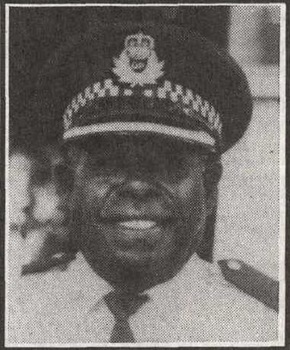
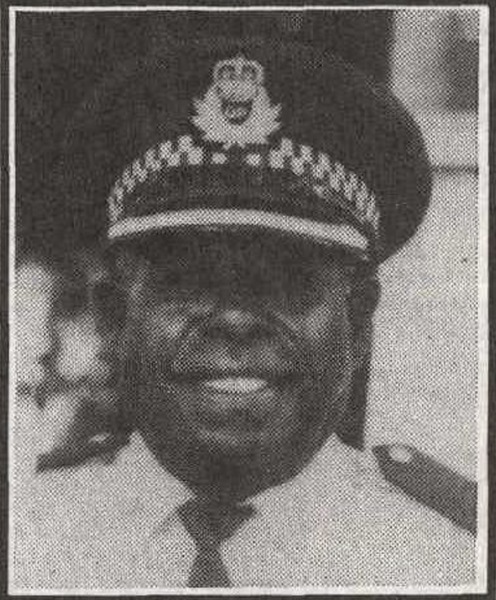
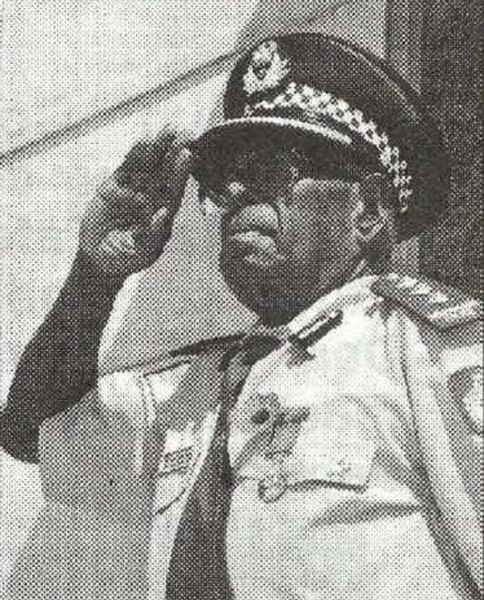
Recognition for Carolus's work was soon forthcoming. He received a Certificate of Appreciation from the Queensland Commissioner of Police on April 25, 1983 and on September 16, 1983 was presented with the Order of Australia Medal at Government House Brisbane. Later Carolus was promoted to Honorary Inspector of Torres Strait Island Police, the only person ever appointed to this position and received another award from the Commissioner of Police¹.
However running parallel with Carolus's police service was his role as a traditional leader. In 1986 Carolus and Dana Ober organised and led the Saibai dancing team which performed for the Pope in Alice Springs. In the same year the Saibai/Dauan community rejoiced at the consecration of Bishop Kiwami Dai, the first Torres Strait Islander bishop. The procession to the Cathedral on July 1, 1986 led by a host of Islanders in traditional dress, was a magnificent sight. The cope, mitre and vestments used by Bishop Kiwami were provided by the Saibai community. They feature traditional motifs such as a dhoeri, drum and almond and coconut leaves. A letter to Carolus from John Grimrod Archbishop of Brisbane probably sums up Carolus's role best of all:
"Thank you very much indeed for your leadership in all the ceremonies for the presentation of Bishop Kiwami Dai. Everything was done with great sensitivity and grace. Your skill and dedication was fundamental to it all."
Dancing teams supervised by Carolus have performed at the Cape York Wilderness Lodge and Kewarra Beach Resort north of Cairns. The Kewarra Resort dining room displays a large, fully-rigged Saibai sailing canoe constructed by Carolus.
In December last year came the tombstone opening at Saibai of his brother Isau. It is difficult I think for Europeans to understand the signifigance of a tombstone opening to Islanders. Whilst intensely personal, it is also an occassion to celebrate islander identity and reaffirm islander tradition. Carolus and Mugai Elu of Seisia (Bamaga) are now the leaders of the Saibai koedhal augadalgai (Saibai crocodile god people). For the tombstone opening Carolus invited the crocodile people of Kibul Village which is located far up the Pahoturi River in Papua New Guinea.
Among the Saibai koedhal dancers at the tombstone ceremony were seven of Carolus's eleven grandchildren. The Saibai dancers were joined by the Kibul people who made a ceremonial presentation of a crocodile carved from wood. It was a moment never to be forgotten.
Carolus retired on December 16, 1986 but is as busy as ever. He continues his work as a parole and probation officer (he was appointed in 1984). He still provides advice and assistance to the islander police. He is serving on the Bicentennial Authority's Queensland Aboriginal and Torres Strait Islander Committee. Also he is preparing his koranga (big eagle) dancing team to perform at Expo in Brisbane next month². In his spare time he makes traditional artifacts. I wish him a long and rewarding retirement.
---
Carolus Isua OAM passed away in 2003.
"Carolus' long and illustrious life was full of achievements. He was a respectful leader who was hardworking yet humble of his accomplishments; he was giving and forgiving; and encouraged unity, equity and inclusiveness. He had a huge heart full of love and touched many people in many different ways and will continue to do so in the future."
Obituary – Long and illustrious life full of achievement (trove.nla.gov.au)
¹Carolus continued to assist Queensland Police on cultural issues and the needs of the broader Torres Strait Community. In July 2003, he received recognition for this contribution and was bestowed the title of Honorary Superintendent.
²The Koranga Dancing Group returned from the 1988 World Expo proud of their efforts to place Torres Strait culture before the eyes of the world.
Sources:
Part 1 "My Life" (trove.nla.gov.au) (1988, May 13) Torres News p.12
Part 2 "My Life" (trove.nla.gov.au) (1988, May 20) Torres News p.25
Dance Trip to Expo (trove.nla.gov.au) (1988, July 15) Torres News p.21
Click images to start slideshow.