








S1071
BRIGHT, Harold John William
| Service Number: | 19 |
|---|---|
| Enlisted: | Not yet discovered |
| Last Rank: | Corporal |
| Last Unit: | 5th Infantry Battalion |
| Born: | County Offaly, Ireland , 14 March 1882 |
| Home Town: | Not yet discovered |
| Schooling: | Not yet discovered |
| Occupation: | Soldier |
| Died: | Adelaide, South Australia, 9 December 1949, aged 67 years, cause of death not yet discovered |
| Cemetery: |
West Terrace Cemetery (AIF Section) Section: KO, Road: 15, Site No: 34 |
| Memorials: |
World War 1 Service
| 21 Oct 1914: | Involvement Corporal, 19, 5th Infantry Battalion, --- :embarkation_roll: roll_number: '8' embarkation_place: Melbourne embarkation_ship: HMAT Orvieto embarkation_ship_number: A3 public_note: '' | |
|---|---|---|
| 21 Oct 1914: | Embarked Corporal, 19, 5th Infantry Battalion, HMAT Orvieto, Melbourne | |
| 11 Nov 1918: | Involvement 19 |
Help us honour Harold John William Bright's service by contributing information, stories, and images so that they can be preserved for future generations.
Add my storyBiography contributed by Trevor Pyatt
Sergeant Harold John William Bright
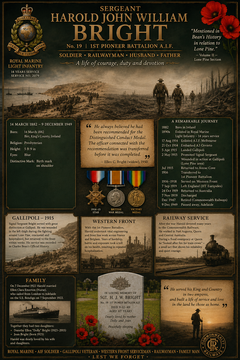
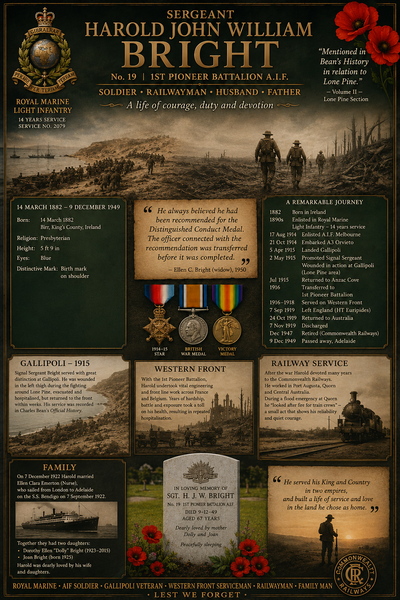
Sergeant Harold John William Bright was born on 14 March 1882 at Birr, King’s County, Ireland (now County Offaly), during the height of the Victorian era and the British Empire. His life would become one of remarkable military service, endurance, migration, and reinvention — spanning the Royal Marines, Gallipoli, the Western Front, Commonwealth Railways, and eventually family life in South Australia.
Harold was the son of Arthur John William Bright and was raised in Ireland before embarking upon a military career at a young age. Long before the outbreak of the First World War, he enlisted in the:
Royal Marine Light Infantry
where he served for fourteen years.
This extensive pre-war military experience distinguished Harold from many later AIF volunteers. His Royal Marines service record confirms:
date of birth: 14 March 1882,
birthplace: Birr, King’s County, Ireland,
service number: 2079,
blue eyes,
and a birthmark on his shoulder.
By 1914 Harold was living in Australia at:
40 Boundary Street, South Melbourne, Victoria
and working as a:
Sailmaker
Despite already completing long Imperial military service, Harold again volunteered shortly after the outbreak of war.
First World War Service
Harold enlisted in the Australian Imperial Force on:
17 August 1914
Melbourne, Victoria
He joined:
5th Battalion, E Company
with regimental number:
19
His enlistment papers describe him as:
5 feet 9 inches tall,
189 pounds,
Presbyterian,
with previous Royal Marine service.
Harold embarked from Melbourne aboard: Transport A3 Orvieto on 21 October 1914 as part of the First AIF convoy.
Gallipoli Campaign
After training in Egypt, Harold embarked for Gallipoli on 5 April 1915.
During the campaign he served as a signals NCO and was promoted:
Signal Sergeant — 2 May 1915
Only days later he was wounded during the fighting around Lone Pine and Gallipoli operations. His records state he suffered:
a wound to the left thigh / leg
He was evacuated through:
hospital ships,
Cairo hospitals,
and convalescent depots in Egypt.
Remarkably, after recovery Harold returned to frontline service at Anzac Cove in July 1915.
The Gallipoli service records reveal the enormous physical toll of the campaign. Later in 1915 Harold again entered hospital suffering from:
periostitis
while serving around Lemnos and Mudros.
Mentioned in Bean’s Official History
One of the most extraordinary discoveries within Harold’s file is official correspondence noting he was:
“mentioned in Bean’s history in relation to Lone Pine.”
The file specifically references:
Volume II — Lone Pine section
This indicates Harold’s service during Gallipoli was significant enough to appear within Charles Bean’s official war history — an uncommon distinction.
Western Front Service
In 1916 Harold transferred to:
1st Pioneer Battalion
and embarked for France.
The Pioneer Battalions undertook some of the most difficult work of the war:
trench construction,
road building,
engineering tasks,
transport duties,
and battlefield repairs close to the front lines.
Harold served extensively in France and Belgium throughout the war.
The strain of prolonged combat eventually became visible within his service record. In 1917 he received severe reprimands relating to:
alcohol-related misconduct,
and neglect of duty.
These incidents reflected the immense physical and psychological pressure endured by long-serving front-line troops after years of trench warfare.
Despite this, Harold continued serving and later attended:
2nd Army Infantry School
By 1918 his health had deteriorated significantly due to years of service. His medical records reference:
myalgia,
glossitis,
repeated hospital admissions,
and long convalescence periods in England.
Distinguished Conduct Medal Claim
Another fascinating chapter emerged after Harold’s death.
In 1950, his widow Ellen Clara Bright wrote to Army authorities claiming Harold had always believed he had been recommended for the:
Distinguished Conduct Medal (DCM)
According to Ellen:
the officer connected with the recommendation had been transferred before the award process was completed.
Harold reportedly retained documents concerning the recommendation until the early 1920s, though they were later destroyed. Authorities ultimately concluded there was:
“no evidence to support the claim.”
Even so, the inquiry strongly suggests Harold and those around him genuinely believed he had performed gallantry-worthy actions during Gallipoli service.
Return to Australia
Harold finally departed England aboard:
HT Euripides
on 7 September 1919
returning to Australia after nearly five years overseas.
He disembarked in Melbourne on 24 October 1919 and was formally discharged on:
7 November 1919
For his wartime service Harold was awarded:
1914–15 Star
British War Medal
Victory Medal
Ellen Clara Emerton — A Possible Wartime Connection
One of the most intriguing aspects of Harold’s later life concerns his future wife:
Ellen Clara Emerton
Passenger records show Ellen departed London aboard the:
S.S. Bendigo
on 7 September 1922
bound for Adelaide. She was listed as:
Occupation: Nurse
Given Harold’s lengthy wartime hospitalisation and rehabilitation in England between 1918 and 1919, it is entirely possible the pair first became acquainted through military or medical circles during or after the war.
While no direct evidence yet confirms this, the timeline fits remarkably well.
Marriage & Commonwealth Railways
On 7 December 1922 Harold married Ellen Clara Emerton at the Registry Office in Port Augusta, South Australia.
Harold later worked for:
Commonwealth Railways
The surviving railway service records show him associated with:
Port Augusta,
Quorn,
and Central Australian railway operations.
One handwritten commendation records Harold:
“looked after fire at Quorn for train crews”
during a flood emergency.
The records further note he:
retired on superannuation in December 1947.
Harold and Ellen became the parents of:
Dorothy Ellen “Dolly” Bright (1923–2015)
Joan Bright (born 1925)
Their daughters were born in railway districts connected with Harold’s employment.
Final Years
Harold spent his later years residing at:
Southwark, South Australia
He passed away at Adelaide on:
9 December 1949
aged 67 years.
He was buried at:
West Terrace Cemetery
Kendrew Oval — Row 15 — Site 34
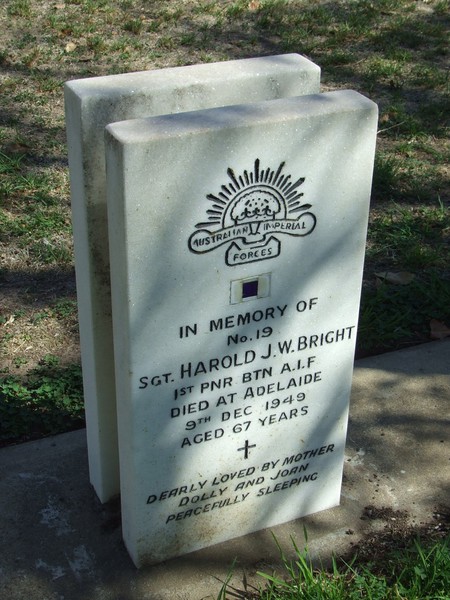
His military memorial headstone reads:
IN LOVING MEMORY OF
SGT. H. J. W. BRIGHT
No. 19 1st PIONEER BATTALION A.I.F.
DIED 9-12-49
AGED 67 YEARS
Dearly loved by mother
Dolly and Joan
Peacefully sleeping
Legacy
Harold John William Bright lived an extraordinary life:
Irish-born Royal Marine,
Australian soldier,
Gallipoli veteran,
Lone Pine survivor,
wounded Signal Sergeant,
Pioneer Battalion NCO,
railway employee,
husband,
father,
and patriarch of a South Australian family line.
His surviving records reveal a man who experienced:
the British Empire,
the horrors of Gallipoli,
trench warfare in France,
long wartime hospitalisation,
migration,
railway life in inland Australia,
and family life across two continents.
He stands as a remarkable example of the generation whose lives bridged the Victorian world and modern Australia.
Sources
National Archives of Australia
Royal Marine / Naval Service Record —
Australian Imperial Force Service File —
Commonwealth Railways Service Record —
South Australian Records
Marriage: Harold John William Bright & Ellen Clara Emerton, 7 Dec 1922, Frome District, Book 293, Page 740
Death: Harold John William Bright, 9 Dec 1949, Adelaide District, Book 748, Page 6046
Burial: West Terrace Cemetery
Biography by Trevor Pyatt 15/05/2026
Click images to start slideshow.