







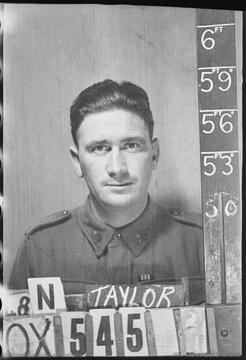
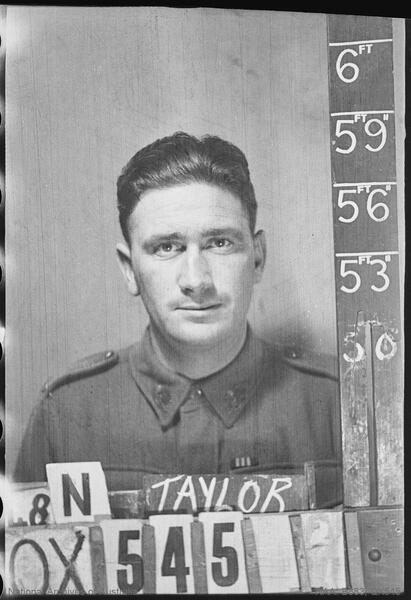
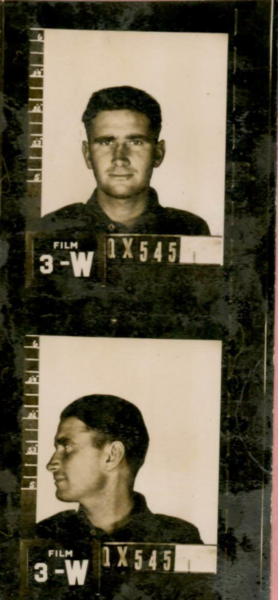
TAYLOR, Matthew Arthur
| Service Number: | QX545 |
|---|---|
| Enlisted: | 22 October 1939 |
| Last Rank: | Private |
| Last Unit: | 2nd/3rd Railway Construction Company (RAE) |
| Born: | Sydney, New South Wales, Australia, 18 March 1914 |
| Home Town: | East Brisbane, Brisbane, Queensland |
| Schooling: | St Laurence's College, Brisbane, Queensland, Australia |
| Occupation: | Labourer |
| Died: | Fortitude Valley, Queensland, Australia, 23 December 1956, aged 42 years, cause of death not yet discovered |
| Cemetery: |
Toowong (Brisbane General) Cemetery, Queensland |
| Memorials: |
World War 2 Service
| 22 Oct 1939: | Enlisted Australian Military Forces (WW2) , Private, QX545 | |
|---|---|---|
| 22 Oct 1939: | Enlisted Australian Military Forces (WW2) , Private, QX545 | |
| 21 Mar 1941: | Honoured Military Medal, Libya/North Africa, Awarded for "great gallantry, initiative and daring" to put a machine gun post out of action. | |
| 26 Feb 1944: | Discharged | |
| 26 Feb 1944: | Discharged Australian Military Forces (WW2) , Private, QX545, 2nd/3rd Railway Construction Company (RAE) |
Help us honour Matthew Arthur Taylor's service by contributing information, stories, and images so that they can be preserved for future generations.
Add my storyBiography contributed by John Dinnen
St. Laurence’s College Old Boy
Private Matthew Arthur Taylor QX545, 9th Division, 2nd AIF
That the Australian soldier has long held a reputation of being difficult to discipline, is a little disputed fact.
Commenting upon the Aussies, the famous British Officer known as the “unkillable soldier”, Lt. General Sir Adrian Carton de Wiart VC, a veteran of the Boer War, and World Wars 1 and 2, and had commanded Australians in each of those wars, said:
“For dash and gallantry, the Australians to my mind were the most aggressive and managed to keep their form in spite of their questionable discipline. Out of the line, they were undoubtedly difficult to handle, but once in it they loved a fight. They were a curious mix of toughness and sentimentality.”
De Wiart may well have been describing Private Matthew (Matty) Arthur Taylor QX545 MM, and SLOB circa 1930.
Matty was that type of soldier, one who was a nightmare to his superiors when not in battle, yet was the dream soldier they needed in the toughest of battles.
Matty was born in Sydney on the 18th of March 1915, just a few weeks prior to the opening day of St Laurence’s College on the 11th of April.
His father, William and mother Mary moved to 12 Louisa Street Highgate Hil and Matty was sent to Lauries for his education.
A strong all-round student, Matty performed forcefully in sport in an era when Rugby League was the code of choice, primarily due to the removal of SLC from the GPS competition, and recess of senior Rugby Union in Queensland from 1916 to 1929.
At the College Swimming Championships held at the Davies Park Baths on Friday the 11th of March 1927, he claimed the College Juvenile swimming championship winning the 50-yard, 220-yard, and Diving events (Catholic Advocate 24 March 1927).
Academically, he also challenged the best of the College, and in 1925 he won the Proxime Accessit award for coming second in the class.
But never mind the sport and academics, Matty was no doubt the Dux of Good Times and Gallantry.
Matty enlisted in the AIF on the 22nd of October 1939 and was assigned to the famous 9th Infantry Battalion where it soon became clear that he was a stoic man of great fortitude, a soldier who the men would look to follow when the battle took a turn for the worst.
This was reflected in his promotion to Corporal only 6 months after enlisting, and despite being disciplined 7 times for being Absent without Leave and one arrest for public inebriation, his Officers knew that despite his party boy reputation, he possessed a special quality as a doughty soldier and a leader of men.
For, during his service Matty came under the disciplinary scrutiny of his Commanding Officers on many occasions, as follows:
1. Arrested for Public Inebriation on 1 occasion.
2. Being Absent without Leave on 17 occasions.
3. 110 days in detention (7 occasions).
4. Fined 58 pounds (10 fines) which was equivalent to approximately 6 months’ pay.
5. Four arrest Warrants issued.
6. Faced four separate Court Martial proceedings.
7. Promoted twice and demoted twice.
So, Matty’s military record, both pre and post deployment periods placed him firmly in contention for a Dishonorable Discharge, yet his Commanding Officers continued to stand by him. They clearly knew that despite the disciplinary nightmare he presented, when duty called, he was amongst the best and bravest soldiers they had in their command, and it wasn’t long before their faith in him was rewarded in spades.
On the 23rd of April 1941 Matty’s platoon was engaging in a concerted attack on the high ground fortress of Jaghbub, in Lybia. This attack was the culmination of a 3-month siege aimed at eliminating the highly valued strategic outpost held by the Axis Forces.
Capturing Jaghbub would allow the Australians to stop the fortress from launching its attacks on the Australian supply routes, as well prevent further attacks on the Siwa Oasis, a crucial water source in the Libyan desert.
Finally, by eliminating the Axis forces here, the Australians would shorten their vital supply lines for the upcoming battle with Rommel’s advancing Afrika Corps at Tobruk.
Enduring what was described as a blinding sandstorm, and friendly fire due to the miscalculations of the 4th British Royal Horse Artillery, the Australian’s continued their assault on the fort.
At some time during this assault, Matty’s platoon was pinned down by an Italian Breda M37 Heavy Machine Gun post. This post was manned by the up to nine men, the Squad Leader, the Gunner, and the assistant Gunner/Loader, those three were backed up by two Tripod Bearers, two ammunitions Bearers, and a Reserve of two men.
The Aussies couldn’t move for risking being cut to pieces by the enemy machine gun crew, in fact several men had already been hit.
At this stage, the sandstorm was becoming intermittent and there were periods of clear vision followed by the regeneration of the storm. During one of the clear spells, Matty lay low and made a mental note of the exact location of the machine gun post and nearby landscape features, noting distances and directions.
As the sand began to swirl, Matty took his opportunity and on his own, made his way towards and around the rear of the machine gun post.
When the time was right, and the storm was once again swirling the sand, Matty charged the heavy machine gun post and neutralized it. The demise of the Italians, nor how many he encountered in that post is not recorded, but one can imagine that one soldier taking up to nine-armed enemy prisoner was not a likely outcome.
What we do know is that Matty saved many of his mates lives that day, and he facilitated the advances on the southern flanks of Jaghbub, thus allowing the Aussies to capture the enemy held town, and ensuring the allies secured supply lines and water sources for the defence of Tobruk against German Field Marshall Rommel’s rapidly approaching Blitzkrieg forces.
Upon receiving a report of Matty’s heroic actions at Jaghbub, the Commander of the 2/9th Battalion, Lt. Colonel J.E.G. Martin recommended him to receive the Australian Military Medal, now known as the Medal for Gallantry. Martin’s recommendation was assented to without hesitation, by Field Marshall Sir Archibald Wavell, the Commander of the Middle East Operations.
The citation reads as follows:
“At Jaghbub on the 21st of March 1941, Pte. Taylor displayed great initiative and daring in unhesitatingly rushing in and putting out of action a Machine Gun post which commanded the approach to the feature of which it was situated, and which was holding up the advance of his platoon.
The gallantry of this soldier enabled his platoon to get a footing on its objective and contributed to its final capture.
A.P. Wavell
Field Marshall
Middle East Command
Private Matthew Arthur Taylor MM, QX545, returned to Australia and continued to serve within Australia until he was discharged from the AIF on the 8th of February 1944. He also continued his party boy antics until the day of his discharge.
After discharging and upon returning to Brisbane, Matty resided in Fortitude Valley until he died on about the 17th of December 1956 at the age of 41 years. He is buried in Plot 7A 220/#/18 at the Toowong Cemetery, and rests there with his beloved mother, Mary Ellen Taylor.
Matty Taylor will always be regarded as an unrelenting exemplar of Lt. General de Wiart’s favourite Aussie, the tough and sentimental Aussie soldier.
Click images to start slideshow.