



GAY, Howard
| Service Numbers: | 966, 33 |
|---|---|
| Enlisted: | Not yet discovered |
| Last Rank: | Corporal |
| Last Unit: | 3rd South Australian Bushmen's Contingent |
| Born: | Adelaide , 27 April 1879 |
| Home Town: | Largs Bay, Port Adelaide Enfield, South Australia |
| Schooling: | Not yet discovered |
| Occupation: | Soldier |
| Memorials: |
Boer War Service
| 1 Oct 1899: | Involvement Corporal, 33, 3rd South Australian Bushmen's Contingent | |
|---|---|---|
| 1 Oct 1899: | Involvement Sergeant, 966, 2nd Battalion, Australian Commonwealth Horse |
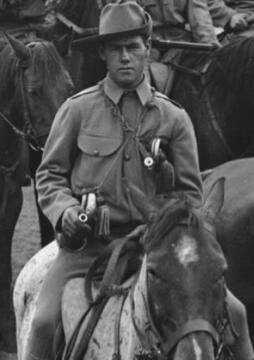
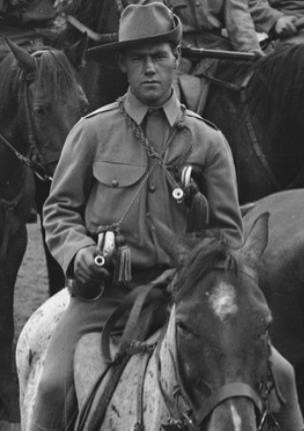
Howard Gay, Bugler
Howard GAY was born 27 April 1879 in Adelaide.
He was the youngest child of Archibald and Mary Watts (COLBEY) GAY who had 6 children, 5 of whom survived to adulthood, Florence Isabel (1870), Horace Denzil (1872–1872), Horace Denzil (1873),
Archibald Ernest (1875), Beaumont ‘Beau’ Colbey (1876), Howard (1879).
Howard’s father Archibald GAY and his uncle Patrick GAY were cabinet makers, furniture retailers and undertakers based in Hindley Street and Rundle Street, Adelaide.
Howard attended both the North Adelaide Primary School and Sturt Street School where his mother Mary enrolled him in Grade 3, 31 March 1890, stating she was a nurse and her residence was Jeffcott Street, North Adelaide.
After leaving school, Howard joined the South Australian Permanent Artillery based at Largs Bay.
The Boer War third contingent, the South Australian (Citizen) Bushmen’s Corps was funded by public subscription and the philanthropy of wealthy individuals. The third selection of men, on 15 February at the Exhibition Grounds saw about 28 men chosen from a crowd of about 200 volunteers. Among the published names was ‘GAY, H., 21, single (trumpeter).
The Advertiser of 8 March 1900 reported that 120 horses and 100 men of the South Australian Bushmen’s Corps were loaded on the troopship Maplemore at the Ocean Steamer’s Wharf, Port Adelaide, the previous day, 7 March. Already on board were some of the Queensland and New South Wales contingents.
The ‘Critic’ of 10 March 1900 reported that ‘The S.A. Bushmen are fortunate in having secured such a good bugler for their contingent. Trumpeter GAY, who belongs to the Artillery, is the best trumpeter and bugler in Adelaide, besides being a thoroughly good horseman
When the Western Australian troops were loaded, 'The Advertiser'
reported that 'Trumpeter GAY, of South Australia, has been appointed head trumpeter and gives the others a lesson every day.
After serving in South Africa, Howard GAY and others embarked at Cape Town, 29 April 1901 on the troopship Morayshire, and arrived in Adelaide, 3 June 1901.
On Sunday, 14 July 1901, a memorial was unveiled by H.R.H. the Duke of Cornwall and York, K.G., at St Peter’s Cathedral to South Australian soldiers who had fallen in the South African campaign. As the last words of the prayer died away the notes of a bugle rose at the other end of the nave, and the beautiful music of the last call was rendered with a pathos which moved the hearts of all hearers. The bugler was Sergeant GAY, who took part in the campaign under the late Captain Hubbe reported the newspapers.
The Advertiser published a notice on 25 December 1901 asking for all returned South African soldiers who wished to return to the South African war to send their names and addresses to Colonel J. Stuart. On the 6 January 1902, the day a South Australian unit was authorized for the Second Battalion Australian Commonwealth Horse, Howard GAY signed for further service in South Africa.
Howard GAY of Fort Largs, 22 years and 8 months of age was one of the men sworn in for the SEVENTH CONTINGENT.
He had previously served 1 year 120 days with the THIRD CONTINGENT – Bushmen’s Corps. Howard GAY, Number 966 was a sergeant and his attestation papers stated his occupation was a soldier with the SA Permanent Artillery at Largs Bay. He was 5 feet 7½ inches with brown eyes, dark hair and a dark complexion. His mother, Mary Watts GAY was listed as his next of kin.
The troopship Manchester Merchant embarked 5 officers, 116 troops and 121 horses of the 2nd Battalion Commonwealth Horse, South Australian unit on 20 February 1902 at the Ocean Steamer’s Wharf, Port Adelaide.
The Battalion disembarked at Durban 14 March and served around Newcastle, Botha’s Post then were part of operations from Klerksdorp to Devondale Siding. Peace was declared 31 May 1902.
Howard GAY never married and after travelling to Canada, he died 17 August 1907, aged 27 at Victoria, British Colombia. He is buried in the Ross Bay Cemetery, Victoria, British Colombia.
Submitted 16 March 2026 by Kathleen Emms
Click images to start slideshow.