


MCGRATH, John
| Service Numbers: | 948, 248 |
|---|---|
| Enlisted: | 14 September 1914 |
| Last Rank: | Trooper |
| Last Unit: | 7th Light Horse Regiment |
| Born: | Cobargo, New South Wales, Australia, 27 August 1879 |
| Home Town: | Dorrigo, Bellingen, New South Wales |
| Schooling: | Not yet discovered |
| Occupation: | Labourer / Farmer |
| Memorials: |
Boer War Service
| 1 Oct 1899: | Involvement Trooper, 948, 2nd New South Wales Mounted Rifles |
|---|
World War 1 Service
| 14 Sep 1914: | Enlisted AIF WW1, Trooper, 248, 7th Light Horse Regiment | |
|---|---|---|
| 20 Dec 1914: | Involvement Private, 248, 7th Light Horse Regiment, --- :embarkation_roll: roll_number: '2' embarkation_place: Sydney embarkation_ship: HMAT Ayrshire embarkation_ship_number: A33 public_note: '' | |
| 20 Dec 1914: | Embarked Private, 248, 7th Light Horse Regiment, HMAT Ayrshire, Sydney | |
| 28 Jun 1915: | Wounded AIF WW1, Trooper, 248, 7th Light Horse Regiment, ANZAC / Gallipoli, Gun shot wound left forearm and chest. | |
| 8 Jul 1915: | Transferred AIF WW1, Trooper, 7th Light Horse Regiment, Transferred to No.2 General Hospital AIF, Mena House, Cairo Egypt | |
| 2 Sep 1915: | Transferred AIF WW1, Trooper, 7th Light Horse Regiment, Transferred back to Australia for Discharge | |
| 8 Dec 1915: | Discharged AIF WW1, Trooper, 248, 7th Light Horse Regiment, Discharged and pensioned due to wounds received in Gallipoli. |
Help us honour John McGrath's service by contributing information, stories, and images so that they can be preserved for future generations.
Add my storyBiography contributed by Evan Evans
From Australian Remembrance Army
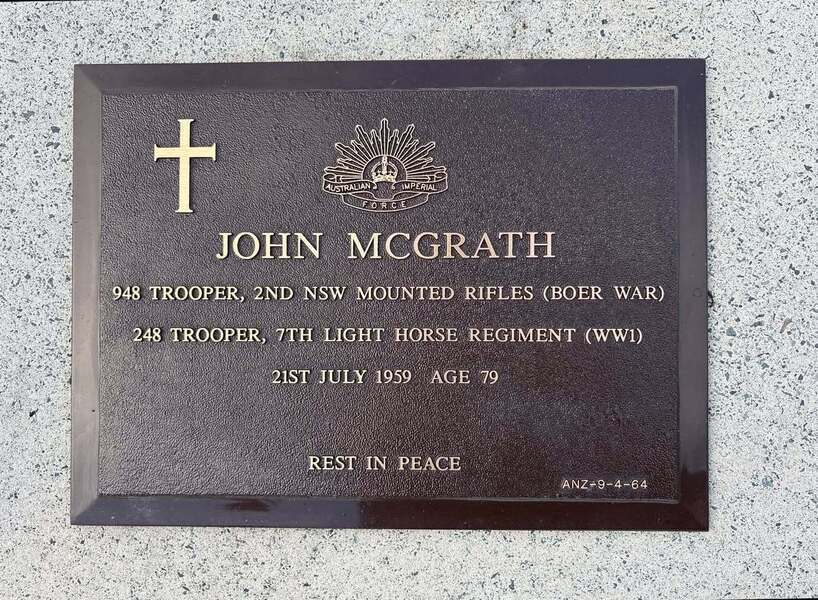
Trooper John “Jack” McGrath, an Australian veteran who served in both the Boer War and the First World War when he was severely injured at Gallipoli, is among almost 800 previously unmarked WWI veterans at Lutwyche Cemetery whose graves we have now marked with plaques in recognition of their service to Australia.
We unveiled his plaque in Lutwyche Cemetery on 16 May 2026, along with a further 185 plaques on the previously unmarked graves of Australian World War One veterans:
See Australian Remembrance Army Facebook page
Boer war:
948, Trooper, Boer War, 2nd NSW Mounted Rifles
WWI:
248, Trooper, 7th Light Horse Regiment
John McGrath was born on 27 August 1879 in Cobargo, New South Wales to John McGrath and Sarah McGrath, nee Leplaw. John was an Indigenous Australian man who worked as a labourer and farmer, and he would go on to serve Australia in two wars. As a young man he enlisted for the Boer War, serving as Trooper 948 with the 2nd New South Wales Mounted Rifles. When he returned home in 1902, the people of Narooma held a welcome-home gathering for “Trooper Jack McGrath”, recognising his service in South Africa. More than ten years later, when the First World War began, John again answered the call. He enlisted in September 1914 as Private 248 with A Squadron, 7th Light Horse Regiment, Australian Imperial Force. His wife, Jessie Ellen McGrath, who he had married in June 1905, was listed as his next of kin.
John embarked from Sydney on HMAT Ayrshire in December 1914 and served overseas with the 7th Light Horse. In June 1915, while at Gallipoli, he was badly wounded by a gunshot to his left forearm. The wound fractured bone, damaged his arm and hand, and left him with lasting loss of strength and movement. His records show that the injury was accepted as being caused by active service. He was treated in Egypt and returned to Australia later in 1915. He was eventually discharged as medically unfit, but the war did not end for him when he came home.
For the rest of his life, John lived with the consequences of that wound.
Repatriation and pension records show years of medical reviews, changing pension rates, and repeated assessments of his injured arm, fingers, chest and ability to work. He tried to support his family, but his damaged arm made hard labour difficult. At times he asked for help so he could make a better living, including hopes of working land and supporting his wife and children. His records show the sad reality faced by many returned soldiers: he had served his country twice, but still had to keep proving the extent of his injury and need.
By the late 1950s, John’s health had declined further. Records from Brisbane Mental Hospital at Goodna show that he was admitted on 1 November 1958, aged about 79. Hospital correspondence described him as a Boer War veteran and First World War veteran, and recorded his next of kin as his sons A. W. McGrath of Grafton and D. D. McGrath of Coffs Harbour. The hospital papers also show that there was some confusion at first because another John McGrath appeared in the records, but staff later identified him as the man who had served as Trooper 248 with the 7th Light Horse.
The clinical notes from Goodna paint a very sad picture of John in old age. He was described as an elderly deaf man who was unable to give a clear account of himself. He could not properly answer simple questions, had little insight into his condition, and was recorded as confused, untidy and difficult to communicate with. His provisional diagnosis was cerebral arteriosclerosis, a condition that can cause confusion, memory loss and decline in mental functioning. The notes also recorded his physical decline, including poor coordination and difficulty carrying out simple tasks.
Trooper John McGrath died at Brisbane Mental Hospital Goodna on 21 July 1959, aged 79, and was buried in Anzac Portion 9, Lutwyche Cemetery, Brisbane. His death was recorded as being due to bronchopneumonia and cerebral arteriosclerosis. A later repatriation claim connected to his death was rejected, with the decision noting that his death was not accepted as due to war service and therefore not entitled to official commemoration at his place of burial. His funeral notice remembered him as “formerly of Grafton”, an ex-Boer War veteran and 1st A.I.F. veteran, and named members of the McGrath family at Grafton and Coffs Harbour.
His story is one of service, injury, hardship and endurance. He served Australia in two wars, came home permanently wounded from Gallipoli, spent decades carrying the cost of that service, and died in old age at Brisbane Mental Hospital far from the public welcome he had once received as a young returned soldier.
After decades without recognition at his place of burial, his grave now bears a plaque commemorating his service to Australia — ensuring his name endures among those remembered for their duty and sacrifice. His identity and dignity have now been restored.
We have remembered him.
Lest We Forget
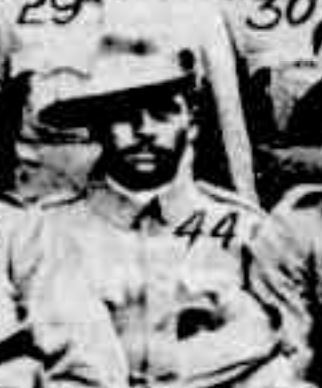
Note Portraits sourced from ancestry.com
Group portrait description:
Back - David (Joe), Bill (Jack's son), John (Jack)
Middle - Jessie Ellen (Jack's wife), Charlotte with Ted (Albert) on lap (David's wife & son)
Front - David (Jack's son)

Click images to start slideshow.