

ALLEN, Leslie Clarence
| Service Number: | VX12513 |
|---|---|
| Enlisted: | 14 April 1940 |
| Last Rank: | Private |
| Last Unit: | 2nd/5th Infantry Battalion |
| Born: | Ballarat, Victoria, Australia , 9 September 1918 |
| Home Town: | Ballarat, Central Highlands, Victoria |
| Schooling: | Not yet discovered |
| Occupation: | Farm labourer |
| Died: | Diabetes/heart attack, Sovereign Hill, Victoria, Australia , 11 May 1982, aged 63 years |
| Cemetery: |
Ballarat New Cemetery and Crematorium, Victoria Garden Of Memories, Section 24, Number 10. |
| Memorials: | Victorian Garden of Remembrance |
World War 2 Service
| 14 Apr 1940: | Enlisted Private, VX12513, 2nd/5th Infantry Battalion | |
|---|---|---|
| 19 Apr 1940: | Enlisted Australian Military Forces (WW2) , Private, VX12513 | |
| 15 Sep 1940: | Embarked Private, VX12513, Disembarked in Palestine 1 December 1940 | |
| 4 Aug 1942: | Involvement Private, 2nd/5th Infantry Battalion , Returned from the Syrian Campaign for retraining and mobilisation to PNG | |
| 14 Apr 1943: | Promoted Corporal | |
| 10 May 1944: | Involvement Private, Rank reduced to Private as a result of striking an Officer | |
| 10 Sep 1944: | Discharged Private, VX12513, 2nd/5th Infantry Battalion | |
| 10 Sep 1944: | Discharged Australian Military Forces (WW2) , Private, VX12513 |
Help us honour Leslie Clarence Allen's service by contributing information, stories, and images so that they can be preserved for future generations.
Add my storyBiography contributed
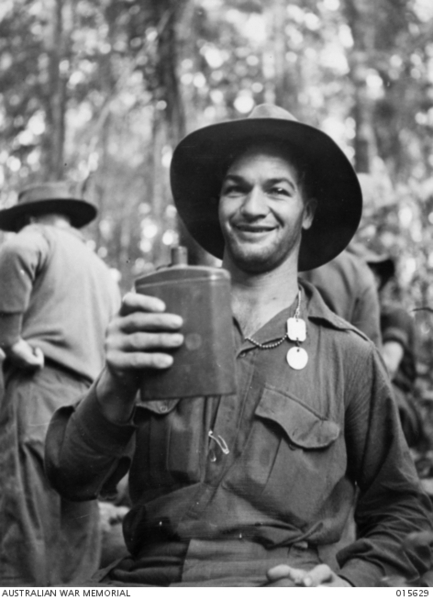
Leslie "Bull" Allen never had it easy. Abandoned as a child, he and his sister were raised in a Ballarat orphanage. By twelve, he was working as a farm laborer. He grew into a powerfully built man who earned his nickname charging through opponents on the football field. In 1940, he enlisted as a stretcher bearer with the 2/5th Infantry Battalion.
He saw action in Libya and Syria, where he developed a reputation for fearlessness under fire. But war leaves marks that don't show. In April 1941, he was hospitalized with "anxiety neurosis." He recovered and kept going. In February 1943, at Crystal Creek in New Guinea, he rescued wounded soldiers under intense Japanese fire and earned the Military Medal.
Then came July 30, 1943.
American forces attacked Mount Tambu, a Japanese-held position in terrain so brutal that historian David Dexter called it "one of the most difficult and unpleasant areas ever to confront troops." The attack failed. Fifty Americans lay wounded on the muddy slopes. Two US medics were shot dead trying to reach them.
Bull Allen wasn't ordered to help. His unit was on standby. But he watched those wounded men crying out, and he couldn't stand it.
So he walked into the chaos alone.
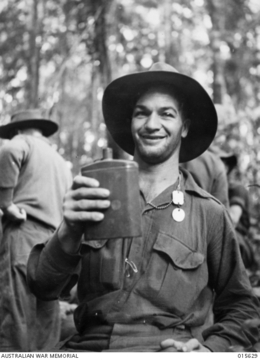
He hoisted a wounded American over his shoulders and carried him down the mountain. Then he went back. And again. And again. Each time he disappeared into the gunfire, soldiers placed bets on whether he'd return. Each time, he did. War correspondent Gordon Short captured him mid-rescue in a photograph that would become iconic: a giant of a man striding through hell like he was on a Sunday walk.
Twelve times he went up that mountain. Twelve Americans owe their lives to a man who had no obligation to save them.
America awarded him the Silver Star. First Lady Eleanor Roosevelt began a correspondence with him that would last years. When Allen married former army nurse Jean Floyd in 1949, Eleanor sent her congratulations. When his daughter was born, he named her Eleanor.
But Australia? His own country never officially recognized what he did on Mount Tambu.
The war broke him in ways that medals couldn't fix. Back in Australia, his behavior became erratic. He struck an officer and was court-martialed. In September 1944, he was discharged as medically unfit, suffering from "constitutional temperamental instability" and "anxiety symptoms."
So traumatized was this veteran of three campaigns that he retreated to an uncle's farm and lost the power of speech for six months. The man whose booming voice and laugh had once echoed across army camps couldn't speak at all.
He eventually recovered enough to build a life. He married Jean, raised a family, worked as a hospital orderly in Ballarat. In his later years, he demonstrated a horse-drawn quartz-crushing mill at Sovereign Hill, a gentle giant showing tourists how the old machines worked. Locals remembered him fondly.
But the nightmares never stopped. The PTSD haunted him until his death in 1982.
Here's what haunts me: In 1979, the Army named a canteen at Puckapunyal after him, the CPL LC Allen MM Canteen. They knew his actions on Mount Tambu were extraordinary. Australian newspapers had called him "one of the war's most gallant stretcher-bearers" and an "Australian Superman."
Yet they never gave him the Victoria Cross. They never officially recognized what he did that day.
America saw a hero. Eleanor Roosevelt saw a hero. Swedish metal band Sabaton wrote a song about him in 2014. In 2019, Australia's Prime Minister gave a bronze statue of that famous photograph to the US President as a symbol of the alliance between our nations.
But Bull Allen himself? The orphan who became a legend? The man who walked into fire twelve times to save strangers? The soldier who came home so shattered he couldn't speak?
He died without his country ever officially honoring what he did on Mount Tambu.
Some heroes are only recognized by everyone except their own.


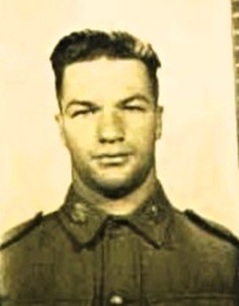
Click images to start slideshow.