



PARTRIDGE, Frank John
| Service Number: | NX700426 |
|---|---|
| Enlisted: | 21 December 1942 |
| Last Rank: | Private |
| Last Unit: | 8 Infantry Battalion AMF |
| Born: | Grafton, New South Wales, Australia, 29 November 1924 |
| Home Town: | Newee Creek, Nambucca Shire, New South Wales |
| Schooling: | Tewinga Public School, New South Wales, Australia |
| Occupation: | Farmer |
| Died: | Car Accident, Near Belligen, New South Wales, Australia, 23 March 1964, aged 39 years |
| Cemetery: |
Macksville General Cemetery, New South Wales Buried with full military honours |
| Memorials: | Bowraville Frank Partridge VC Military Museum, Keith Payne VC Memorial Park, Macksville Frank Partridge VC Memorial, Menangle Private Frank Partridge V.C. Memorial Rest Area, Nambucca Heads "PARTRIDGE" Memorial Plaque, Nambucca Heads Frank Partridge VC Public School, North Bondi War Memorial |
World War 2 Service
| 21 Dec 1942: | Enlisted Australian Military Forces (WW2) , Private | |
|---|---|---|
| 21 Dec 1942: | Enlisted Australian Military Forces (WW2) , Private, NX700426 | |
| 17 Oct 1946: | Discharged Australian Military Forces (WW2) , Private, NX700426, 8 Infantry Battalion AMF |
Help us honour Frank John Partridge's service by contributing information, stories, and images so that they can be preserved for future generations.
Add my storyBiography contributed by Faithe Jones
Partridge, Frank John (1924–1964)
by Barry O. Jones
Frank John Partridge, soldier, farmer and quiz-champion, was born on 29 November 1924 at Grafton, New South Wales, third of five children of Patrick (Paddy) James Partridge, an Australian-born farmer, and his wife Mary, née Saggs, who came from England. Frank left Tewinga Public School at the age of 13 and worked on the family farm—dairying and growing bananas at Upper Newee Creek, near Macksville. While serving in the Volunteer Defence Corps, he was called up for full-time duty in the Australian Military Forces on 26 March 1943. He was posted to the 8th Battalion, a Militia unit which moved to Lae, New Guinea, in May 1944 and to Emirau Island in September.
From June 1945 the 8th Battalion operated in northern Bougainville, containing Japanese forces on the Bonis Peninsula. On 24 July Partridge was a member of a patrol ordered to destroy an enemy post, known as Base 5, near Ratsua. The Australians came under heavy machine-gun fire. Despite wounds to his arm and thigh, Partridge rushed the nearest bunker, killing its occupants with grenade and knife, then began to attack a second bunker until loss of blood forced him to stop. He was awarded the Victoria Cross. Of the Australians who won the V.C. in World War II, he was the youngest and the last, and the only militiaman. After visiting London in 1946 for the Victory march, he was discharged from the A.M.F. on 17 October in New South Wales; he was again to travel to England in 1953 for the coronation of Queen Elizabeth II and in 1956 for the Victoria Cross centenary celebrations.
Read more open link below in New Tab
https://adb.anu.edu.au/biography/partridge-frank-john-11346 (adb.anu.edu.au)
He left school at 13 to work on a dirt-floor farm. He taught himself everything by reading encyclopedias by kerosene lamp. At 20, he won Australia's highest military honour. At 38, he won a national quiz show. At 39, he finally had a wife and baby — and was killed building their dream home.
Frank Partridge was born in Grafton, New South Wales, in 1924. His father Paddy was a tough bushie who ran a dairy and banana farm at Upper Newee Creek, near Macksville. The farmhouse had a dirt floor. There was no electricity.
Frank left school at 13 to work the land alongside his father. But he never stopped learning. Night after night, he'd sit by kerosene lamp reading the Encyclopedia Britannica, cover to cover. Teaching himself everything formal education hadn't given him.
When war came, Frank was only 15. He joined the Volunteer Defence Corps as soon as he was old enough, then was called up for full-time duty in March 1943. He was posted to the 8th Battalion — a Militia unit, not regular army.
By June 1945, the 8th Battalion was on Bougainville, containing Japanese forces in what would become one of the last campaigns of the Pacific War. The fighting was brutal — stinking jungle, putrid swamps, constant clashes with an enemy that fought to hold every track and river crossing.
On 24 July 1945, Frank Partridge was 20 years old.
Two platoons were ordered to attack a Japanese strongpoint called Base 5, near Ratsua. Frank's section came under devastating machine-gun fire almost immediately. The Bren gunner was killed. Frank was shot — once in the arm, once in the thigh.
Most men would have stayed down. Frank Partridge decided to charge.
He grabbed the Bren gun from beside the dead gunner and began firing at the nearest bunker. Then he rushed forward — wounded, bleeding, armed with a grenade and a knife.
He threw the grenade into the bunker, silencing the machine gun. Then he dived inside and killed the only living occupant with his knife.
Still bleeding, he began attacking a second bunker. Only when blood loss made it physically impossible to continue did he finally stop, calling out to his section commander that he couldn't go on.
But he wasn't done. When the platoon was forced to withdraw under heavy fire, Frank Partridge — shot twice, bleeding out — rejoined the fight and remained in action until the withdrawal was complete.
His citation later read that he "inspired his comrades to heroic action" and saved the small force "from complete annihilation."
Frank Partridge became the youngest Australian awarded the Victoria Cross in World War II. He was also the last Australian to receive the VC in that war. And the first Militiaman ever to receive it.
He was 20 years old.
After the war, Frank went to London for the Victory March, met the King, and then did something unexpected.
He went home.
Back to the dirt-floor farmhouse. Back to dairying and growing bananas with his father. Back to reading by kerosene lamp in a house that still had no electricity.
But Frank kept learning. That extraordinarily retentive memory — the one that had helped him survive in combat — was now absorbing everything from history to science to literature.
In 1962, Australia discovered what Frank Partridge had been doing in that dirt-floor farmhouse for 16 years.
Bob Dyer's Pick-a-Box was the biggest quiz show in the country. Frank Partridge walked onto that stage — a laconic, soft-spoken farmer — and stunned everyone.
He was one of only three contestants in the show's history to win all forty boxes. His prizes were valued at more than £12,000 — over $250,000 in today's money. His natural modesty and quiet manner made him a national celebrity.
Many of his prizes were electrical appliances. His farmhouse still had no power to run them.
But something else happened during his television fame.
Frank Partridge, the 37-year-old bachelor who'd spent his whole life on a remote farm, met a woman.
Barbara Dunlop was a 31-year-old nurse from Turramurra in Sydney. Their wedding in February 1963 received extensive media coverage. The quiz champion and Victoria Cross hero had finally found love.
There was just one problem: Barbara had her nursing career in Sydney, and Frank's farm was hours away in the Nambucca Valley.
So Frank started building them a dream home on the farm — a proper house, nothing like the dirt-floor shack he'd grown up in. Every weekend, he'd drive down to Sydney to see his new wife. During the week, he'd work on the house.
In late 1963, Barbara gave Frank a son. They named him Lachlan.
Frank enrolled the baby at Knox school, to start when he turned six. He was planning for a future now — a real future, with a wife, a child, a home of his own. Everything he'd never had.
The house was nearly finished. Barbara had never lived in it.
On 23 March 1964, Frank Partridge was driving his Volkswagen on the winding Thora Road near Bellingen — not far from home. His car collided head-on with a logging truck.
He was taken to Bellingen Hospital with serious head, chest, and internal injuries.
He died that evening.
He was 39 years old.
4,000 people attended his funeral at Macksville Cemetery. Frank Partridge was buried with full military honours — the youngest and last VC winner of World War II, the quiz champion, the farmer who taught himself the world from encyclopedias.
Barbara never moved into the dream house he'd built for her. She sold it, having never lived there, and used the money to fund Lachlan's education — just as Frank had planned.
Lachlan was 14 weeks old when his father died. He grew up watching old Pick-a-Box reruns to hear his father's voice. To this day, he has refused to sell his father's medals, though they're held at the Australian War Memorial.
Here's what breaks me about this story:
At 20, Frank Partridge charged through bullets to destroy Japanese bunkers, armed with a grenade and a knife. He was shot twice and kept fighting until blood loss made it physically impossible to continue.
He survived that.
At 39, he was killed on a country road, driving home to finish building the house where his wife and baby son were finally going to live with him.
He'd waited his whole life — the dirt-floor farmhouse, the kerosene lamp, the years alone on the farm — and when he finally had everything, it was taken away in an instant.
Today, the Frank Partridge VC Public School stands at Nambucca Heads. The Frank Partridge VC Military Museum operates in Bowraville. His grave marker reads: "Honoured and loved by all in life and death."
But there's a plaque that I think says it best. It's at a rest area on the Hume Highway named after him.
Most drivers probably don't stop to read it. They don't know about the 20-year-old who charged bunkers with a knife. They don't know about the quiz champion who educated himself by kerosene lamp. They don't know about the dream house that was never lived in, or the baby who grew up watching old TV reruns just to hear his father's voice.
He survived the war. He survived the jungle. He survived charging into machine-gun fire with bullets in his arm and leg.
He didn't survive a country road at 39. - Forgotten but True (www.facebook.com)


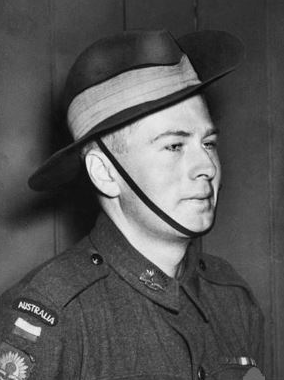
Click images to start slideshow.