






AMOS, John Alfred
| Service Number: | 39405 |
|---|---|
| Enlisted: | Not yet discovered |
| Last Rank: | Lance Corporal |
| Last Unit: | Not yet discovered |
| Born: | East Brunswick, Victoria, Australia, 2 February 1947 |
| Home Town: | Glenroy, Moreland, Victoria |
| Schooling: | Not yet discovered |
| Occupation: | Driver |
| Memorials: |
Vietnam War Service
| 27 Mar 1968: | Involvement Australian Army (Post WW2), Lance Corporal, 39405 |
|---|
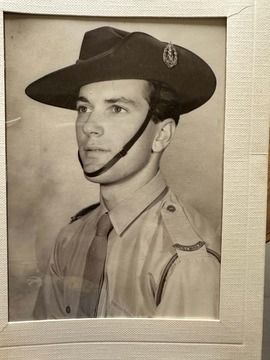
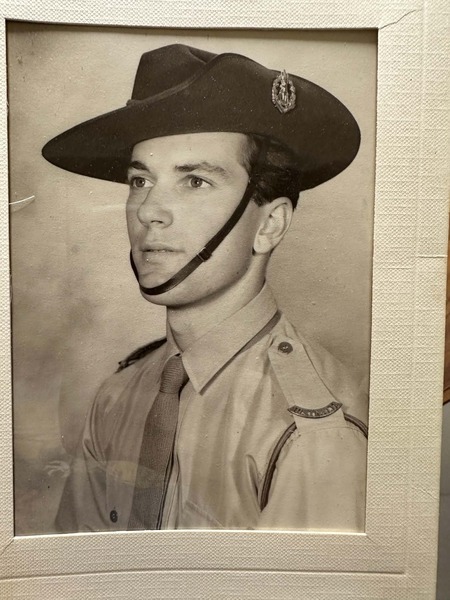
John Mousie Amos
enlistment in 1968 • Brunswick
AMOS, John Alfred [ Mousie ] was a lance-corporal in the Australian Army during the Vietnam War. Service number 39405. Regimental No 3009405
Hailing from EAST BRUNSWICK VIC AUSTRALIA, John served Australia with distinction. he served from 27 March 1968 to 23 October 1968 when wounded
he was with the 1st Battalion, Royal Australian Regiment (1 RAR) 2nd tour
TRAINING 1967/8 After vigorous training in the Holsworthy area the battalion conducted intense training, including Exercise "Grass Parrot" at Shoalwater Bay, Queensland.
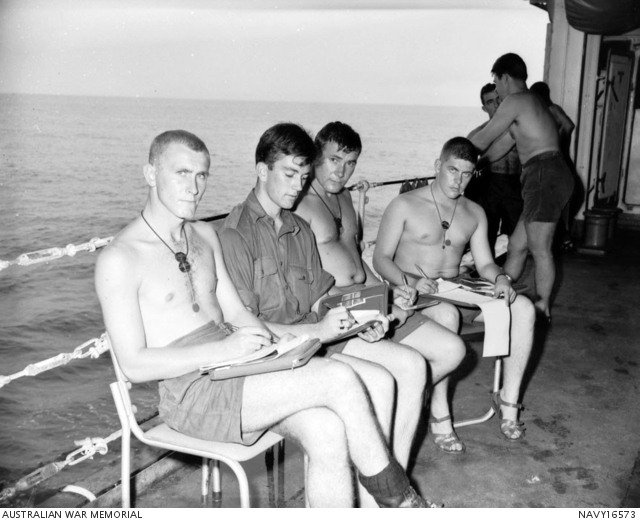
John sail on the HMAS Sydney also known as “The Vung Tau Ferry
John photograph on the HMAS Sydney (III) is transporting troops from Australia to Vung Tau, South Vietnam. Here four soldiers from the 1st Battalion, The Royal Australian Regiment (1RAR) write home as they relax on the weather deck. Left to right: 3791095 Private (Pte) Richard Edward Przewloka, of Springvale, Vic; 39405 Pte John Alfred Amos, of Glenroy, Vic; 39410 Pte Brian David Whyte, of Preston, Vic; and 3176992 Pte Christianus Joannes (Chris) Vanbergen, of Ballarat, Vic
John arrived and Relieved 7 RAR on 9 April 1968, operating from Nui Dat in Phuoc Tuy province. They were attached to US Big Red One : 1 RAR was the first Australian unit to serve in a US formation, acting as the third battalion of the 173rd Airborne Brigade. And was primarily involved in patrols, searches, reconnaissance and security operations.
Operation PEGASUS (22 Apr 68)
Op Pegasus was the first operation conducted by the Battalion in the second tour of Vietnam. This was an air-mobile assault to practice the battalion in air operations.
Operation BLAXLAND (24 Apr – 1 May 68)
Op Blaxland was the first major operation conducted by the Battalion. It commenced shortly after the unit had arrived in Vietnam and was designed to locate and destroy enemy camps in the Nui Dinh hills. It was quite a productive operation with A Company achieving the first enemy KIA. Across the Battalion there were a number of enemy camps and caches discovered. Broadly speaking it was quite a successful operation
On 12 May John with the 1RAR was redeployed north of Saigon for Operation Toan Thang (21 April - 7 June). This operation aimed at blocking the communist withdrawal following the 1968 Tet Offensive. 1RAR patrolled the Bien Hoa-Bien Nuong border.
On 11 May the battalion arrived at Fire Support Base Coral. The base was attacked twice, firstly on 13 May and again on 16 May. Both attacks were repulsed. On 6 June Coral was closed, and 1RAR returned to Nui Dat.
Battle of Coral Balmoral;
Operation Toan Thang 1 was to become what was probably the Battalion’s defining operation. Whilst the operation name itself is not widely recognised, an action within the operation is probably the Battalion’s most revered action. It became known as the Battle of Coral. Fire Support Base (FSB) Coral was one of 2 FSBs established within adjacent AO’s. AO Bondi and AO Manly were allocated to I RAR and 3 RAR respectively. AO Bondi contained FSB Coral and AO Manly contained FSB Coogee. The FSBs were positioned to provide indirect fire support to the two Infantry Battalions, which were patrolling and ambushing at company and platoon strength with the respective AO’s.
The rifle companies were deployed into independent AO’s and the remainder of the Battalion Group was at Coral. Coral was defended by Battalion HQ, Mor P1, Pnr PI, Anti-Tk PI, 102 Fd Bty and HQ 12 Fd Regt.
During the night of 12/ 13 May, an enemy force of approximately Battalion strength attacked FSB Coral. Much of the Mor P1 was overrun along with one gun of 102 Fd Bty. Support in the form of helicopter gunships and ‘Spooky’ air fire support aircraft as well as the integral weapons enabled Coral to remain defended until first light when the enemy broke contact and withdrew
During the period 13 -15 May, the development of FSB Coral continued. After the action on the night of 12-13 May all the rifle companies were recalled to the FSB in anticipation of a more substantial enemy attack. The attack came on the night of 15-16 May when a regimental strength attack developed against the part of the perimeter defended by A and B Companies. Whilst some of the fighting pits of A Coy were occupied, no substantial penetration of the Battalion occurred. Just prior to first light a second major assault developed in front of A, B and C Companies. This attack was ultimately repelled causing the enemy to break contact and withdraw at first light.
Over the next two weeks, I RAR was involved in ongoing contacts at and around FSB Coral. These actions and the major engagements at Coral were important in developing an understanding of the NVA’s strategic objectives and large-scale troop dispositions. The Battalion can lay claim to the destruction of a substantial element and major disruption to the plans of the 7th NVA division, which at the time was poised to move on Saigon.
Action on 30 May 1968: C Company, supported by tanks, came under heavy fire while conducting a reconnaissance-in-force approximately \(3,000\) meters east of Coral, highlighting the danger and intense close combat of the campaign. These engagements reinforced the importance of infantry-tank cooperation, with tanks helping C Company to break contact and withdraw, subsequently revealing substantial enemy
A follow-up operation, Toan-Thang II (13 June - 18 July 1968), saw the battalion move to the Bien Hoa-Long Khanh border. 1RAR participated from 13 June to 3 July.
Operation Hawkesbury
September 12 to September 24, 1968, in Phuoc Tuy Province
No.9 Squadron helicopters airlifted members of 1st and 4th Battalions, (1 RAR and 4 RAR/NZ), The battalion moved into blocking positions east of Route Two on the western edge of the enemy zone known as the Thua Tich. 1 RAR then swept west. 4RAR targeting Viet Cong forces locate and destroy enemy bunker systems and disrupt supply routes in the Thua Tich area. A 150-bunker complex was discovered, and documents revealed it was the headquarters of the 84 Rocket Regiment inc the capture of significant documents
25 enemy were killed Thier were four Austalians killed and 21 wounded during the operation
Operation Windsor John was badly wounded
John was in the jungle of the Hat Dich area, around 10 miles from Nui Dat,
This was heliborne operation launched by 1 RAR and 3 RAR of the 1st Australian Task Force in October 1968, targeting Viet Cong forces in the Hat Dich area north of Phuoc Tuy province, Vietnam. 1RAR along the Firestone Trail It was a search-and-destroy mission aimed at reducing enemy presence near Nu specific actions of C Company in the Battle of Windsor (Operation Windsor, Vietnam), t
Lance Corporal John Amos ("Mousie") of C Company, 1st Battalion, Royal Australian Regiment (1 RAR), was severely wounded on October 8, 1968, during operations in Vietnam. While the major battles at Fire Support Bases Coral and Balmoral occurred in May 1968, 1 RAR continued operations in the region later that
Injury Details: John Amos suffered a severe neck wound and was in shock with temporary paralysis after being wounded alongside four others.
Brian Wrigley wrote
LCpl J A Amos, C Coy 1 RAR was wounded on the 8th of October 1968, along with four others. "Mousie Amos' wound to the neck was far more serious. He had developed paralysis down the right side and was sure his right arm had been shot off; he was in shock".
He was operated on and was repatriated back to Australia and recovered from his injuries.
He later married had 2 girls and moved to Broken John and wife Liz ran successful business in town
John help design the Broken Hill war memorial
Des Kennedy started the Broken Hill Vietnam Veterans Club in 1999 with John Amos, together with their wives Olga Kennedy and Liz Amos. John designed the memorial. Both men served with the First Battalion of the Royal Australian Regiment on the second tour in 1968/1969.
He retired and moved to Queensland
Submitted 31 May 2026 by Anthony Davis
Click images to start slideshow.