







MURRAY, Charles William
| Other Name: | Sanderson, John |
|---|---|
| Service Number: | 3912 |
| Enlisted: | 1 February 1917 |
| Last Rank: | Private |
| Last Unit: | 4th Pioneer Battalion |
| Born: | Hartlepool, County Durham, England, February 1878 |
| Home Town: | Kulara, Tablelands, Queensland |
| Schooling: | Not yet discovered |
| Occupation: | Labourer |
| Died: | Brisbane, Queensland, Australia, 12 December 1948, cause of death not yet discovered |
| Cemetery: |
Lutwyche Cemetery, Brisbane, Qld Anzac Portion 7 |
| Memorials: |
World War 1 Service
| 1 Feb 1917: | Enlisted AIF WW1, Private, 3912, 4th Pioneer Battalion | |
|---|---|---|
| 13 Jun 1917: | Involvement Private, 3912, 4th Pioneer Battalion, --- :embarkation_roll: roll_number: '5' embarkation_place: Sydney embarkation_ship: HMAT Hororata embarkation_ship_number: A20 public_note: '' | |
| 13 Jun 1917: | Embarked Private, 3912, 4th Pioneer Battalion, HMAT Hororata, Sydney | |
| 7 Dec 1918: | Discharged AIF WW1, Private, 3912, 4th Pioneer Battalion, 3rd MD, medical discharge (wounded) |
Help us honour Charles William Murray's service by contributing information, stories, and images so that they can be preserved for future generations.
Add my storyBiography contributed by Evan Evans
From Australian Remembrance Army
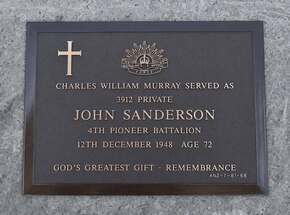
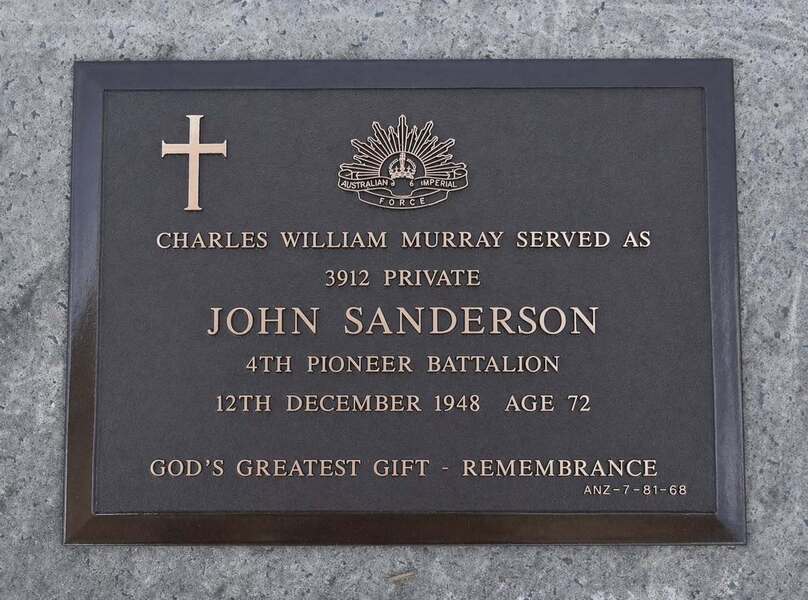
Australian World War One veteran Private Charles William Murray (served as John Sanderson, service no. 3912), is among almost 800 previously unmarked WWI veterans’ graves in Lutwyche Cemetery we have now marked with a plaque recognising their service for Australia.
We unveiled his plaque in Lutwyche Cemetery on 15 April 2023, along with a further 246 plaques on the previously unmarked graves of Australian World War One veterans:
See Australian Remembrance Army Facebook page
Charles William Murray, born in 1876 at Hartlepool, County Durham, England, was the son of John James Murray and Jane Robson Murray (née Sanderson). Prior to the First World War he worked as a labourer and later served as an able seaman in the merchant service. On 1 February 1917 he enlisted in the Australian Imperial Force at Cairns, Queensland, under the assumed name John Sanderson, giving his age as 39 years. He later formally declared that he used an alias because he had left a coastal ship in order to volunteer for military service. At the time of enlistment, he was single and named his sister, Mrs Sarah Wilson of Hartlepool, England, as his next of kin.
Murray was posted as a private to the 4th Pioneer Battalion and embarked from Sydney in June 1917 aboard HMAT Hororata, disembarking at Liverpool on 26 August 1917. After training in England, he proceeded to France in January 1918 and served with his unit on the Western Front. On 26 February 1918 he was wounded in action, sustaining gunshot wounds to the left hip, leg, shoulder and abdomen. His injuries were described as severe, and he was evacuated through field medical units to hospitals in France before being transferred to England, where he underwent extended treatment at several military hospitals.
Due to the seriousness of his wounds, Murray was returned to Australia in July 1918 for medical discharge. While an inpatient at No. 6 Australian General Hospital he made a statutory declaration on 22 October 1918 confirming his true identity as Charles William Murray and requesting that his discharge and military records be issued in his correct name rather than his enlistment alias. His service was formally recognised under both names.
Private Charles William Murray died on 12 December 1948, aged 72, and was buried in Anzac Portion 7, Lutwyche Cemetery, Brisbane. He was unmarried and had no known children.
His funeral notice read:
“MURRAY — The Relatives & Friends of Mr. & Mrs. J. H. Mill, of 71 Glen St., Kelvin Grove, are invited to attend the Funeral of their deceased Friend, Charles William (Sandy) Murray, late 4th Pioneer Batt., 1st A.I.F., to leave the Funeral Parlour, 45 Adelaide St., City, this (Tuesday) Afternoon, after Service commencing at 1.45 o'clock, for the Lutwyche Cemetery.”
After decades without recognition at his place of burial, his grave now bears a plaque commemorating his service to Australia — ensuring his name endures among those remembered for their duty and sacrifice. His identity and dignity have now been restored.
We have remembered him.
Lest We Forget.
Click images to start slideshow.