







LUSCOMBE, Leslie George
| Service Number: | 596 |
|---|---|
| Enlisted: | Not yet discovered |
| Last Rank: | Lance Corporal |
| Last Unit: | 42nd Infantry Battalion |
| Born: | Not yet discovered |
| Home Town: | Not yet discovered |
| Schooling: | Not yet discovered |
| Occupation: | Not yet discovered |
| Memorials: | Pittsworth Great War 'Served and Returned' Roll of Honour |
World War 1 Service
| 5 Jun 1916: | Involvement Lance Corporal, 596, 42nd Infantry Battalion, --- :embarkation_roll: roll_number: '18' embarkation_place: Sydney embarkation_ship: HMAT Borda embarkation_ship_number: A30 public_note: '' | |
|---|---|---|
| 5 Jun 1916: | Embarked Lance Corporal, 596, 42nd Infantry Battalion, HMAT Borda, Sydney |
The Boy from Pittsworth Who Served in Two World Wars
The Herbert Pardey Collection of Glass Plate Negatives 1907-1917.
David Owens
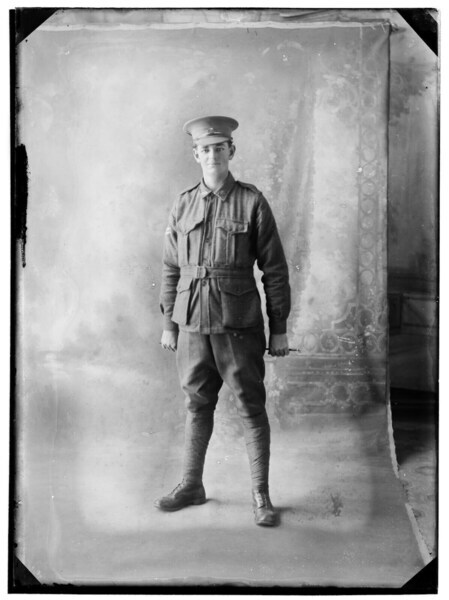
Among the hundreds of glass plate negatives preserved in the Herbert John Pardey Collection is this striking portrait of a young Australian soldier. Captured in Herbert Pardey’s Pittsworth studio during the First World War era, the image shows a confident young man standing proudly in uniform, his hands clasped behind his back as he faces the camera with quiet determination. More than a century later, modern technology has helped restore his identity.
Using Ancestry’s facial recognition tool, I uploaded the image and searched for possible matches among millions of family history records and photographs. The result was immediate and compelling. The young soldier was identified as Leslie George Luscombe, a Pittsworth local whose life would span two world wars and whose story is deeply woven into the history of the district.
Leslie George Luscombe was born on 3 June 1896 at Pittsworth, the son of George William Heywood Luscombe and Sarah Morrison. He grew up in the rapidly developing Darling Downs community and, like many country boys of his generation, entered the workforce early. At just fourteen years of age he was appointed a telephonist in Pittsworth on 22 May 1911, becoming part of the communication network that linked rural Queensland with the wider world.
When the First World War engulfed Europe, Leslie was among the many young men who answered the call to serve. Enlisting in the Australian Imperial Force, he joined the 42nd Infantry Battalion and was allocated service number 596. On 5 June 1916 he embarked from Sydney aboard HMAT Borda as a Lance Corporal, bound for the battlefields of Europe.
The portrait Herbert Pardey captured was likely taken around this time, before Leslie departed Queensland for the uncertainty of war. His uniform is immaculate, his puttees neatly wound around his lower legs, and his expression reflects both youth and resolve. Like so many soldiers photographed in country studios before embarkation, he could not have known what lay ahead in France.
Leslie survived the war and returned home to Pittsworth. By 1919 he was farming on a property known as Waratah, rebuilding a life interrupted by conflict. Yet his personal story contained an unexpected twist. Before the war, Leslie and local girl Lillian May Holmes had been childhood sweethearts. While Leslie was serving overseas, however, Lillian married William Walter Hardy in Pittsworth in February 1917. The marriage produced one son, Walter Hayward Hardy, before William’s death in 1928.
A decade later fate brought the former sweethearts together once more. On 8 October 1938, both aged forty-two, Leslie married the widowed Lillian May Hardy (née Holmes) in Pittsworth. Their marriage rekindled a relationship that had begun in childhood and endured despite years of separation and changing circumstances.
By the early 1940s Leslie was living in Hill Street, Pittsworth, where he operated as a radio and electrical dealer. Yet when Australia again found itself at war, he once more volunteered for service. Enlisting in the Citizen Military Forces during the Second World War, Leslie served from 1942 to 1946 and rose to the rank of Captain. Few men from the district could claim service in both global conflicts.
Following the war, Leslie resumed civilian life in Pittsworth, working as a radio and machinery agent and remaining a familiar figure in the community he had called home since birth. His life reflected the experiences of many Australian veterans who balanced military service with family, business and community responsibilities.
Tragically, Leslie’s story ended suddenly on 20 February 1964. While returning to Pittsworth after attending a concert in Toowoomba, the vehicle he was driving left the road and rolled. Lillian was trapped beneath him in the wreckage. Leslie was taken to Brisbane Hospital but succumbed to his injuries, aged sixty-seven. He was cremated at Mount Thompson Crematorium in Brisbane. Lillian survived him by almost seventeen years, passing away in Pittsworth in 1981 at the age of eighty-four.
Today, thanks to Herbert Pardey’s camera and the survival of a fragile glass plate negative, we can look directly into the face of a young Pittsworth man standing at the threshold of history. What was once an anonymous soldier among hundreds of unidentified portraits has become a recognised individual once more — a telephonist, farmer, businessman, husband, veteran of two wars, and a proud son of Pittsworth.
More than a century after the shutter clicked, Leslie George Luscombe’s story has found its way home.
(Ref: 400 - 33532-0001-0334)
Submitted 12 July 2026 by Carol Berry


Click images to start slideshow.