








About This Unit
At the outbreak of war in August 1914 the Australian fleet comprised the battlecruiser HMAS Australia, the light cruisers Melbourne, Sydney and Encounter, the small cruiser Pioneer, the destroyers Parramatta, Yarra and Warrego, and the submarines AE1 and AE2. The Commonwealth also possessed some ageing gunboats and torpedo boats from the former colonial navies. The permanent strength of the RAN at that time comprised 3800 personnel, of whom some 850 were on loan from the Royal Navy. The naval reserve forces provided a further 1646 personnel.
The first task of the RAN following the declaration of war was to seize or neutralise German territories in the Pacific stretching from the Caroline and Marshall Islands in the north, to New Britain and German New Guinea in the south. The British War Office considered it essential that Vice Admiral von Spee's East Asiatic Squadron of the Imperial German Navy be denied the use of German facilities which represented a formidable network capable of providing intelligence, communication and logistic support to von Spee. Based in Tsingtao in China, the enemy squadron comprised the armoured cruisers SMS Scharnhorst and SMS Gneisenau and the light cruisers SMS Emden, SMS Nürnberg and SMS Leipzig.
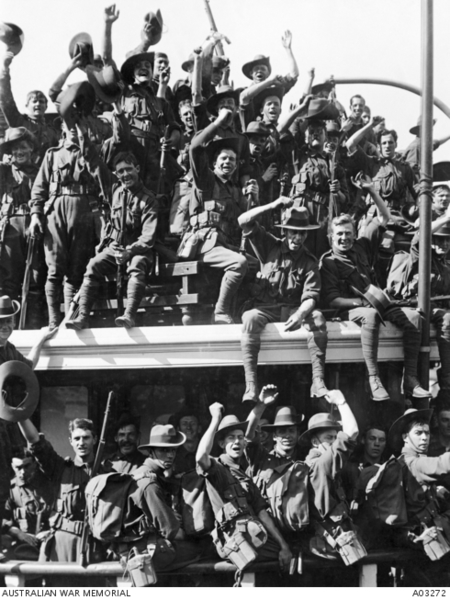
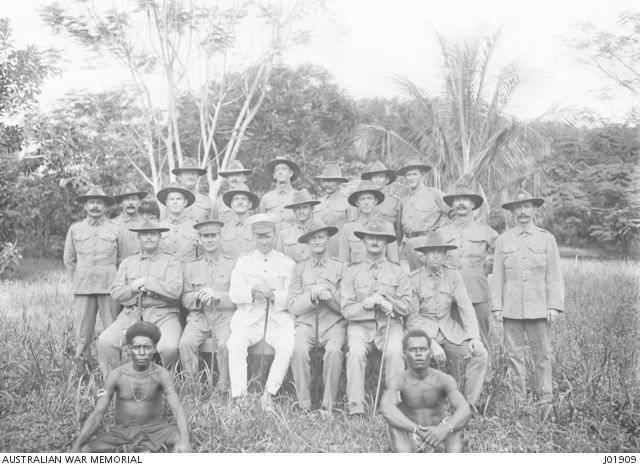
Australia’s major effort was consequently directed at seizing German interests in New Guinea, and in particular New Britain, which formed part of the German wireless network. To achieve this objective a volunteer force known as the Australian Naval and Military Expeditionary Force (ANMEF) was hastily raised in early August 1914. It comprised eight companies of infantry, designated ‘A’ thru ‘H’, while 500 naval reservists and time-expired Royal Navy seamen drawn from Queensland, New South Wales, Victoria and South Australia made up six companies of the Royal Australian Naval Reserve placed under the command of Commander JAH Beresford RAN. Although many of those who volunteered for the infantry component had little or no experience in the military, the men of the naval forces were, in comparison, disciplined, well drilled in musketry, cutlass skills, field gun use and general field work, all of which was to place them in good stead for their impending mission.




Click images to start slideshow.