








About This Unit

4th Light Horse Regiment (AIF WW1)
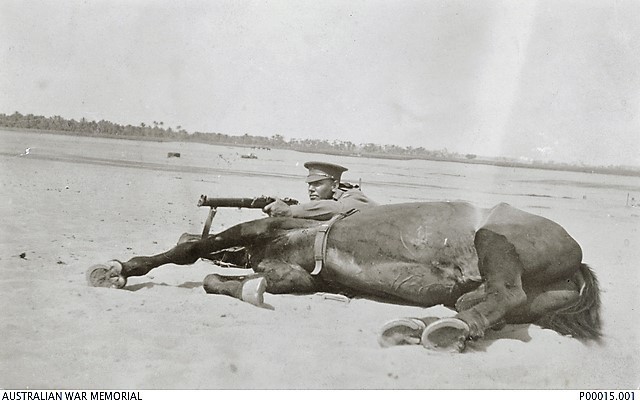
Light Horse Regiments were mounted infantry units rather than classic cavary / hussar units. They were mounted on Australian bred 'Waler' horses, tens of thousandws of which had been supplied to the British Army in India prior to the Great War. Derived from hardy stock horses, they proved to be admirably suited to the role in which they found themselves.
The 4th Light Horse is the only Light Horse Regiment that saw significant service in both the Middle East and the Western Front during WW1. It thus posseses a unique set of Battle Honours, including the most famous Light Horse battle of them all; the charge at Beersheba in October 1917.
This siutation came about when, after Gallipoli where the Light Horse was deployed without its horses, two squadrons of the 4th Light Horse were despatched to the Western Front. The remainder stayed on in Palestine and went on to write history.
On 11 August 1914, the 4th Light Horse Regiment was raised in Melbourne, as the divisional cavalry regiment of the 1st Division. Light Horse Regiments normally comprised twenty-five officers and 497 other ranks serving in three Squadrons, each of which comprised six Troops. Each Troop was divided into eight Sections, of four men each.
The 4th Light Horse later raised five Squadrons and later in the war, two of these were sent to accompany the Australian infantry divisions to France, while the other three remained to the Middle East, serving with the Australian and New Zealand Mounted Division.
All Australian Light Horse regiments used cavalry unit designations, but operated as mounted infantry, mounted exclusively on the Australian Waler horse. In action, as a tactical measure, the men would dismount and the 'fourth man' of each Section was nominated as a horse holder to keep them out of hasrm's way and under control, but this had the effect of reducing the section, and by extension regiment's rifle 'firepower' by 25%.
The 4th Light Horse unit identity persisted between the two World Wars, and its Militia entity persisted until WW2 (see separate entry), and beyond.
Formation / Embarkation / Gallipoli
The Regiment sailed for war on 19 October 1914 and arrived in Egypt on 10 December.
When the rest of the division departed to take part in the Gallipoli, Light Horse elements were not included because the terrain was deemed unsuitable for mounted troops
However, losses among the infantry Battalions were heavy, so it was decided to send them, dismounted, to reinforce the units of the First Division. Organisational differences between the Australian and British Armies resulted in the 4th Brigade being split off to form the ANZAC Disivion. The 4th Light Horse Regiment landed at what became known as ANZAC Cove between the 22 and 24 May 1915. Initially, the Regiment was broken up and provided squadrons as reinforcements for infantry battalions at various points around the beachhead, and it was not until 11 June that the regiment concentrated as a formed unit. The Regiment left Gallipoli prior to the end of the campaign on 11 December 1915.
On their return to Egypt the regiment was required to raise a fourth Squadron, known as 'D' Squadron. With 'B' Squadron, 'D' Squadron was detached from the regiment and assigned as the divisional cavalry formations, for the 1st and 3rd Divisions, and in mid-1916 they were sent to France, for service on the Western Front, an arrangement unique among the Light Horse Regiments.
These two squadrons later took part in the Battle of Messines, the Third Battle of Ypres, the Battle of Broodseinde and the Battle of Passchendaele. Early in 1918 the German Spring Offensive broke across the Allied front, and the Light Horse were employed in defensive operations near Ypres in the Battle of the Lys, the Battle of Kemmel. Mid year they were committed to blunting the German's last gasp offensive in the Second Battle of the Marne. The two squadrons together with a squadron from New Zealand were eventually amalgamated and renamed the I Anzac Corps Mounted Regiment.
Battle/ Campaign/ Involvement
B and D Squadrons on the Western Front.
Battle of Messines (June 1917)
Third Ypres (Jul-Nov 1917)
Broodseinde Ridge (Oct 1917)
Paschendaele (Oct - Nov 1917)
Battle of the Lys (German Spring Offensive)
Second Battle of the Marne (immediately prior to the 'Last Hundred Days')
Battle of Tardenois (part of the above)
Egypt / Sinai / Palestine
With only two Squadrons (A and C) remaining in Egypt, a new squadron was raised. Confusingly it was also designated as 'B' Squadron. The regiment deployed in defence the Suez Canal, for the remainder of the year 1915. In 1916, plans were made to convert the 4th Light Horse, along with the 11th and 12th Light Horse Regiments into units of the Camel Corps, but this plan was not followed through.
In April 1917, the regiment moved into the Sinai but saw no combat as they were employed in rear area security. The regiment was then assigned to the 4th Light Horse Brigade, and on 31 October took part in its first large battle: the Battle of Beersheba, which was part of the wider Third Battle of Gaza. The 4th and 12th Light Horse Regiments executed the legendary cavalry charge on the town of Beersheba, which has since become known as the "charge of Beersheba".
Taking part in the subsequent advance into Palestine, they were rested in the early months of 1918. During the rest of the campaign the regiment took part in the following:
Battle of Mughar Ridge,
the Battle of Nebi Samwill,
the capture of Jerusalem,
Es Salt,
Megiddo
A patrol from the regiment were among the first Allied troops to enter Damascus on 1 October 1918.[1]
The Ottoman Empire signed the Armistice of Mudros on 30 October 1918, and the war in the Middle East ended. However, the regiment had to return to Egypt, where rioting had started in March 1919, and they were subsequently involved in policing duties. Finally, in June 1919, the regiment sailed for Australia where it was eventually disbanded. The regiment's involvement in the war cost them 105 killed and 332 wounded
Aftermath
See the separate listing for the 4th Light Horse in WW2, designated as a Militia unit. In 1943, it was gazetted as an AIF unit after the majority of its personnel volunteered to serve outside of Australian territory; nevertheless, it did not serve overseas
We would particularly like to encourage individual historians, researchers or members of unit associations to contribute to the development of a more detailed history and photographs pertaining to this unit and its members.
Please contact [email protected] (mailto:[email protected]) for details on how to contribute.



Click images to start slideshow.