



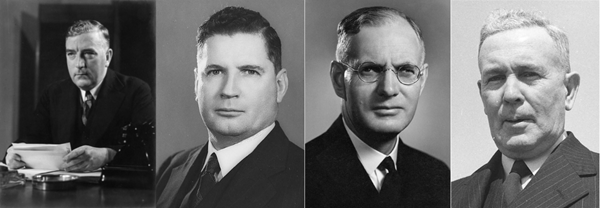
Australia's 4 wartime Prime-Ministers. Robert Menzies and Arthur Fadden from the coalition. John Curtin and Ben Chiffley from the Labor Party.
Australia's government during the Second World War had 2 distinct phases. The first was that of the divided and unstable governments of Robert Menzies and Arthur Fadden that then fell apart to be replaced by the stable and outward looking Labor administration of John Curtin.
The United Australia-Country Coalition had been in power since 1932, and by the time war came, the UAP in particular was starting to lose its position in society. Seen as a relic of the past, a party of rich industrialists and capitalists without any real connection to the common people.
At the September 1940 election, support for the government fell, and a finely balanced hung parliament was returned, with ultimate power in the hands of a group of independents. Prime Minister Menzies' already weak position was further hurt by his long absences in wartime London and devotion to the far away Empire.
Things came to a head in late 1941 as the coalition fell apart and lost control of the Parliament. Needing opposition support for further trips to the UK, Menzies could not reach agreement with the Labor Party and after a short stint of Arthur Fadden trying to lead, Labor leader John Curtin formed a government with the support of the independents, keen to end any wartime instability.
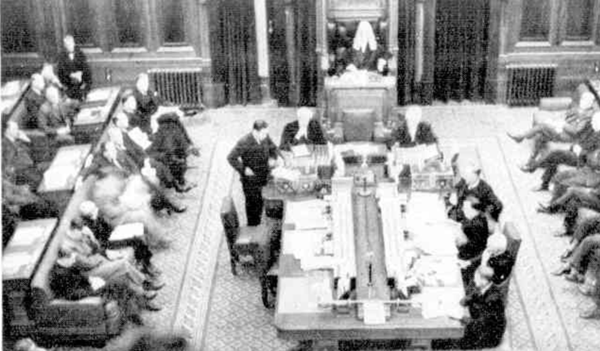
The fall of the Fadden government. October 1941.
With the bombing of Pearl Harbour and the United States and Japanese entry into the war, exactly 2 months into his prime-ministership, John Curtin stressed the need for Australia to provide for its independent defence, withdrawing troops from the Middle East to fight the Japanese and began the process of shifting our major alliance away from Britain to the United States.
As part of this, the Curtin government passed the Statute of Westminster Adoption Act 1942, which removed the power for the British Parliament to override the Australian Parliament. Although passed in 1942, the legislation applied retrospectively from September 3 1939, the date the war began.
Curtin subsequently gained a strong Labor Parliamentary majority in the 1943 Federal election, achieving a 2-party preferred result of 58.2% and 49 of the 75 seats in the House of Representatives. Labor also achieved a Senate majority for the first time since 1914, another wartime election. Clearly, the stability and independent direction of the Curtin government resonated with voters.
John Curtin's health began to deteriorate during 1944 as he took long trips to America and the UK. He had a heart attack in November 1944, and did not return to work until January 1945. On 5 July 1945, John Curtin died at The Lodge in Canberra at the age of 60.
Upon his death he was described by the local press to be a self-sacrificial casualty of war. The next day, Curtin's body was laid in state at the King's Hall in Parliament House, where a memorial service was held. Bearing his coffin from the King's Hall were Opposition Leader Robert Menzies, and former prime ministers Billy Hughes, Earle Page and James Scullin.
After a party leadership ballot, Curtin was succeeded by Ben Chifley, who then led the Labor to another election victory in 1946.
By 1944, the old United Australia Party had totally collapsed, and in its place Menzies built a new "Liberal Party", promising to represent the "Forgotten People" unrepresented by organised labour and the elites the UAP appealed to.
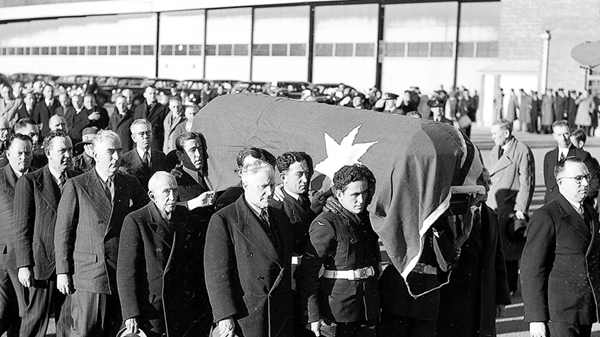
John Curtin's coffin being carried by former Prime Ministers.