


PYNSENT, Alfred Francis
| Service Number: | 5438 |
|---|---|
| Enlisted: | Not yet discovered |
| Last Rank: | Private |
| Last Unit: | 4th Infantry Battalion |
| Born: | Bondi, New South Wales, Australia, 17 July 1896 |
| Home Town: | Canterbury, Canterbury, New South Wales |
| Schooling: | Not yet discovered |
| Occupation: | Stockman |
| Died: | Natural causes, 24 October 1981, aged 85 years, place of death not yet discovered |
| Cemetery: | Not yet discovered |
| Memorials: |
World War 1 Service
| 14 Apr 1916: | Involvement Private, 5438, 4th Infantry Battalion, --- :embarkation_roll: roll_number: '8' embarkation_place: Sydney embarkation_ship: HMAT Ceramic embarkation_ship_number: A40 public_note: '' | |
|---|---|---|
| 14 Apr 1916: | Embarked Private, 5438, 4th Infantry Battalion, HMAT Ceramic, Sydney |
Help us honour Alfred Francis Pynsent's service by contributing information, stories, and images so that they can be preserved for future generations.
Add my storyBiography contributed by Robbie Haig
Pre war.
Alfred Francis Pynsent was born on the 17th of july 1896 in Bondi NSW. He was born to Joseph and Nellie Pysent being the middle child of what would be 11 children. Alfred grew up in Canterbury, Sydney, and went on to graduate high school to become a stockman. Alfred was only 18 years old when Great Britain declared war on Germany on the 4th of august 1914.
An important thing to remember was that this was only the turn of the century and a poor, teenage stockman from Sydney had not yet experienced the world, so war was seen as an opportunity for adventure for thousands of Australian teenagers, Alfred was one of them. When Alfred was 19 years old he forged his Father’s signature to join the Australian Imperial Forces, or the A.I.F, and was shipped off for training in Egypt on the 14th of April, departing on the ship HMAT Ceramic from Sydney. But he was not aware of the 3 years of horror that awaited him.
War experiences
When Alfred Francis Pynsent arrived in Egypt on the 17th of may 1916, he began basic training with the 4th infantry battalion, 17th reinforcement. The 4th battalion was one of the first infantry units to touch down in Egypt as a part of the 1st brigade. The 4th battalion had only returned the previous year from Gallipoli when their Lieutenant, Lieutenant A.J.O Simpson was killed in action, so they naturally needed more recruits.
The A.I.F then decided to split the 4th battalion as ordered by the Australian government, this new action was called, The Expansion and Reorganisation Of The A.I.F in Egypt. Alfred was picked to train with the newly formed 56th battalion, while the 4th battalion was shipped off to the middle east. Although Alfred was not a fan of this, just two months after arriving in Egypt he attempted to join the B.E.F, ( British Expeditionary Forces ).
The 56th battalion first arrived in France on the 30th of june 1917, their first major battle was on the 12th of july when they helped defend the lines at Fromelle for 1 week. The battle was a complete disaster for the Australian as the 56th suffered heavy casualties, still, they sat on the lines at Fromelle for more than two months. After enduring all of this Alfred decided to go on a little journey for a day or two, he was reported AWOL from the 4-5th of september 1916 and was consequently docked 7 days of pay, quite a substantial amount for a family in 1916.
Only 11 days later on the 16th of september 1916, Alfred was shot in the leg while in the Somme Valley. He was immediately transported to a field hospital where he spent 8 days receiving treatment before returning with his battalion. On the 24th of September 1916 Alfred was taken on strength, ( rejoined his battalion ), and spent the rest of the year in the Somme Valley. On the 16th of october 1916 he was again docked 7 days of pay for speaking out and on the 20th of the same month, was fettered and handcuffed for 7 days for falling out on route. This brought about the new year of 1917.
There is not much documentation for Alfred in early 1917 except for a few incident reports and minor battles with his battalion. In June 1917 the 56th battalion participated in the advance on German lines near the Hindenburg line. This successful advance from the first battalion allowed further advance of the 2nd battle on Bullecourt. On the 30th of August 1917 Alfred was sent on furlough, ( leave for soldiers to return home temporarily ) and returned to his battalion on the 14th of September 1917. 12 days later the 56th battalion had one of its largest battle at Polygon wood.
During this 8 day campaign, 5700 Australian soldiers died, but the allies were successful in their efforts. This victory allowed allied advancements on Broodseinde which drastically accelerated war efforts. 2 months later on the 10th of October, Alfred was bayoneted while clearing a German trench. He sustained mild to serious injuries that required medical assistance and left a lifelong scar. After being allocated time to rest after this injury he returned to his battalion on the 23rd of november. Not much is known about Alfred or the 56th battalion up until the start of 1918.
While Alfred was on furlough from the 18th of march 1918 till the 4th of April 1918, the 56th battalion defended the Western Front during a mass invasion from the Germans. Thousands of soldiers died in the defence but the line was held until the Germans retreated. Just 3 days after Alfred returned from leave on the 7th of April he was accidentally burned on the head, neck and hands by a flamethrower. He was immediately transported to Camberwell hospital in London, arriving on the 10th of april.
He spent 4 days in hospital before being sent back on furlough on the 11th of april, only 4 days after he had just returned. Alfred spent 12 days in Australia before being returned to the battlefield on the 23rd of April. There is no record of events up until the 2nd of August when Alfred was admitted to Camberwell hospital after contracting Venereal Disease, ( a Sexually Transmitted disease ). Alfred spent 78 days in hospital recovering from this disease while his battalion launched an offence on the village of Bretonneux.
Alfred then returned to his battalion on the 18th of november, only 2 days later he was gassed in a German offence and on the 23rd of october, contracted Tuberculosis, ( a disease that eats away at the lungs, very fatal ). Alfred spent 39 days in a field hospital slowly deteriorating from Tuberculosis as a vaccine was not yet available. According to his own account, “ If you got TB, you were put at stage 1, if you didn’t get better you kept going up stages until stage 10. Most people died at stage 10, I was at stage 10.”
Fortunately, Alfred was selected to be one of the first soldiers to test a new experimental treatment for Tuberculosis symptoms. While it was not the actual Tuberculosis cure, it was successful in treating his Tuberculosis.
While Alfred was being prepped for return to his battalion he went awol from the 3rd-5th of december and was docked 6 days pay. He then went AWOL one last time on the 9th of December and was docked 2 days pay. After 3 years of war service, Private Alfred Francis Pynsent was returned to Australia on the 19th of January 1919.
Post war
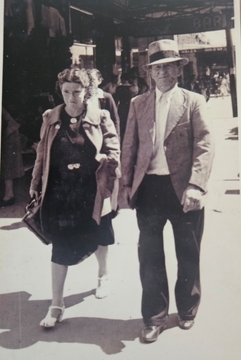
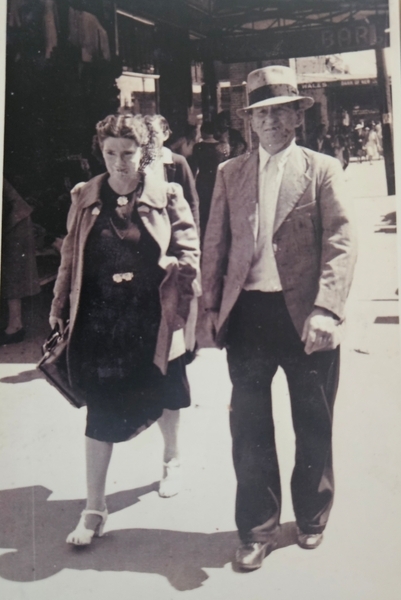
After returning to Sydney Alfred had to undergo 2 weeks of quarantine because of the ongoing Spanish flu epidemic. After the 2 weeks Alfred was truly home, surrounded by his loved ones. Alfred married Elsie Jefferies somewhere in 1921 and went on to have 6 children: Leslie, Joe, Alan, Elsie junior, Joan and Hazel, ( Leslie being my Great grandfather ). Alfred lived quite a normal life after that but one question always remained, what was the war like?
The thing was that people had no idea of what the soldiers experienced in the war. Some soldiers wrote books, some opened up to their families and some vowed silence on the matter. No one in my direct family ever heard anything about Alfred’s war experiences except for one occasion. When my grandmother, ( Alfred’s granddaughter, Leslie's daughter ) brought her boyfriend away on a family holiday. As quoted by my grandmother, “ Your grandfather sat next to Alfred and asked him the simple question, what was the war like?” Alfred then began talking to my grandfather openly about everything he experienced and did during the war. When Alfred left the table my grandmother asked my grandfather what Alfred said, my grandfather replied, “ I can’t tell you, for now.”
My great grandfather, ( Leslie, Alfred's son ) then said to my grandfather, “ You are the only person he has ever told about the war, not his parents or siblings, not his children or even his wife, but you.” This event happened in 1966, that means Alfred held his word for 47 years since he returned home. But the history of war service didn't die in the Pynsnet family as both Leslie and Joe signed up for the WW2 war efforts, they both survived. Upon Alfred's death on the 24th of october 1981, my grandfather could finally tell his kids about who their great grandfather was, and so the story continues.
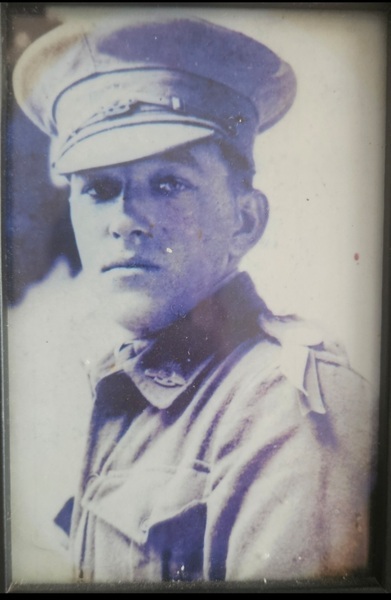
That is the story of my great great grandfather:
Private Alfred Francis Pynsent.
17/7/1896 - 24/10/1981
Click images to start slideshow.