





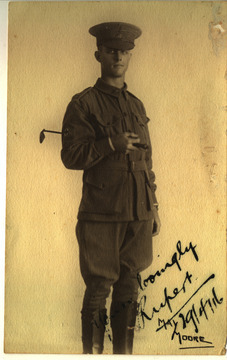
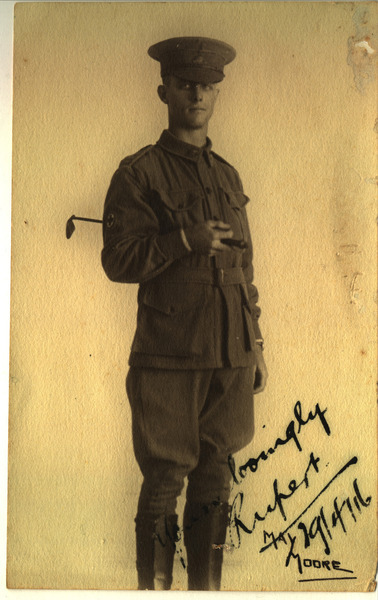
COOKE, Frederick Rupert
| Service Number: | 11931 |
|---|---|
| Enlisted: | Not yet discovered |
| Last Rank: | Private |
| Last Unit: | 9th Field Ambulance |
| Born: | Not yet discovered |
| Home Town: | Not yet discovered |
| Schooling: | Not yet discovered |
| Occupation: | Not yet discovered |
| Memorials: | Mosman Methodist Church Great War Roll of Honour, Pyrmont Dalgety & Company Limited Sydney Branch Staff On Active Service Roll |
World War 1 Service
| 11 May 1916: | Involvement Private, 11931, 9th Field Ambulance, --- :embarkation_roll: roll_number: '23' embarkation_place: Sydney embarkation_ship: HMAT Argyllshire embarkation_ship_number: A8 public_note: '' | |
|---|---|---|
| 11 May 1916: | Embarked Private, 11931, 9th Field Ambulance, HMAT Argyllshire, Sydney |
Some notes by his grandson
I asked my mother (Rupert Cooke's only child) whether she heard any
anecdotes from his service in WW1. She said that he refused to talk about it, and guessed that it was too terrible to discuss.
Rupert Cooke's brother Cecil Henry Cooke is also found on this website.
In addition to the memorial mentioned at the (former) Mosman Methodist Church, both are also commemorated on the Mosman War Memorial in the
park.
He used an ingenious way to keep his relatives informed of his location while he was at the front, while not causing trouble with the
military censor. Before setting off for Europe, his father bought three identical maps of France; he kept one, and gave one to each of
his two sons going to war. When Rupert (or Cecil) wrote home, he aligned his letter paper with the map, and made a pinprick corresponding to his location. When received in Australia, his family could align his letter over their copy of the map, and thus discover
where he was when he wrote.
It is perhaps of interest that when his father wrote to him in 1916, he would sometimes describe his sons as Englishmen, sometimes
Australian. (Henry Cooke was born in England but emigrated to NSW in
1870.)
While on leave in England, Rupert Cooke visited Old Whittington where his father was born and grew up. There is a memorial to his relations at St Bartholomew's: In Affectionate Remembrance of Hannah the daughter of William and Hannah Cooke who died December 9th 1854 aged 9 months, also of Richard their son who died March 25th 1859 aged 3 years and 4 months, also of four children died in infancy, also the above William Cooke who died May 7th 1875 aged 61 years, also of Hannah, wife of the above who died at East Maitland, New South Wales, December 26th 1896, aged 71 years, also of Thomas, youngest son of the above who died at Newcastle, New South Wales June 6th 1910, aged 52
years.
Later in the war, or perhaps just afterwards (he worked at the AIF HQ in London after the armistice) he had the rank of sergeant (his
stripes are still kept in the family).
After WW1 Rupert Cooke played the organ at church. There is a memorial plaque to him at St Jude's Randwick. My mother said that
when it was time to play the national anthem (then "God Save the King"), he would play it in the minor key. Whether this was merely
mischievous humour, or a comment on his time in the King's service, I do not know.
Rupert Cooke died in 1974 and his ashes are interred at the Northern
Suburbs Crematorium (645 TE).
Submitted 14 May 2026 by David Stone
Click images to start slideshow.