





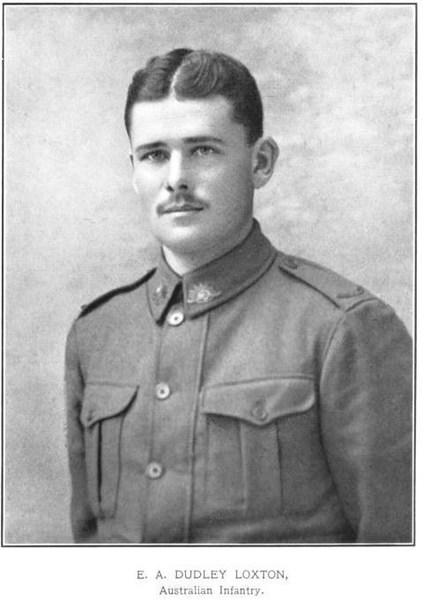
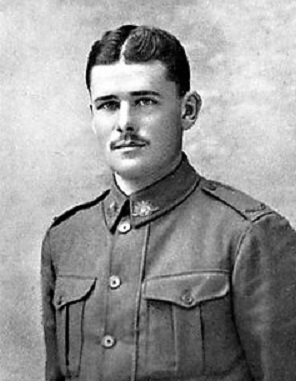
LOXTON, Ernest Adshead Dudley
| Service Number: | 2067 |
|---|---|
| Enlisted: | 10 April 1915 |
| Last Rank: | Private |
| Last Unit: | 9th Infantry Battalion |
| Born: | Teddington, North London, England, 13 February 1889 |
| Home Town: | Toogoolawah, Somerset, Queensland |
| Schooling: | Vesey's Grammar School, England |
| Occupation: | Railway employee |
| Died: | Killed in Action, Meteren, France, 24 April 1918, aged 29 years |
| Cemetery: |
Caestre Military Cemetery Plot I.A.7 |
| Memorials: | Australian War Memorial Roll of Honour, Esk War Memorial, Toogoolawah War Memorial |
World War 1 Service
| 10 Apr 1915: | Enlisted AIF WW1, Private, 2067, 9th Infantry Battalion | |
|---|---|---|
| 16 Apr 1915: | Involvement Private, 2067, 9th Infantry Battalion, --- :embarkation_roll: roll_number: '9' embarkation_place: Brisbane embarkation_ship: HMAT Kyarra embarkation_ship_number: A55 public_note: '' | |
| 16 Apr 1915: | Embarked Private, 2067, 9th Infantry Battalion, HMAT Kyarra, Brisbane |
Help us honour Ernest Adshead Dudley Loxton's service by contributing information, stories, and images so that they can be preserved for future generations.
Add my storyBiography contributed by Ian Lang
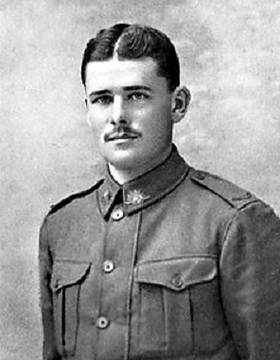
# 2067 LOXTON Ernest Adshead Dudley 9th Battalion
Ernest Loxton, who preferred to be known as Dudley, was born on 13th February 1889 in Teddington, North London. When Dudley was five years old, his father went to South Africa and it appears that young Dudley went to live with his mother’s sister and her husband, Dr Thomas Watson in Birmingham. After completing his education, Dudley began working for an engineering firm in Birmingham. He also served with the Territorial Army for a short time. Around 1911, Dudley emigrated to Australia and by the time of the outbreak of war was working for Queensland Government Railways in Toogoolawah.
Dudley presented himself to the Shire Council offices where the shire chairman signed his enlistment papers on 26th October 1914. Dudley gave his age as 26 years and named his uncle, Dr Watson of Birmingham, as his next of kin. He stated his occupation as station hand. Dudley reported to Chermside Camp where he was placed into the 5th Light Horse. Dudley only remained with the Light Horse for three weeks before requesting a discharge. There is no clue in the files as to the reason for discharge. Perhaps the authorities assumed that the statement of “station hand” was the same as stockman and that Dudley was a good horseman. Dudley returned to his work on the railways and was transferred to Mitchell on the western line.
On 10th April 1915, Dudley presented himself once more to a recruiting depot; this time at Mitchell where he was quickly accepted. He proceeded to Brisbane by train and was taken on by the 5th reinforcements for the 9th Battalion. Six days after taking the oath in Mitchell, Dudley boarded the “Kyarra” in Brisbane for the voyage to Egypt. When the reinforcements landed in Egypt in the middle of May, Dudley had had very little training. Nevertheless, on 22nd June 1915, Dudley was one of 113 reinforcements who waded ashore at Anzac Cove to bivouac with the 9th Battalion in Shrapnel Gulley. The 9th Battalion war diary records that once the reinforcements were organised, intensive training in musketry began so that the reinforcements could be put to good use once the battalion went back into the line.
The situation on the Gallipoli front was difficult for the Australians. Repeated attempts to push the line forward from the precarious positions achieved on the first day all failed. Water was rationed, food was mainly tinned or dried offering little nutrition, and the abundance of flies presented a constant threat of dysentery. The war diary of the 9th Battalion records the high incidence of sickness and the fact that many men continued to occupy the front lines while suffering from illness.
On 18th September, Dudley was reported as being “Missing.” It would take some time before his whereabouts became known to the Battalion. Dudley had in fact reported sick to the 6th Field Ambulance in Shrapnel Valley. The initial diagnosis was influenza and he was evacuated from Anzac Cove by hospital ship and taken to the field hospitals on the island of Lemnos.
The staff at the Australian hospital diagnosed Dudley’s condition as enteric fever (typhoid) and arranged for him to be transferred to the Cottenero Hospital at Malta. Upon arrival in the harbour at Valletta, Dudley’s condition was listed as serious. On 16th October 1915, Dudley, who was by that time dangerously ill, was carried aboard a hospital ship to be transhipped to the Royal Victoria Hospital in Southampton. Dudley remained in hospital for the next six months.
Dudley reported to the convalescent depot at Weymouth on 5th April 1916 where he remained for the next three months. Probably during his stay at Weymouth, he had the opportunity to visit his aunt and uncle in Birmingham. On 25th July, Dudley marched in to the 3rd Training Battalion at Perham Downs where he resumed training in preparation for being sent back to the front. On the 9th August 1916, Dudley rejoined his battalion.
Dudley had been away from the 9th battalion for almost 11 months and during that time the makeup of the battalion had changed considerably. Half of the original battalion from Gallipoli had gone off to create a new battalion. The half that remained were reinforced by brand new recruits from the camps in Egypt. In July 1916, the 9th Battalion had been involved in its first major action on the western front at Pozieres. The combination of new reinforcements and casualties at Pozieres meant that Dudley would have known very few of the battalion’s lower ranks.
Dudley’s stay in France lasted less than three weeks. On 1st September, he reported to the 3rd Canadian Casualty Clearing Station. He was moved on to a Canadian hospital at Boulogne where he was diagnosed with colitis, no doubt caused by the lingering E. Coli infection that had caused his typhoid. For the second time, Dudley was transferred by hospital ship to England and the 3rd Northern General Hospital. Dudley recovered well and was discharged to furlough on 5th October 1916. When the fortnight’s leave expired, Dudley reported back to the convalescent depot at Wareham. He spent the next five months at Wareham before being transferred to the 69th Battalion on 23rd March 1917.
The 69th Battalion was planned to be part of a 6th Division of the AIF. It was being raised in England and numbers were made up from new reinforcements and returning sick and wounded. Dudley was one of the first taken on by the fledgling unit. During the next few months, Dudley uncharacteristically fell foul of military discipline with two bouts of Absent Without Leave and a charge of using foul language on parade. The large AIF casualty count from Bullecourt and Messines during 1917 meant that filling vacancies in existing battalions had a higher priority than forming a new division. The defeat of the 2nd plebiscite on conscription in Australia was the death knell for the 6th Division. On 29th November 1917, Dudley took a night ferry across the English Channel to the large infantry depot at Havre. There his file was amended to indicate a return the 9th Battalion, which he rejoined on 4th December 1917.
All five divisions of the AIF were relieved after the rigours of the Ypres Campaign (sometimes known as Passchendaele) in November 1917 and spent the first months of the winter in billets around Poperinghe. Only eight days after marching in to the 9th Battalion lines, Dudley was back at Havre, this time with a case of VD. He would spend 33 days in the dermatological ward during which his pay was stopped. Dudley returned to the 9th at the end of January 1918.
The latter part of 1917 produced a change in the strategic situation as far as Germany’s command was concerned. The Bolshevik Revolution in Russia brought about the end to fighting on the Eastern Front. A peace treaty between Germany and Russia released up to sixty German divisions which, once re-equipped and re-trained, could be used to press home a distinct advantage on the Western Front. The window for exploiting this advantage was however rather small as the entry of the United States into the war and an expected surge in troop numbers from July 1918 onwards would swing the advantage back to the Entente. The German commander, Ludendorff had only a short time to press home his advantage.
The British Commander, General Haig, was fully expecting a German assault in the spring of 1918 but he guessed incorrectly that the main thrust would be aimed at the Ypres salient in Belgium. When Operation Michael began on 21st March, the main assault was aimed along the line of the Somme River in France. The British 5th Army, which was holding the line astride the Somme was unable to hold the German onslaught. As the British retreated, German Stormtroopers retook all of the gains made by the British in the Somme campaign of 1916 and were within a few days of capturing the vital communication city of Amiens. If Amiens fell, Haig might well lose the war; the situation was deadly serious. To meet the threat, Haig ordered his most successful and battle-hardened troops, four of the five divisions of the AIF in Belgium to race south to establish a defensive line in front of Amiens. The 1st Division AIF, of which the 9th Battalion was part, remained behind in Belgium to meet any threat in that area and to boost the effectiveness of British regiments. The battalion remained in training around Hazebrouck for the first two weeks of April before being ordered up to the front near the village of Meteren. The battalion received orders to take over the front line on 23rd April in preparation for a night attack to take Meteren. During this action, Dudley was brought in to a field dressing station with shrapnel wounds to his shoulder and a perforated lung. Unfortunately, he died on the stretcher before reaching the station.
Dudley was buried in a nearby military cemetery at Caestre. Dudley’s aunt completed the Roll of Honour Circular. Upon Dudley’s death, his aunt probably wrote to her sister to inform her of her son’s death. Mrs Stratton became listed as Dudley’s next of kin. When permanent headstones were being erected by the Imperial War Graves Commission, no details were recorded for Dudley’s grave. His only commemoration is on the Toogoolawah War Memorial.
Click images to start slideshow.