








BLAKE, David
| Service Number: | 6217 |
|---|---|
| Enlisted: | 27 April 1916 |
| Last Rank: | Private |
| Last Unit: | 13th Infantry Battalion |
| Born: | Mount Keira, New South Wales, Australia , 6 May 1889 |
| Home Town: | Wollongong, Wollongong, New South Wales |
| Schooling: | Mt Keira Public School, New South Wales, Australia |
| Occupation: | Miner |
| Died: | Killed in action, France, 4 February 1917, aged 27 years |
| Cemetery: |
No known grave - "Known Unto God" Villers-Bretonneux Memorial, Villers-Bretonneux, Picardie, France |
| Memorials: | Australian War Memorial Roll of Honour, Villers-Bretonneux Memorial, Wollongong Keiraville District Honour Roll, Wollongong Memorial Arch |
World War 1 Service
| 27 Apr 1916: | Enlisted AIF WW1, Private, 6217, 13th Infantry Battalion | |
|---|---|---|
| 9 Sep 1916: | Involvement Private, 6217, 13th Infantry Battalion, --- :embarkation_roll: roll_number: '11' embarkation_place: Sydney embarkation_ship: HMAT Euripides embarkation_ship_number: A14 public_note: '' | |
| 9 Sep 1916: | Embarked Private, 6217, 13th Infantry Battalion, HMAT Euripides, Sydney |
Help us honour David Blake's service by contributing information, stories, and images so that they can be preserved for future generations.
Add my storyBiography contributed by Stephen Brooks
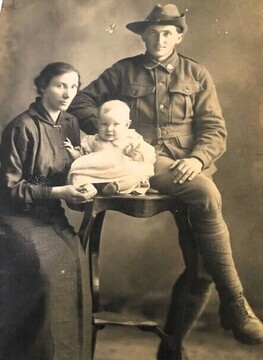
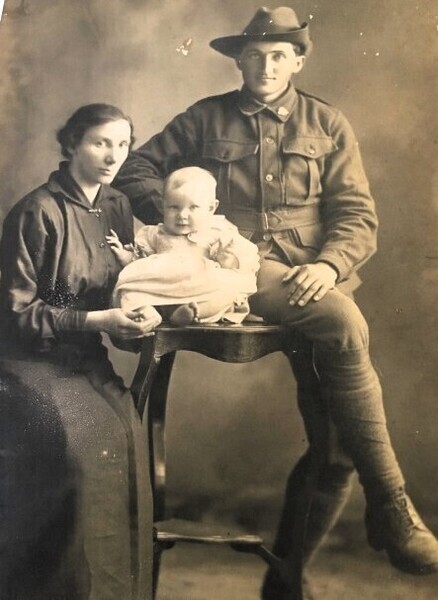
David Blake was the son of Alexander and Christina Blake, of Wollongong, New South Wales. David married Mary Ann Souter in Wollongong during 1913. They had a son born in January 1916 and David enlisted a few months later. He was employed as a miner at the Mount Keira colliery.
David only joined the 13th Battalion at the front on 21 January 1917. He was killed in action less than two weeks later on 4 February 1917. This was during the famous attack on Stormy Trench by the 13th Battalion, in which Harry Murray won the Victoria Cross.
One soldier was a witness to the death of David Blake, 93 Sgt. E.C. Stanford. “I was an eye-witness of this casualty. Blake was a Battalion Bomber and was killed instantly by a shell during attack at Gueudecourt on Feb. 4th 1917. This occurred just after he had gone into the trench known as Stormy Trench. I did not see him buried when I went out, he was lying dead in the trench. He was about 5'3 or 54", medium build, dark complexion.”
The Sydney Evening News reported on 2 March 1917, under the headline
NEWS OF SONS DEATH KILLS MOTHER, WOLLONGONG.
Word has been received that Private D. Blake, of Mount Keira, near Wollongong, has been killed in action in France. When the news was conveyed to his mother she collapsed and died from heart failure, caused by the shock. Private Blake was formerly employed as a miner in the Mount Keira Colliery, and the pit knocked off an hour early to allow the employees to attend Mrs. Blake's funeral.
The Wollongong Illawarra Mercury also reported on the same day,
TRAGIC OCCURRENCE. Mother Dies on Hearing of Son's Death.
“Our Keiraville correspondent writes . — Keiraville continues to be shrouded in gloom; On Wednesday night the Rev. W. E. Weymouth conveyed to Mrs. David Blake the sad news that her husband had been killed in action in France on February 4th. It is only natural that the young wife should be stunned by the news, but it proved too much for the poor old mother of the deceased soldier, and she passed away half an hour after the sad intelligence was conveyed to her. It is only about six months since Private Blake left Sydney, and he must only just have gone into the firing line. He was a splendid young man, and was married to a daughter of Segt. J. Souter, who has also been wounded in France. He was a member of the old Keira Brass Band, and of the Glen Lodge of Druids. Prior to enlisting he was employed as a miner at the Mount Keira colliery. We extend our sympathy to the relatives that have been called upon to bear a double bereavement.”
David Blake’s mother, Christina, died on 28 February 1917, aged 67.
David left a son, who had just turned one year old when he died. His wife, Mary Anne, remarried during 1920.
Click images to start slideshow.