



HOLE, Alec
| Service Number: | 657 |
|---|---|
| Enlisted: | 26 September 1914 |
| Last Rank: | Corporal |
| Last Unit: | 6th Light Horse Regiment |
| Born: | Coonabarabran, New South Wales, Australia , 3 January 1874 |
| Home Town: | Wee Waa, Narrabri, New South Wales |
| Schooling: | Not yet discovered |
| Occupation: | Station overseer |
| Died: | Brisbane, Queensland, Australia, 16 April 1957, aged 83 years, cause of death not yet discovered |
| Cemetery: |
Lutwyche Cemetery, Brisbane, Qld Anzac Portion 8, Lutwyche Cemetery, Brisbane. |
| Memorials: |
World War 1 Service
| 26 Sep 1914: | Enlisted AIF WW1, Private, 657, 6th Light Horse Regiment | |
|---|---|---|
| 22 Dec 1914: | Involvement 657, 6th Light Horse Regiment, --- :embarkation_roll: roll_number: '2' embarkation_place: Sydney embarkation_ship: HMAT Forty-One embarkation_ship_number: A41 public_note: '' | |
| 22 Dec 1914: | Embarked 657, 6th Light Horse Regiment, HMAT Forty-One, Sydney | |
| 24 Feb 1919: | Discharged AIF WW1, Corporal, 657, 6th Light Horse Regiment, 2nd MD |
Help us honour Alec Hole's service by contributing information, stories, and images so that they can be preserved for future generations.
Add my storyBiography contributed by Evan Evans
From Australian Remembrance Army
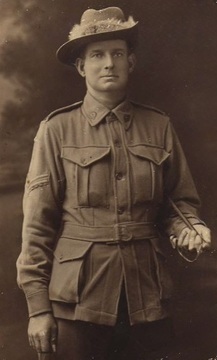
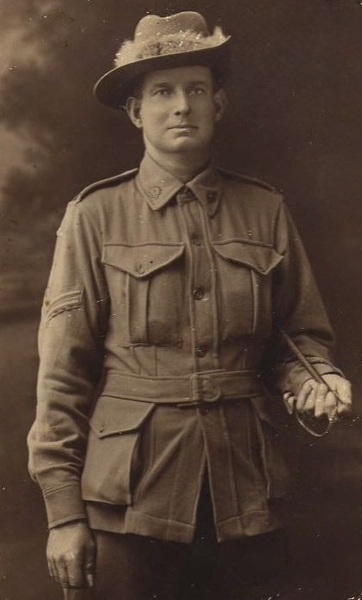
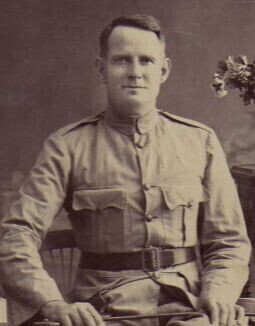
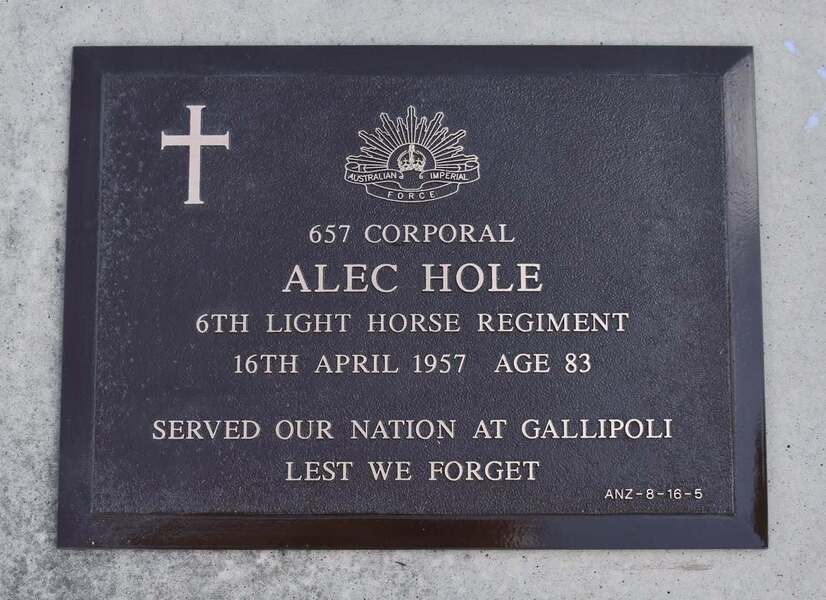
Corporal Alec Hole (Service Number 657), an Australian World War One veteran who served our nation at Gallipoli, is among almost 800 previously unmarked WWI veterans’ graves in Lutwyche Cemetery we have now honoured with a plaque recognising their service for Australia.
On 23 September 2023, his plaque was unveiled in Lutwyche Cemetery, along with a further 300 plaques on the previously unmarked graves of Australian World War One veterans:
See Australian Remembrance Army Facebook page
Alec Hole was born on 3 January 1874 in Coonabarabran, New South Wales to parents Samuel Reynolds Hole and Margaret Amelia Hole (nee Johnston).
Alec (aka Alex) Hole enlisted in the Australian Imperial Force on 26 September 1914, joining the 6th Light Horse Regiment, 1st Reinforcements. He was 40 years and 9 months old, worked as a station overseer, and single. His next of kin was his father C/- Commercial Bank, Wee Waa, New South Wales.
He embarked from Sydney aboard HMAT Lutzow in December 1914 and joined his unit at Gallipoli on 15 May 1915. Within a few months he was hospitalised, suffering from diarrhoea and enteritis, and was admitted to No. 3 Auxiliary Hospital, Heliopolis, on 10 August 1915. He was later transferred to hospitals at Helouan and Zeitoun, where he was treated for recurring illness and returned to light duties in October 1915. In September 1916 he was again admitted to hospital with gastro-enteritis, but returned to duty later that month.
In early 1917, Alec marched out from Kantara to Moascar, joining the 2nd Light Horse Training Regiment. He was attached to the Anzac Rest Hut at Kantara from March to April 1917 before being admitted to the 14th General Hospital in Cairo in August with debility. His health continued to deteriorate, and he was periodically treated for malaria, debility, and rapid pulse, rendering him medically unfit for full duty.
By late 1918, he was serving in the ANZ Training Regiment and was at the Moascar Rest Camp when arrangements were made for his return home. He embarked from Suez aboard the Port Darwin on 15 November 1918, disembarking in Australia on 24 January 1919. Trooper Alexander Hole was discharged from the AIF on 24 February 1919.
Following his return to Australia, Alexander Hole was living at Tweed Heads, northern New South Wales, where he worked as a labourer. By 1954, records show he had moved to Queensland and was residing at the War Veterans’ Home in Caboolture.
Corporal Alec Hole died on 16 April 1957, aged 83, and was buried two days later in Anzac Portion 8, Lutwyche Cemetery, Brisbane. He was never married and had no known children.
After decades without recognition at his place of burial, his grave now bears a plaque commemorating his service to Australia — ensuring his name endures among those remembered for their duty and sacrifice.
His dignity and identity have now been restored.
We have remembered him.
Lest We Forget.
Click images to start slideshow.