







HEALEY, Daniel
| Service Number: | 12386 |
|---|---|
| Enlisted: | 23 September 1915 |
| Last Rank: | Bombardier |
| Last Unit: | 6th Field Artillery Brigade |
| Born: | Launceston, Tasmania, Australia, 29 February 1888 |
| Home Town: | Launceston, Launceston, Tasmania |
| Schooling: | Not yet discovered |
| Occupation: | Labourer |
| Died: | Brisbane, Queensland, Australia, 29 October 1950, aged 62 years, cause of death not yet discovered |
| Cemetery: |
Lutwyche Cemetery, Brisbane, Qld Anzac Portion 8 |
| Memorials: |
World War 1 Service
| 23 Sep 1915: | Enlisted AIF WW1, Gunner, 12386, 6th Field Artillery Brigade | |
|---|---|---|
| 28 Jan 1916: | Involvement Gunner, 12386, 6th Field Artillery Brigade , --- :embarkation_roll: roll_number: '4' embarkation_place: Melbourne embarkation_ship: HMAT Themistocles embarkation_ship_number: A32 public_note: '' | |
| 28 Jan 1916: | Embarked Gunner, 12386, 6th Field Artillery Brigade , HMAT Themistocles, Melbourne | |
| 7 Jun 1919: | Discharged AIF WW1, Bombardier, 12386, 6th Field Artillery Brigade , 6th MD |
Help us honour Daniel Healey's service by contributing information, stories, and images so that they can be preserved for future generations.
Add my storyBiography contributed by Evan Evans
From Australian Remembrance Army
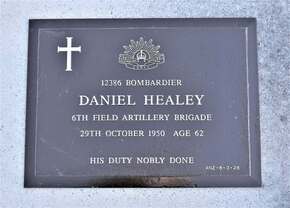
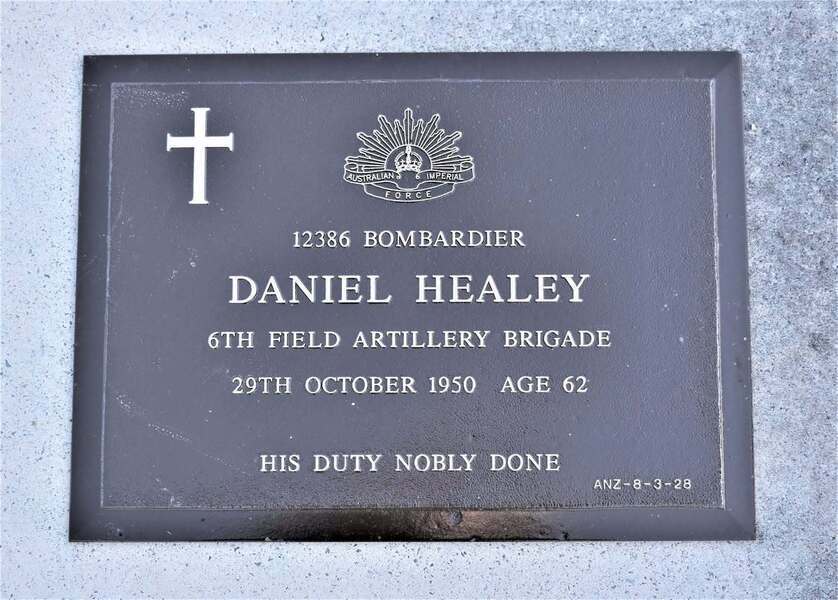
Bombardier Daniel Healey (Service No. 12386), an Australian World War One veteran, is among almost 800 previously unmarked WWI veterans’ graves in Lutwyche Cemetery we have now marked with a plaque recognising their service for Australia.
We unveiled his plaque in Lutwyche Cemetery on 23 September 2023, along with a further 300 plaques on the previously unmarked graves of Australian World War One veterans:
See Australian Remembrance Army Facebook Page
Daniel Healey was born on 29 February 1888 in Launceston, Tasmania, to Thomas William Joseph Healey and Mary Ann Healey (née Elliott). He enlisted in the Australian Imperial Force on 23 September 1915 in Claremont, Tasmania, at the age of 27. Before joining the army, he worked as a labourer and a miner, and he listed his mother, Mary Healey of St Kilda, Melbourne, as his next of kin. He was allocated to the 3rd Reinforcements of the 6th Field Artillery Brigade and departed from Melbourne on 28 January 1916 aboard HMAT Themistocles.
After reaching overseas training depots, Healey was taken on strength of the 2nd Divisional Ammunition Column in March 1916. Later that month he transferred to the 6th Field Artillery Brigade and was posted to the 17th Battery. He proceeded to France with his unit, where, in August 1916, he suffered a scalded foot. His injury required hospital treatment, and on 3 September 1916 he was evacuated to England for further treatment aboard the hospital ship Maheno.
Healey returned to France in December 1916 and rejoined the 6th Field Artillery Brigade in January 1917. He continued to serve with the 17th Battery and was granted leave in the United Kingdom later in 1917. On 20 December 1917 he received a promotion to Bombardier.
In late 1918 Healey became seriously ill. He was admitted to hospital on 30 October with pneumonia and was evacuated to England for further medical care on 22 November. Over the following months he was treated at various hospitals, with diagnoses including pneumonia and influenza. He later continued recuperation at No. 2 Australian General Depot.
Healey remained in convalescence into early 1919. After extended service and recovery from illness, he was discharged from the Australian Imperial Force on 7 June 1919 in Derbyshire, England.
After returning to Australia, he lived in Tasmania before later relocating to various parts of Queensland, where he worked as a labourer.
Bombardier Daniel Healey died on 29 October 1950, aged 62, and was buried in Anzac Portion 8, Lutwyche Cemetery, Brisbane. His death certificate reveals that he was a single man with no children.
After decades without recognition at his place of burial, his grave now bears a plaque commemorating his service to Australia — ensuring his name endures among those remembered for their duty and sacrifice. His identity and dignity have now been restored.
We have remembered him.
Lest We Forget.
Click images to start slideshow.