







BECK, Bernard Redin
| Service Number: | 17507 |
|---|---|
| Enlisted: | 29 July 1916 |
| Last Rank: | Private |
| Last Unit: | 9th Field Ambulance |
| Born: | Cambridge, England, April 1879 |
| Home Town: | Brisbane, Queensland |
| Schooling: | Not yet discovered |
| Occupation: | Book keeper |
| Died: | New Farm, Brisbane, Queensland, 23 April 1946, cause of death not yet discovered |
| Cemetery: |
Lutwyche Cemetery, Brisbane, Qld Anzac Portion 7 |
| Memorials: |
World War 1 Service
| 29 Jul 1916: | Enlisted AIF WW1, Private, 17507, Army Medical Corps (AIF) | |
|---|---|---|
| 1 Aug 1917: | Involvement Private, 17507, Army Medical Corps (AIF), --- :embarkation_roll: roll_number: '23' embarkation_place: Sydney embarkation_ship: HMAT Medic embarkation_ship_number: A7 public_note: '' | |
| 1 Aug 1917: | Embarked Private, 17507, Army Medical Corps (AIF), HMAT Medic, Sydney | |
| 25 May 1920: | Discharged AIF WW1, Private, 17507, 9th Field Ambulance, 1st MD |
Help us honour Bernard Redin Beck's service by contributing information, stories, and images so that they can be preserved for future generations.
Add my storyBiography contributed by Evan Evans
From Australian Remembrance Army
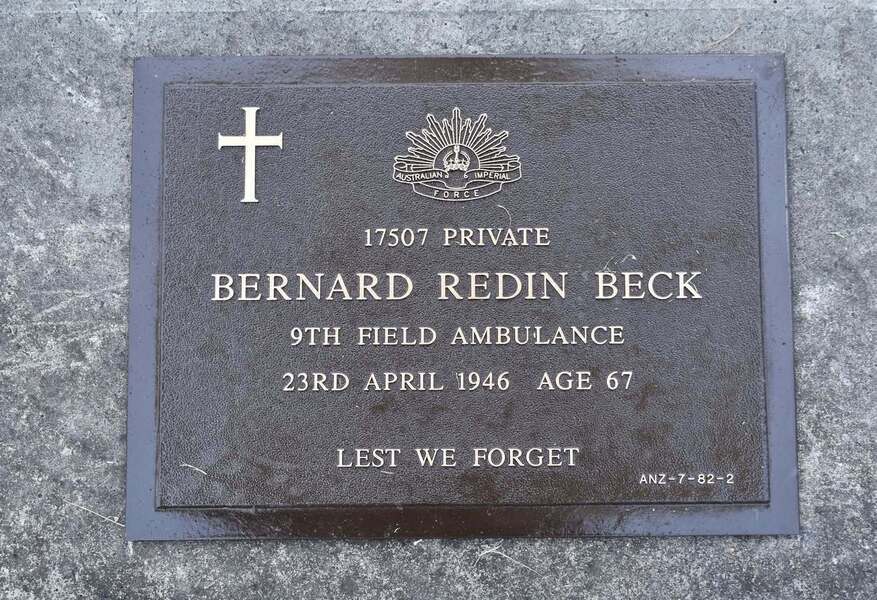
Private Bernard Redin Beck (Service No. 17507), an Australian World War One veteran, is among almost 800 previously unmarked WWI veterans’ graves in Lutwyche Cemetery we have now marked with a plaque recognising their service for Australia.
We unveiled his plaque in Lutwyche Cemetery on 15 April 2023, along with a further 246 plaques on the previously unmarked graves of Australian World War One veterans:
See Australian Remembrance Army Facebook page
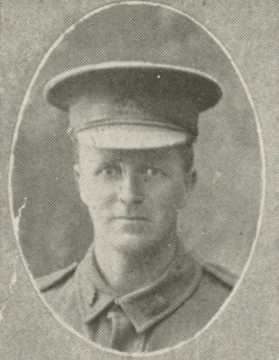
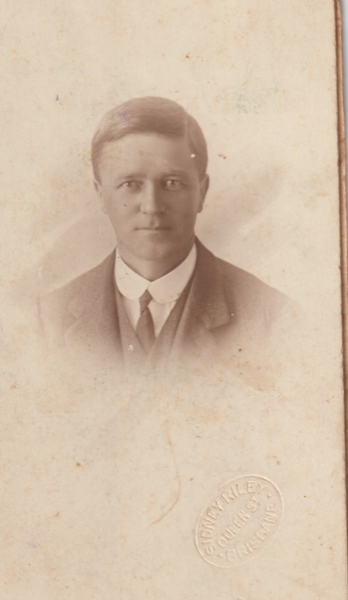
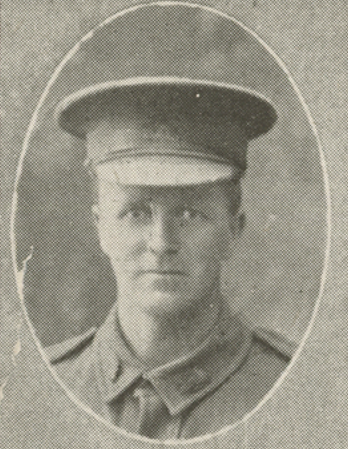
Bernard Redin Beck was born in 1879 in Cambridge, England, to Edward Anthony Beck and Emily Mary Beck (née Clark). He enlisted in the Australian Imperial Force in Brisbane, Queensland, on 29 July 1916, recording his occupation as book keeper and naming his mother, Emily Mary Beck of Trinity Hall, Cambridge, England, as his next of kin. On 1 August 1917, he embarked from Sydney aboard SS Orissa for overseas service.
After disembarking at Liverpool on 3 October 1917, he trained in England before proceeding to France on 18 October 1917. He was taken on strength by the 9th Field Ambulance on 28 October 1917, serving in the demanding conditions of the Western Front as a stretcher-bearer and medical orderly.
In early 1918 he was admitted to hospital with illness, including hernia, requiring treatment across several medical facilities in England and France between January and March 1919. After further hospitalisation in mid-1919, he was granted leave from 5 September to 30 November 1919, with permission to return to Australia at his own expense.
He returned to Australia aboard the Orvieto, arriving on 23 April 1920, and was medically discharged on 24 May 1920.
Following his return to civilian life, Bernard Beck is recorded in 1919 as living at Torrens Creek in Central West Queensland, working as a bookkeeper. By 1925 he was farming at Beerwah, and in 1928 he was residing in the Oxley district of Brisbane, employed as a labourer. In 1930 he was living at Myendetta Station in the Charleville region of Western Queensland, and by 1936 and 1941 he had moved to Charters Towers, where he worked as the bookkeeper at All Souls School. By 1943 he had returned to Brisbane, living in the suburb of New Farm. He remained a single man throughout his life and had no known children.
Private Bernard Redin Beck died on 23 April 1946, aged 67, and was interred in Anzac Portion 7 at Lutwyche Cemetery, Brisbane. His death notice was published in a Brisbane newspaper on Anzac Day 1946: “BECK.— On the 23rd instant, at a private hospital, Brisbane, Bernard Redin Beck, second Son of the late Mr. & Mrs. E. A. Beck, of Trinity Hall, Cambridge.” He was buried the following day.
After almost eight decades without recognition at his place of burial, his grave now bears a plaque commemorating his service to Australia — ensuring his name endures among those remembered for their duty and sacrifice. His identity and dignity have now been restored.
We have remembered him.
Lest We Forget.
Click images to start slideshow.