







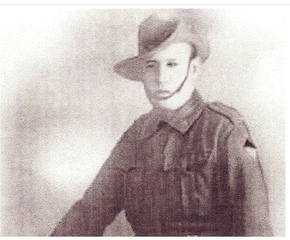
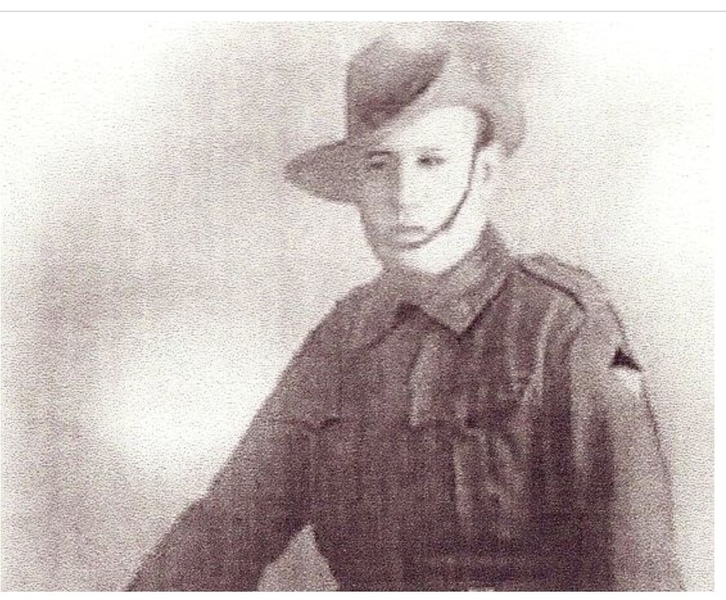
GIMBERT, Walter
| Service Number: | 1810 |
|---|---|
| Enlisted: | 26 June 1915 |
| Last Rank: | Private |
| Last Unit: | 25th Infantry Battalion |
| Born: | Murrurundi, New South Wales. Australia, 12 February 1884 |
| Home Town: | Murrurundi, Upper Hunter Shire, New South Wales |
| Schooling: | Not yet discovered |
| Occupation: | Shearer |
| Died: | Spider bite, Murrurundi ,New South Wales. Australia, 6 December 1948, aged 64 years |
| Cemetery: |
Murrurundi General Cemetery, New South Wales |
| Memorials: |
World War 1 Service
| 26 Jun 1915: | Enlisted AIF WW1, Private, 1810, 2nd/25th Infantry Battalion | |
|---|---|---|
| 20 Aug 1915: | Involvement Private, 1810, 25th Infantry Battalion, --- :embarkation_roll: roll_number: '15' embarkation_place: Sydney embarkation_ship: HMAT Shropshire embarkation_ship_number: A9 public_note: '' | |
| 20 Aug 1915: | Embarked Private, 1810, 25th Infantry Battalion, HMAT Shropshire, Sydney |
Walter Gimbert’s War & life story
Walter was born 12 February 1884 at Murrurundi, born to John & Mary Ann Gimbert nee Maughan. Walter was the third of 10 children, 5sons & 5 daughters. 4 sons were in WW1
and they survived the war but wounded.
17 /10/1915-Gallipoli
30/7/1916-Gun shot shoulder sent to England
17/9/1917-Gun shot chest & left arm Suffolk Hospital England (second occasion)
13/8/1918-Gunshot to chest (3rd occasion)
Returned to Australia from England for discharged
The 25th Battalion was raised at Ennoggera, a suburb of Brisbane, in early 1915, to form the first Battalion of the 7th Brigade in the 2nd Division. The 7th Brigade was drawn from the smaller States. BY late May of 1915 they were embarking for the Middle East but they had precious little training. On arrival in Egypt that deficit was made up and the 7th Brigade began landing at Gallipoli in early September too late for the August Offensive.
Their role was primarily defensive from September until the evacuation in mid December.
Following the extraction of the ANZAC force and its return to Egypt, a major re-structure of the AIF was undertaken. After the raising of the 4th and 5th Divisions (the so-called doubling of the AIF), the 2nd Division embarked for France arriving at Marseilles and then taking the long train journey north.
After a short period in 'The Nursery' near Armentieres / Fleurbaix / Fromelles, the Battalion headed south for the great Somme offensive. The focus of the AIF's endeavours was to be the capture of Pozieres on the right flank of the British front.
The 1st Division had cleared the pulverised remnants of the village all the while under relentless shelling. Casualties mounted at a horrifying rate. The 2nd Division’s job was to extend the line beyond the ruins of a windmill on a hill to the west of the town.
‘The Windmill’, or rather what was left of it was captured by the 2nd Division on 4th August and consolidated by the 4th Division, the direction of the Australian assault switched to Mouquet Farm, with the 1st Division leading once again. The aim was to outflank Thiepval, the main impediment and key objective of the British advance. Bean’s quote, now inscribed on a plinth near the ruins of the Windmill, state:
The ruin of Pozières Windmill which lies here was the centre of the struggle in this part of the Somme battlefield in July and August 1916. It was captured on August 4 by Australian troops who fell more thickly on this ridge than on any other battlefield of the war.
After Pozieres the battalion was sent to Flanders then returned to the Somme to endure the coldest and most bitter winter in living memory. The 7th Brigade was committed to a series of attacks near Flers on a trench system called ‘The Maze’. A repeat was ordered on the 17th November but as had happened on the 4th November, the ground won was lost to subsequent German counter-attacks.
1917 began with a German consolidation of their Front Line and an orderly withdrawal through what were called 'The Outpost Villages'. They used these as fortified posts to conduct a delaying defence. The AIF was tasked to follow this up and a series of engagements ensued around a number of these villages, with the intensity increasing as the Australians approached the main German defence line.
This culminated with their arrival and tasking to attack the German defensive line near Bullecourt. April 11 saw ‘First Bullecourt’, an exclusively 4th Division attack which although successful in breaking in to the German line was not adequately supported and it subsequently failed.
Second Bullecourt followed in May and involved the 1st 2nd and 5th Divisions, with the 2nd Division leading 3-5 May.
Tactically it was very similar to First Bullecourt with a break-in being achieved, the tanks failing - again - and inadequate artillery support because of difficulties getting the guns far enough forward. From a casualty perspective, it was Pozieres all over again.
The 2nd Division was reconstituted and reinforced during the period May -end July, all of the AIF (for the first time including the 3rd Division) was committed to the Third Ypres campaign, an offensive aimed at clearing the high ground surrounding the city of Ypres to deny the enemy observation and the capacity to direct artillery fire on the town. It began well. The 2nd Division was committed to fighting at Menin Road in late September 1917 and at Broodseinde Ridge on 4th October, both of which were resounding successes complemented by Polygon Wood primarily involving the 4th and 5th Divisions on 24/5 September.
However the momentum could not be maintained with the weather playing a major part. The Battalion was engaged in the Battle of Poelcapelle on 9th October, which was really a preliminary operation to capture Passchendaele. Tragically, the The Third Ypres campaign bogged down in the misery of the 1st and 2nd Battles for Passchendaele in late October and November. The 2nd Division played a minor role in the former and none in the latter.
Another winter shut proceedings down until March 1918 with the 2nd Division remaining in Flanders.
Then in late March the Somme front erupted as the Germans unleashed their make or break Spring Offensive , intended to dislocate the French British front and cut Paris off from the Channel Ports to give the Germans the best possible position from which to sue for peace on their terms before the arrival of US forces in large numbers. The 2nd Division defnded b=near the junction of the Somme and Ancre rivers.
In May the Australian Corps was at last formed and General John Monash appointed as its commander, although not without a lot of opposition and thinly veiled anti-Semitism.
Le Hamel was the first test of the new structure, and each Division had at least a token representation in the Order of Battle. It was a set-piece demonstration of the application of Combined Arms theory and it worked perfectly. The 2nd Division contribution comprised elements of the 6th and 7th Brigades, including the 21st 23rd and 25th Battalions on the southern flank of the attack. It was all over in 93 minutes, and Monash’s position as Corps Commander was secure.
A month later and it was time for the main event as the Battalion took its place in the Australian Corps for the Great Allied offensive, the "Last Hundred Days" campaign beginning on the 8th August 1918 with the Battle of Amiens.
The 2nd Division started the Amiens offensive on the left hand flank, but its 'finest hour' would come three weeks later with the attack on Mont St Quentin from 30 August to 2nd September in concert with the 5th Division which cleared the town of Peronne after a risky river crossing of the Somme, and the 3rd Division which secured the Australian Corp's exposed northern flank.
The 6th Brigade’s consolidation of the heights of the Mont was the turning point of the battle, and came only after the initial seizure of the heights was repelled by German counteraattacks.
The Australian Corps was instrumental in the breaching of the Hindenburg Line and it was to be the 2nd Divisions task to finish the AIF's fight on the Beaurevoir line on 5th October
After the 2nd Division attack on the Beaurevoir Line at Montbrehain on the 5th October, the AIF was withdrawn from the line to reinforce and refit following the accumulated losses it had sustained since 8th August. It was still resting and reinforcing when the Armistice was declared on 11 November 1918.
Commanding Officers
Ferguson, George Andrew
Travers, Reginald John Albert
Davis, William MacIntyre
Decorations
2 VC; 3 DSO, 1 bar; 1 MBE; 23 MC, 3 bars; 25 DCM; 92 MM, 4 bars; 4 MSM; 37 MID; 8 foreign awards
Battle /Campaign/ Involvement
ANZAC (/explore/campaigns/1) Apr - Dec 15
ANZAC - Gallipoli (/explore/campaigns/1) 25 April 1915 to 19 December 1915
Pozieres (/explore/campaigns/5) 23 July 1916 to 4 September 1916
Mouquet Farm (/explore/campaigns/103) 8 August 1916 to 5 September 1916
Flers / Guedecourt (/explore/campaigns/24) 4-11 November 1916
German Withdrawal to Hindenburg Line and Outpost Villages(/explore/campaigns/21) 15 February 1917 to 3 April 1917
Second Bullecourt (/explore/campaigns/6) 3 May 1917 to 17 May 1917
Menin Road (/explore/campaigns/26) 20 September 1917 to 25 September 1917
Broodseinde (/explore/campaigns/18) 4 October 1917 to 5 October 1917
Battle of Poelcappelle (/explore/campaigns/27)9 October 1918
Amiens (/explore/campaigns/14) 8 August 1918 to 11 August 1918
Mont St Quentin (/explore/campaigns/15) - 30 August -2 September 1918
Beaurevoir / Montbrehain (/explore/campaigns/128) - 5 October 1918
Walter Gimbert
THE 2nd Division was formed 69 years ago in Egypt on July 26, 1915, under the command of Maj-Gen Legge.
It comprised 5th Brigade from New South Wales, 6th Brigade from Victoria and 7th Brigade comprising battalions from the remaining States of the Commonwealth.
The Division served with distinction at Gallipoli from August 19 to December 20, 1915, when elements of the Division covered the final withdrawal.
WITH the outbreak of WW1 in August 1914, an Australian Imperial Force was formed to fight for the Empire's cause against Germany and Austria-Hungary.
The 1st Division and 1st Light Horse Brigade sailed for the Middle East in October 1914, and with New Zealand and other Allied troops landed at Gallipoli on April 25, 1915.
After the 1st Division and 1st Light Horse Brigades had
departed, the enrolment for service was maintained at such a rate that the Australian Government offered to raise a second contingent of 10,000 men, to comprise the 5th Brigade (17th, 18th, 19th and
20th Battalions from NSW), the 6th Brigade (21st, 22nd, 23rd
and 24th Battalions from Victoria) and the 7th Brigade (25th Battalion — Queensland, 26th Battalion — Queensland and Tasmania, 27th Battalion, — South Australia, and 28th Battalion WesternAustralia).
To these would be added in due course the Divisional Artillery, Engineers, Signals, Pioneers, Machine Guns, Service Corps, Medical, Dental, Veterinary, Supply and Pay units.
On arrival in Egypt in July 1915 approval was given for the three brigades to be formed into 2nd Australian Division, the formal date of raising being promulgated as July 26, 1915.
The Anzac beachhead on Gallipoli was reinforced by the 2nd Division commencing on August 19, 1915; it fought through the last months of that campaign; covering the final withdrawal from Anzac on December 20, 1915.
The 2nd Division moved from Egypt, to France, with the 1st Division and the newly formed 4th and 5th Divisions in March-April 1916 and was the first to enter, the line near Armentieres on April 7, 1916.
In the Battle for the Somme it commenced the relief of 1st Division, after it had captured Pozieres, on July 26.
In 12 days of intense fighting, probably, the heaviest German bombardment of the war and following two major attacks, the 2nd
Division secured the Pozieres Ridge, at a cost of 6,848 officers and men, the highest loss of any Australian division in one action before or since.
The Division fought with distinction until the Armistice in 1918.
Battle honours won by its infantry included, as well as the Somme and Pozieres: Bullecourt, Bapaurrie, Ypres, Menin Road, Polygon Wood, Broodseinde, Poelcapelle, Passchendaele, Hamel, Amiens Albert, Hindenberg Line, and Beaurevoir.
Its most outstanding victory was at Mont St Quentin on August 31 and September 1. 1918, when the Division captured the Mount from the newly reinforced 2nd German Guards Division.
Three Victoria Crosses; Sgt Lowerson of 21 Bn, Pte Mactier of 23 Bn, and Lt Towner of 2nd Machine Gun Bn were won at Mont St Quentin, with a total of 13 VCs awarded for the Division inWW 1.
Disbanded in France on March 20, 1919, the 2nd Division was reformed in NSW as a CMF division on March 31, 1921, with 5th, 9th and 14th Brigades and Divisional troops.
The Muswellbrook Chronicle Saturday 15 January 1916
Mr. John Gimbert, of Murrurundi, has four sons enlisted, namely, Alf, Jack, Walter, and Arthur. The last named two are at the front, and have been in the trenches.
The Scone Advocate Tuesday 20 November 1917
Mrs. Gimbert, of Wingen, has been notified that her husband, Private Walter Gimbert has been severely wounded — gunshot wound to the face — in the fighting in France.
After the war Walter married 1920 Maude Ena Foster at Auburn N.S.W.
Walter & Maude had nine children.
The Australian Worker (Sydney, NSW : 1913 - 1950)Wednesday 22 December 1948 - Page 9
I have been advised by Mr. N. W. Gimbert of the death of his father, Mr. Walter Gimbert, at Murrurundi on December 5.
Our late member whilst employed by the Murrurundi Shire Council was bitten by an insect on the upper lip. He developed an itchy, rash all over the body, which was followed by the insect bite, and died.
Walter Gimbert was, a member of the A.W.U. for 30 years, and it is with sincere regret that I report his death. I desire to convey to the relatives of our late member the Union's sincere sympathy and to add that the matter is being investigated by our solicitors, J. J. Carroll, Cecil O'Dea & Co.
Submitted 17 January 2026 by Kerry Hockey
Click images to start slideshow.