






S19349
LEAK, John
| Service Number: | 2053 |
|---|---|
| Enlisted: | 28 January 1915, Rockhampton, Queensland |
| Last Rank: | Private |
| Last Unit: | 9th Infantry Battalion |
| Born: | Portsmouth, England, February 1892 |
| Home Town: | Rockhampton, Rockhampton, Queensland |
| Schooling: | Not yet discovered |
| Occupation: | Teamster |
| Died: | Natural causes, Adelaide, South Australia, Australia, 20 October 1972 |
| Cemetery: |
Stirling District Cemetery, S.A. |
| Memorials: | Adelaide 150 Jubilee Commemorative Pavement Plaques - WW1 VC Recipients, Adelaide Torrens Training Depot, Keith Payne VC Memorial Park, North Bondi War Memorial, Rockhampton John Leake VC Memorial, South Australian Garden of Remembrance , Winchelsea Memorial |
World War 1 Service
| 28 Jan 1915: | Enlisted AIF WW1, Private, 2053, Rockhampton, Queensland | |
|---|---|---|
| 16 Apr 1915: | Involvement AIF WW1, Private, 2053, 9th Infantry Battalion, Enlistment/Embarkation WW1, --- :embarkation_roll: roll_number: '9' embarkation_place: Brisbane embarkation_ship: HMAT Kyarra embarkation_ship_number: A55 public_note: '' | |
| 16 Apr 1915: | Embarked AIF WW1, Private, 2053, 9th Infantry Battalion, HMAT Kyarra, Brisbane | |
| 22 Jun 1915: | Involvement AIF WW1, Private, 2053, 9th Infantry Battalion, ANZAC / Gallipoli | |
| 23 Jul 1916: | Involvement AIF WW1, Private, 2053, 9th Infantry Battalion, Battle for Pozières , (Awarded VC) | |
| 31 May 1919: | Discharged AIF WW1, Private, 2053, 9th Infantry Battalion |
Not perfect but perfectly brave
Private John Leak of the 9th Battalion was awarded the Victoria Cross for extraordinary bravery at Pozieres on 23 July 1916. Leak’s platoon was suffering casualties from Germans throwing hand grenades into their trench from an elevated position. Leak climbed out of his trench alone and single-handedly assaulted the German trench, killing three occupants. His comrades then came up to him to occupy the new trench. The Germans then counter-attacked and the Australians withdrew with Leak the last to leave providing covering fire so that his comrades could get out. Leak was uninjured and the trench was later retaken by the Australians. In 1917, Leak’s discipline deteriorated. Beginning in January of that year, he was reprimanded for entering the Officer’s Mess and demanding drink. This was compounded by a defiant rejection of orders to leave by the officers present. He was then found guilty of taking absence without leave (AWL) on three separate occasions. By October 1917, a recuperated Leak was posted to Belgium and offended again. This time, more seriously as his AWL was from the frontline. He faced a Field General Court Martial on November 25, 1917, for absenting himself from November 1 until 6. On December 15, the outcome was a suspended sentence. It is important to bear in mind the gravity of this offence during this period in military history. Soldiers were being executed for these transgressions. Leak was perhaps leniently dealt with because of his VC. The very thing that almost got him killed in 1916, saved his life in 1917. In March 1918, Leak was again wounded in action and taken from the battlefield, following a gas attack. He spent the next months in English hospitals but was well enough to again be AWL in May of that year. Further charges of insolence to commanding officers followed before he returned to France in June 1918. He survived the last few months of war, but the gas poisoning was to have a lasting effect on his health. Leak was not a perfect human, but he was a brave one. There is a memorial to him in Rockhampton, Queensland.
Submitted 28 August 2019 by John Phelan
Biography contributed
He charged a German machine gun nest alone, bayoneted three men, then wiped the blood from his blade with his slouch hat. A year later, standing before a court-martial for desertion, he said simply: I cannot stand the artillery fire.
John Leak was born around 1892 in Portsmouth, England. His origins are shrouded in mystery. He claimed at various times to have been born in Canada, Australia, England, or Wales. No birth record has ever been found. What we know is that by the time war came, he was living in Rockhampton, Queensland, working as a teamster.
On January 28, 1915, Leak enlisted in the Australian Imperial Force. He was short and slight, just 167 centimetres and 59 kilograms, with dark hair and thick eyebrows. What he lacked in size, he made up for in something harder to measure: a reckless, almost defiant courage that made him indifferent to danger and contemptuous of authority.
He served at Gallipoli, suffering bouts of dysentery that sent him to hospitals in Malta and England. When the campaign ended, he rejoined his unit and sailed for France. It was there, in the summer of 1916, that John Leak would create a legend in fifteen minutes of extraordinary violence.
The Battle of Pozières was one of the bloodiest engagements in Australian military history. Over seven weeks, 23,000 Australians would become casualties. The official historian Charles Bean called it more densely sown with Australian sacrifice than any other place on earth.
On July 23, 1916, Leak's 9th Battalion was pushing forward when they were pinned down by a German strong point supported by two machine guns. The German grenades outranged the Australian Mills bombs. Every attempt to advance was driven back.
Then John Leak did something that defied every instinct of self-preservation.
He climbed out of the trench alone and ran forward under heavy machine gun fire at close range. He threw three grenades into the enemy post. Then he leapt in among them with his bayonet.
By the time the rest of his platoon reached the position, Leak was standing among the dead, calmly wiping blood from his bayonet onto his slouch hat.
The fighting was not over. German counterattacks drove the Australians back. But Leak was always the last to withdraw at each stage, hurling bombs to cover his comrades' retreat. His ferocity weakened the German defence so severely that when reinforcements arrived, the position was retaken.
For this action, John Leak was awarded the Victoria Cross. On November 4, 1916, while recovering from wounds received at Mouquet Farm, he stood before King George V at Buckingham Palace to receive the highest military honour the British Empire could bestow.
Photographs from that day show him looking uncomfortable, almost sullen, while his companions beam with pride. Among them was a young Welsh woman named Beatrice Chapman, who can be seen discretely holding his hand.
But the war was not finished with John Leak.
He returned to the front in October 1917. Almost immediately, his behaviour began to deteriorate. In January, he was reprimanded for barging into the Officers' Mess and demanding a drink, then refusing to leave when ordered. He went absent without leave on multiple occasions.
Then came the incident that nearly cost him everything.
On November 1, 1917, as his unit prepared to move into the front-line trenches near Zonnebeke, Belgium, Leak disappeared. He was arrested five days later. On November 23, he stood before a Field General Court Martial, charged with desertion.
It is important to understand what this meant. Soldiers were being executed for desertion. The firing squad was a real and present consequence for men who abandoned their posts.
When asked to explain his actions, Leak said simply: I cannot stand the artillery fire.
The court found him guilty. The sentence was penal servitude for life, the most severe punishment available for Australian forces. This was later commuted to two years hard labour.
And then something remarkable happened.
The sentence was suspended. John Leak, convicted deserter, was returned to his unit on December 23. The Victoria Cross he had earned by charging a German position alone had saved him from the consequences of being unable to endure what came after.
The very thing that almost got him killed in 1916 saved his life in 1917.
He continued to serve, but on March 7, 1918, during a gas attack near Hollebeke, Leak was severely poisoned. The damage to his lungs would plague him for the rest of his life. He spent months in English hospitals and was absent without leave again in May. Further charges of insolence to commanding officers followed.
He survived to the Armistice. On December 30, 1918, just weeks after the war ended, John Leak married Beatrice Chapman at St John the Baptist Church in Cardiff. She was twenty-one years old. They had known each other since at least 1916, when her family had been helping him search for his Welsh roots.
Six weeks later, Leak sailed for Australia. His young bride was supposed to follow, but the Australian government would not fund her passage, and he could not afford it himself.
Beatrice never came to Australia.
She stayed in Wales, living with her parents under her maiden name, until at least 1935. After that, she disappeared from records entirely. What happened to the Welsh girl who held John Leak's hand outside Buckingham Palace remains unknown.
Leak drifted. He worked in Queensland, then New South Wales, then South Australia, then Western Australia. In 1927, he married again, this time to Ada Victoria Bood-Smith. The couple were devoted to each other and had eight children together.
But the war never let him go.
John Leak was severely affected by his experiences. He would not talk about his service, even to his own family, until very late in life. He did not attend reunions. He did not march on Anzac Day. He stored his Victoria Cross in a box in his bedroom, and it largely stayed there.
When he finally did speak of the war, he remembered dead comrades and also those he had killed.
The gas that poisoned his lungs in 1918 eventually manifested as bronchitis and emphysema. In 1964, his beloved Ada died suddenly. Eight years later, on October 20, 1972, John Leak died at Redwood Park in Adelaide. He was buried beside Ada in Stirling Cemetery.
He had faded into such obscurity that for decades, few remembered him. It was not until April 20, 2012, forty years after his death, that a monument was finally unveiled in Rockhampton to honour Queensland's first Victoria Cross winner.
Think about what John Leak's story tells us.
He was brave beyond comprehension. He charged machine guns alone. He bayoneted three men and covered his platoon's retreat with such ferocity that an enemy position was retaken. For fifteen minutes on a July day in France, he was invincible.
But courage in one moment does not make a man immune to terror in all the others. The same soldier who charged into certain death could not endure the endless waiting, the constant shelling, the slow destruction of the mind that trench warfare inflicted on so many.
His Victoria Cross saved him from the firing squad when he broke. But nothing could save him from the memories.
He abandoned one wife and spent decades haunted by the faces of men he had killed. He kept his medal in a box. He refused to march on Anzac Day. He lived with lungs slowly destroyed by the gas that poisoned him in 1918.
John Leak won the Victoria Cross for fifteen minutes of extraordinary courage. He spent the next fifty-six years paying for it.
Some things deserve to be remembered. Not just the moment of glory, but everything that came after.
John Leak deserved better.
Biography
'English-born John Leak (1892-1972) came to Australia as a boy and in January 1915 enlisted in the AIF. He served on Gallipoli and next year accompanied his unit to France, in time to be thrown into the bloody fighting at Pozières. In a battle notorious for its scale and intensity, Leak's solo attack with bombs and bayonet on a German post stood out. In a further action on 21 August he was wounded.
Few came out of Pozières without physical or mental scars and this brave soldier was no exception, yet he served on only to be severely gassed in March 1918. After a few jobs, Leak became a garage proprietor in Western Australia, before retiring to South Australia, where he died.' - SOURCE (www.awm.gov.au)


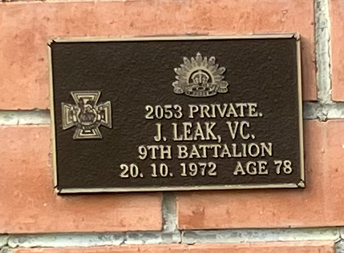
Click images to start slideshow.