







COE, Frederick Charles
| Other Name: | KEMP, Frederic |
|---|---|
| Service Numbers: | 1010, 65081 |
| Enlisted: | 21 August 1914 |
| Last Rank: | Private |
| Last Unit: | 1st to 8th (QLD) Reinforcements |
| Born: | Lowestoft, Suffolk, England, 17 July 1885 |
| Home Town: | Cairns, Cairns, Queensland |
| Schooling: | Not yet discovered |
| Occupation: | Cane farmer |
| Died: | Drowning by accident, near Cleveland, Brisbane, Queensland, Australia, 3 May 1944, aged 58 years |
| Cemetery: |
Lutwyche Cemetery, Brisbane, Qld ANZAC-7-85-23 Death officially 29/7/1944 but fell overboard 3/5/1944 |
| Memorials: |
World War 1 Service
| 21 Aug 1914: | Enlisted AIF WW1, Lance Corporal, 1010, 9th Infantry Battalion | |
|---|---|---|
| 24 Sep 1914: | Involvement Lance Corporal, 1010, 9th Infantry Battalion, --- :embarkation_roll: roll_number: '9' embarkation_place: Brisbane embarkation_ship: HMAT Omrah embarkation_ship_number: A5 public_note: '' | |
| 24 Sep 1914: | Embarked Lance Corporal, 1010, 9th Infantry Battalion, HMAT Omrah, Brisbane | |
| 1 May 1915: | Wounded Gallipoli. Evacuated due to dysentry and chronic anaemia. | |
| 19 Mar 1918: | Discharged AIF WW1, 1010, Returned to Australia in Dec 1917 due to chronic anaemia. | |
| 20 Sep 1918: | Enlisted AIF WW1, 65081, Re-enlisted using the false name of Frederick Kemp. Although his sickness was successfully hidden, Fred spent 3 days in Brisbane hospital before embarkation. | |
| 7 Nov 1918: | Involvement Private, 65081, 1st to 8th (QLD) Reinforcements, --- :embarkation_roll: roll_number: '20' embarkation_place: Sydney embarkation_ship: SS Carpentaria embarkation_ship_number: '' public_note: '' | |
| 7 Nov 1918: | Embarked AIF WW1, 65081, Embarked at Sydney per "SS Carpentaria" with 8th Qld Reinforcements. Troopship recalled. Returned 28th November. | |
| 7 Nov 1918: | Embarked Private, 65081, 1st to 8th (QLD) Reinforcements, SS Carpentaria, Sydney | |
| 28 Dec 1918: | Discharged AIF WW1, Fred's English bride, Kate Beatrice Jackson, and his son, Peter remained in England. |
Fred Coe
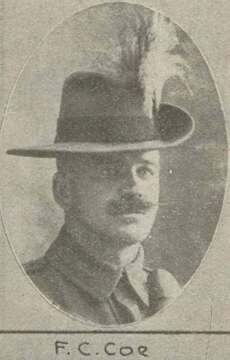
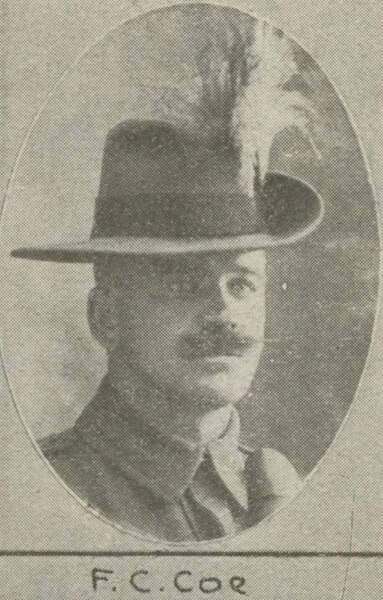
Frederick Charles Coe migrated to Australia in 1908 after serving 8 years in the British Army in India. When war broke out, he was farming bananas at Smithfield, just outside of Cairns.
Previous military experience meant he was almost immediately promoted to Sergeant. At the Gallipoli landing, he was put in charge of the 9th Battalion Scouts.
Fred was one of the first to step ashore at Gallipoli and fought valiantly to hold the left flank on the first day.
Fortunately Sergeant Coe was also a capable communicator who enjoyed writing. His letters provide us with a very personal and accurate record of events.
‘We touched shore, and Lieutenant Chapman was the first man ashore. I followed him, and we all got ashore. Private AK Wilson was taking my pack off when the first shot rang out; a pause; then seven more…..” (from the Preface to The Story of Anzac, Volume 1, 3rd Ed. by Dr C.E.W. Bean, pxii)
A letter penned from his hospital bed in 1915, described the landing,
‘In justice to the late Major Beresford Robertson, Lieut. Rigby, and the men who fell with them, and who consequently cannot speak for themselves, and as one of the very few of the survivors, I will attempt to give their friends an idea of what they did ….
The part done ..(a grand thing).. was accomplished with about only 70 men. We cleared the second ridge by 10 o’clock and it was at 2 o’clock we got it heavy. We were on the extreme left flank, and at 2.30 the Turks put six battalions on to us.
We, on the left, got a goodly share of them, as it was the key of the position, for if they beat us back they could have enfiladed the centre and the right, so there was no retiring where we were.
Major Robertson was doing his utmost to get reinforcements up to us, but the shrapnel was so thick…. Major Robertson told me to hold a trench with 32 men and went away to get reinforcements for us. He was bowled over by a burst of shrapnel, and died a brave gentleman. Lieut. Rigby got a bullet soon afterwards……..
At half-past 5, out of 33 we had in the trench on the left, only two were left, and we were forced to retire, expecting death at any moment. Then down below we heard the glorious cry ring out. ‘Come on, the Otago Regiment!’ Shall I ever forget it? Up they came and we dug in on the first ridge, and with Major Dawson’s men held the enemy. Of our original 70, under Major Robertson, I think only 6 are left.’
(from Brisbane Courier, 18th August 1915, page 7)
Submitted 20 October 2016 by Peter Burgess
Biography contributed by VWM Australia
Reenlisted in 1918 under alias Frederic Kemp
Biography contributed by Evan Evans
From Australian Remembrance Army
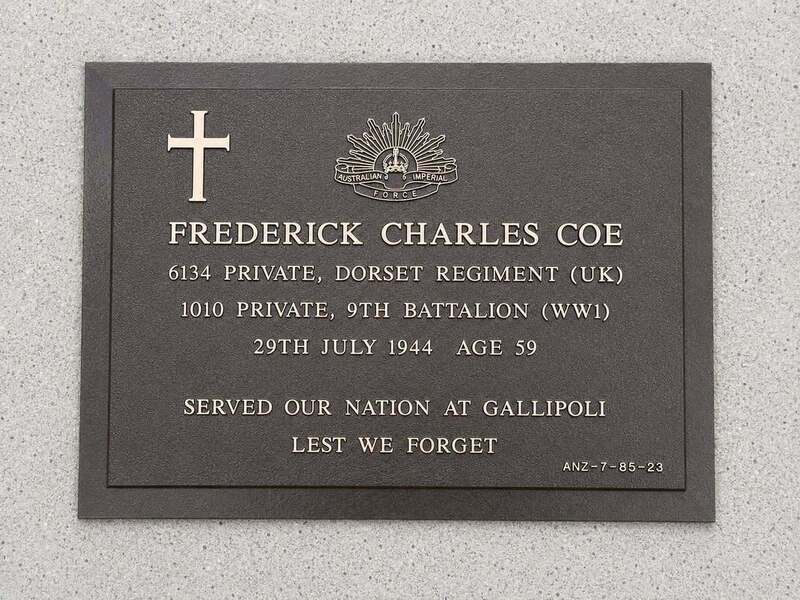
Private Frederick Charles Coe, Service No. 1010, an Australian World War One veteran who served our nation at Gallipoli, is among almost 800 previously unmarked WWI veterans’ graves in Lutwyche Cemetery we have now marked with plaques in recognition of their service for Australia.
We unveiled his plaque in Lutwyche Cemetery on 15 April 2023, along with a further 246 plaques on the previously unmarked graves of Australian World War One veterans:
See Australian Remembrance Army Facebook page
Frederick Charles Coe, also recorded as Francis Charles Coe and Frederick Charles Kemp, was born in 1885 at Lowestoft, Suffolk, England, to John Charles Coe and Jane Harriet Coe, née Kemp.
He enlisted in the Australian Imperial Force at Enoggera, Brisbane, on 21 August 1914. At the time, he was single, 29 years of age, and working as a farmer. He nominated his brother in England as his next of kin, and his attestation papers recorded eight years’ previous service with the Dorset Regiment.
Private Coe was allotted to the 9th Battalion and embarked from Brisbane aboard HMAT Omrah on 24 September 1914.
Coe served with the 9th Battalion in Egypt and during the Gallipoli campaign. His records show repeated illness, including anaemia, dysentery and pyrexia. In June 1915, he was admitted to hospital at Gaba Tepe, Gallipoli, suffering from post-dysentery anaemia, and was later treated through hospital ship and base hospital channels. He was evacuated from the Mediterranean theatre and embarked for England in September 1915.
After further treatment and recovery in England, Coe returned to active service in France in April 1916 and rejoined his unit in the field in May. On 2 June 1916, he was wounded in action in France, suffering a fractured radius and ulna, also recorded as a gunshot wound to the arm. He was evacuated through field ambulance and ambulance train channels to England, where he underwent further hospital treatment and convalescence.
In 1917, he had further treatment for chronic anaemia. In December 1917, he was returned to Australia aboard HMAT Persic for discharge due to chronic anaemia. After a delay at Cape Town, he continued his return journey and was discharged from the AIF on 19 March 1918.
Coe’s post-war Repatriation file records a complex family history. In 1918, he applied for free passage for his wife, Kate Beatrice Coe, and his child, Peter Coe, then living at 26 Lowman Road, Holloway, England, although the file notes there was no indication the passage was used. In 1940, when applying for a war pension, he stated that his wife was Florence Ellen, that they had married in 1925, and that they were living apart.
By 1940, Coe was living at Caloundra and applied for recognition of disability affecting his left forearm and wrist. He stated that the injury had resulted from his 1916 wounding at Fleurbaix and had left him with weakness and limited movement. Repatriation accepted the fractured left radius and ulna as due to war service and granted him a 10 per cent war pension from 3 September 1940.
Newspaper reports stated that on 29 July 1944, decomposed remains were found among mangroves at Coochie Mudlo Island, near Cleveland. The body was believed to be that of Frederick Charles Coe, also known as Frederick Charles Kemp, who had disappeared about three months earlier after leaving Cleveland alone in a dinghy to fish and inspect crab pots in Moreton Bay. His dinghy was later found stranded on Moreton Island, and it was thought he had fallen overboard and drowned.
As the exact date of death could not be established, his death was registered as 29 July 1944, the date his body was found. The Queensland death registration was recorded under the name Frederick Charles Kemp and named his parents as John Charles Coe and Jane Harriet Kemp. He was buried in early August 1944 in Anzac Portion 7, Lutwyche Cemetery, Brisbane.
After decades without recognition at his place of burial, his grave now bears a plaque commemorating his service to Australia — ensuring his name endures among those remembered for their duty and sacrifice.
His identity and dignity have now been restored.
We have remembered him.
Lest We Forget



Click images to start slideshow.