







HALL, David
| Service Number: | 6260 |
|---|---|
| Enlisted: | 30 October 1915 |
| Last Rank: | Private |
| Last Unit: | 9th Infantry Battalion |
| Born: | Brisbane, Queensland, Australia, 16 May 1884 |
| Home Town: | Ayr, Burdekin, Queensland |
| Schooling: | Not yet discovered |
| Occupation: | Farmer |
| Died: | Meningitis, Brisbane, Queensland, Australia, 29 March 1920, aged 35 years |
| Cemetery: |
Lutwyche Cemetery, Brisbane, Qld Monumental General Portion 5 |
| Memorials: |
World War 1 Service
| 30 Oct 1915: | Enlisted AIF WW1, Private, 6260, 9th Infantry Battalion | |
|---|---|---|
| 7 Sep 1916: | Involvement Private, 6260, 9th Infantry Battalion, --- :embarkation_roll: roll_number: '9' embarkation_place: Brisbane embarkation_ship: HMAT Clan McGillivray embarkation_ship_number: A46 public_note: '' | |
| 7 Sep 1916: | Embarked Private, 6260, 9th Infantry Battalion, HMAT Clan McGillivray, Brisbane | |
| 7 Dec 1918: | Discharged AIF WW1, Private, 6260, 9th Infantry Battalion, 1st MD, Medically discharged (wounding) |
Help us honour David Hall's service by contributing information, stories, and images so that they can be preserved for future generations.
Add my storyBiography contributed by Evan Evans
From Australian Remembrance Army
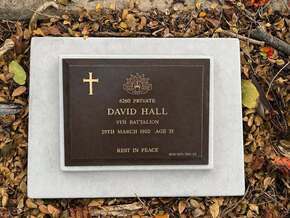
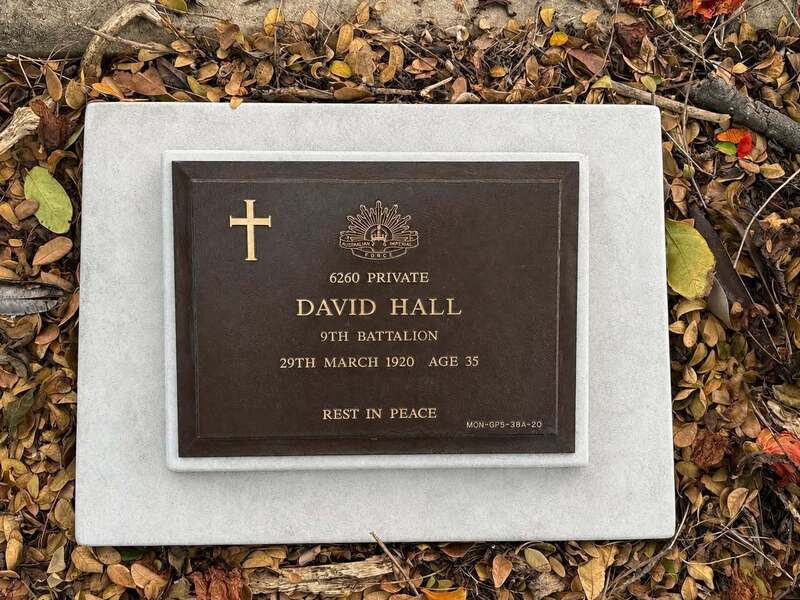
Australian World War One veteran Private David Hall (Service No. 6260), is among almost 800 previously unmarked WWI veterans’ graves in Lutwyche Cemetery we have now marked with plaques in recognition of their service for Australia.
We unveiled his plaque in Lutwyche Cemetery on 16 May 2026, along with a further 185 plaques on the previously unmarked graves of Australian World War One veterans:
See Australian Remembrance Army Facebook page
David Hall was born in Brisbane, Queensland, on 16 May 1884 to William Hall and Catherine Hall, née O’Brien. Before the First World War he worked as a farmer at Plumtree Farm near Ayr in North Queensland.
Hall enlisted in the Australian Imperial Force at Townsville on 30 October 1915 at the age of 29. His mother, Mrs K. Hall of Plumtree Farm, Lower Burdekin, Ayr, was listed as his next of kin. He joined the 9th Battalion, 20th Reinforcement, as a Private and embarked from Brisbane aboard HMAT A46 Clan McGillivray on 7 September 1916. After arriving in England at Plymouth on 2 November 1916, he proceeded overseas to France via Folkestone aboard the Princess Clementine in December 1916, before joining the 9th Battalion on the Western Front in early January 1917.
Hall’s casualty forms reveal the difficult conditions of trench warfare and the repeated illnesses and injuries that interrupted his service. In April 1917 he was admitted to hospital suffering from influenza and was transferred through several medical units in France, including Wimereux, Boulogne, Escault, and Étaples. After a period in convalescent depots he rejoined the 9th Battalion in July 1917. Only months later, in September 1917, he was again evacuated sick, this time suffering from a severe “scald foot”, a painful condition caused by prolonged exposure to wet and cold conditions in the trenches. He was treated through casualty clearing stations and hospitals at Étaples and Boulogne before eventually returning to his battalion in January 1918.
On 23 April 1918, during fighting in Belgium near Meteren, Hall was severely wounded in action by fragments from a high explosive shell. His records describe multiple shell wounds to both legs, his left foot, and right arm. A shell fragment penetrated his left foot and fractured the third metatarsal bone, while numerous foreign bodies had to be removed under anaesthetic. He was transferred through a succession of hospitals in France before being evacuated to England and admitted to the Ontario Military Hospital at Orpington, Kent. Medical reports noted that his wounds were slow to heal and that he had suffered destruction of muscle in his right calf. One assessment recorded that he had effectively lost the use of both legs as a result of his wounds.
A Medical Board later determined that Hall’s disability was entirely attributable to his war service and assessed him as 100 per cent disabled. Doctors described his condition as permanent and concluded that he was unfit for further military service. In July 1918 he was returned to Australia medically unfit, his records specifically noting “loss of use of both legs due to shell wounds.”
Private David Hall died on 29 March 1920 from meningitis, aged 35, and was buried the following day in Monumental General Portion 5, Lutwyche Cemetery, Brisbane.
He was unmarried with no known children.
After over a century without recognition at his place of burial, his grave now bears a plaque commemorating his service to Australia — ensuring his name endures among those remembered for their duty and sacrifice. His identity and dignity have now been restored.
We have remembered him.
Lest We Forget
Click images to start slideshow.