







MOORE, Charles Frederick
| Service Number: | 241 |
|---|---|
| Enlisted: | 5 January 1916 |
| Last Rank: | Lance Corporal |
| Last Unit: | 1st Machine Gun Battalion |
| Born: | Kent, England,, September 1891 |
| Home Town: | Brisbane, Queensland |
| Schooling: | Not yet discovered |
| Occupation: | None supplied |
| Died: | Brisbane, Queensland, 2 June 1958, cause of death not yet discovered |
| Cemetery: |
Lutwyche Cemetery, Brisbane, Qld Anzac Portion 9, Lutwyche Cemetery, Brisbane. |
| Memorials: |
World War 1 Service
| 5 Jan 1916: | Enlisted AIF WW1, Private, 241, 13th Machine Gun Company | |
|---|---|---|
| 2 May 1916: | Involvement Private, 241, 13th Machine Gun Company, --- :embarkation_roll: roll_number: '21' embarkation_place: Sydney embarkation_ship: HMAT Hororata embarkation_ship_number: A20 public_note: '' | |
| 2 May 1916: | Embarked Private, 241, 13th Machine Gun Company, HMAT Hororata, Sydney | |
| 12 Sep 1919: | Discharged AIF WW1, Lance Corporal, 241, 1st Machine Gun Battalion , 1st MD |
Help us honour Charles Frederick Moore's service by contributing information, stories, and images so that they can be preserved for future generations.
Add my storyBiography contributed by Evan Evans
From Australian Remembrance Army
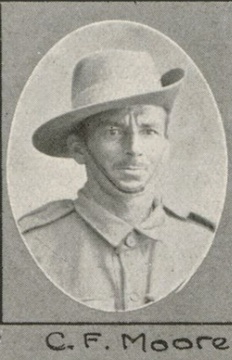
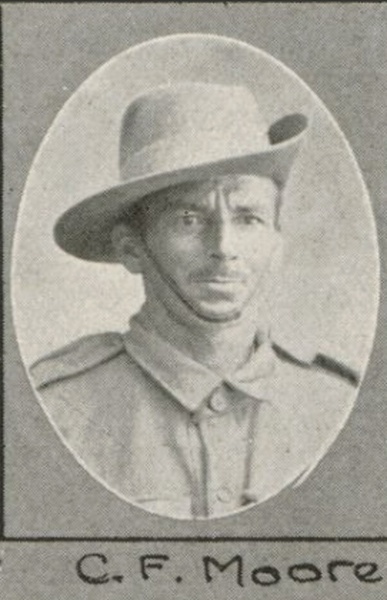
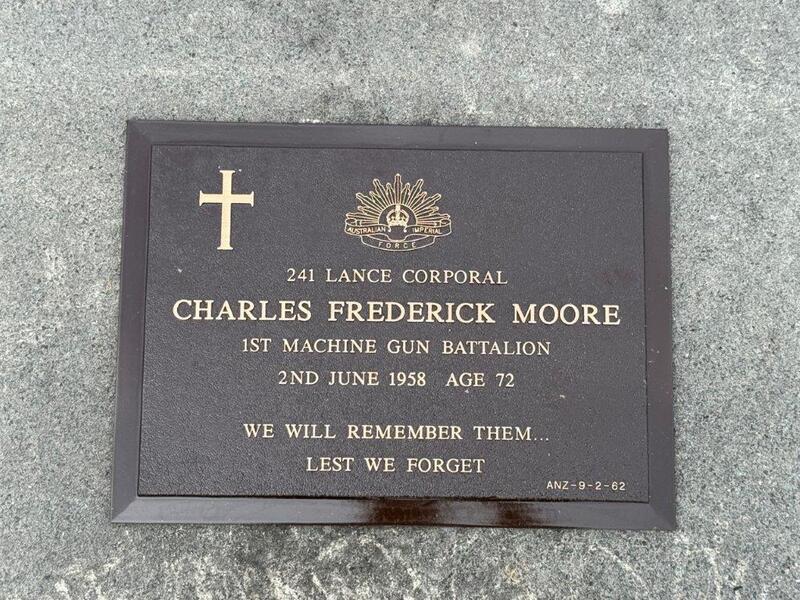
Lance Corporal Charles Frederick Moore (Service No. 241), an Australian World War One veteran, is among almost 800 previously unmarked WWI veterans’ graves in Lutwyche Cemetery we have now marked with a plaque recognising their service for Australia.
We unveiled his plaque in Lutwyche Cemetery on 20 September 2025, along with a further 161 plaques on the previously unmarked graves of Australian World War One veterans:
See Australian Remembrance Army Facebook page
Charles Frederick Moore was born in 1886 in Kent, England, and later migrated to Australia, where he enlisted in the Australian Imperial Force on 5 January 1916 at the age of twenty-four. After embarking for active service on 30 April 1916, he travelled via England before proceeding to France in November 1916, where he joined machine-gun units and began continuous operational service on the Western Front.
During 1916 and 1917, Moore moved frequently between machine-gun companies, reinforcement camps, and base depots, reflecting the heavy demands placed on machine-gun personnel. His service record shows repeated hospital admissions for bronchitis and other illnesses, including trench fever, conditions commonly associated with trench warfare. Despite these setbacks, he was consistently returned to duty and rejoined his unit on multiple occasions, serving with both the 3rd and later the 1st Machine Gun units as they were reorganised into battalions.
In 1918, Moore continued active service in France through the final and most intense year of the war. He was again hospitalised, yet each time was discharged back to duty. In August 1918, he was wounded in action, though the injury was not severe enough to remove him permanently from service, and he remained on duty following treatment. His endurance and experience were recognised when he was appointed Lance Corporal in January 1919.
Following the Armistice, Moore returned from France to England in April 1919. He embarked for Australia on 12 June 1919 aboard the transport Port Darwin and disembarked in Melbourne on 27 July 1919. He was formally discharged from the Australian Imperial Force in Brisbane on 12 September 1919.
Lance Corporal Charles Frederick Moore died on 2 June 1958, aged 72, and was buried in Anzac Portion 9, Lutwyche Cemetery, Brisbane.
After decades without recognition at his place of burial, his grave now bears a plaque commemorating his service to Australia — ensuring his name endures among those remembered for their duty and sacrifice. His identity and dignity have now been restored.
We have remembered him.
Lest We Forget.

Click images to start slideshow.