







LE BOUTILLIER, Arthur Louie
| Service Numbers: | 3186, 3186A |
|---|---|
| Enlisted: | 4 October 1916 |
| Last Rank: | Private |
| Last Unit: | 49th Infantry Battalion |
| Born: | Masterton, New Zealand, 2 September 1886 |
| Home Town: | Brisbane, Queensland |
| Schooling: | Masterton, New Zealand |
| Occupation: | Carpenter |
| Died: | Coronary Thrombosis, Brisbane, Queensland, Australia, 20 September 1964, aged 78 years |
| Cemetery: |
Lutwyche Cemetery, Brisbane, Qld Monumental Part, Portion 14, Section 7, Grave 16. |
| Memorials: |
World War 1 Service
| 4 Oct 1916: | Enlisted AIF WW1, Private, 3186, 52nd Infantry Battalion | |
|---|---|---|
| 23 Dec 1916: | Involvement Private, 3186, 52nd Infantry Battalion, --- :embarkation_roll: roll_number: '19' embarkation_place: Sydney embarkation_ship: HMAT Demosthenes embarkation_ship_number: A64 public_note: '' | |
| 23 Dec 1916: | Embarked Private, 3186, 52nd Infantry Battalion, HMAT Demosthenes, Sydney | |
| 1 Jul 1920: | Discharged AIF WW1, Private, 3186A, 49th Infantry Battalion |
Arthur Louis Le Boutillier - 3186
Arthur Louis Le Boutillier – Hon Sgt 3186a
(1886 -1964)
Arthur Louis (Robins) Le Boutillier was born on 2 September 1886 in Masterton, New Zealand. His adoptive parents were Philip John Le Boutillier (1847-1897) and Mary Juliana Robins (1863-1951).
Arthur's adoptive father was born in St Ouen, Jersey, Channel Islands about 1847 and died near Masterton NZ on 2 July 1897, from injuries sustained in a trap accident. Arthur's adoptive mother was born in Guernsey, Channel Islands in 1863. His natural mother was Florence Maud Robins (Mary's younger sister), who was born in St Pierre Port, Guernsey, Channel Islands in 1869.
Arthur was the only child to Philip and Mary Le Boutillier.
Arthur Louis Le Boutillier married Margaret Ellis (1879-1956) on 12 August 1911 at the Holy Trinity Church, in Fortitude Valley, Qld. Australia. At the time of the wedding, the groom resided at 148 Bowen Street, Brisbane and his bride resided at 114 Upper Edward Street, Brisbane.
Arthur and Margaret had five children together, four boys and one girl. The three oldest children were born before he went off to World War 1.
Arthur Louis was a carpenter, when he enlisted into the Australian Imperial Force (AIF) on 14 October 1916.
At the time of his enlistment, Arthur and Margaret resided in Daisy Road, Manly, Qld.
When Arthur enlisted he was assigned to the 49th Battalion. He was later assigned to the 8 th Reinforcements, 52nd Battalion. Arthur rose to the rank of temporary Sergeant and his Service Number was 3186a.
The following chain of events was sourced from Arthur Louis Le Boutillier’s Service Records (downloaded from National Archives of Australia website).
Arthur departed Australia on 23 December 1916 on-board the ship “H.M.A.T. Demosthenes” from the port of Sydney NSW.
On the voyage to England, Arthur became sick and was admitted to the ship's hospital on 26 December 1916.
He was discharged from the ship's hospital on 4 January 1917.
Arthur disembarked at Plymouth, England on 3 March 1917 and marched into 13th Training Battalion, Codford, England on 4 March 1917.
On 25 June 1917, Arthur marched out of the 13th Training Battalion at Codford and proceeded to France via Southampton. On 30 June 1917, he arrived at the 4th Australian Division Base Depot in Le Havre, France.
On 24 July 1917, Arthur departed Le Havre to join his unit, the 52nd Battalion.
(According to the history of the 52nd Battalion obtained from the Australian War Memorial. Between early June and late September 1917, the 52nd battalion was fighting on the front line in the Ypres sector of Belgium. So that is probably where Arthur went to).
On 23 October 1917, Arthur was sick and was sent to the field hospital. On 25 October, he was transported to the General Hospital in Rouen, France. He was admitted on 26 October suffering from Influenza. He was transferred on 12 November 1917 to the Mile End Military Hospital, Bancroft Road, London, still suffering from Influenza.
On 19 November 1917, Arthur was discharged from Mile End Hospital and reported to No.3 Base Depot, Hurdcott, on Salisbury Plains, England, for repatriation. He remained there until 6 January 1918.
On 12 January 1918, Arthur was admitted to the Fovant Military Hospital in Wiltshire, England with an infected Lymph Gland in his left groin. He was discharged from Fovant Hospital on 9 February and marched back into No.3 Base Depot, Hurdcott Camp on 10 February.
On 30 March 1918, Arthur went from Hurdcott to the Overseas Training Bdge in Longbridge, Deverill, (South-west England).
On 23 April 1918, Arthur proceeded from Longbridge, Deverill via Folkestone (near Dover) to France. He marched into the NZ Base Depot in Ypres, Belgium on 25 April 1918 (ANZAC Day). On 28 April, he marched out to join his unit in the 4th Army Division.
On 5 May 1918, Arthur rejoined his unit in the 52nd Battalion. (According to AWM unit history, the 52nd Bn participated in the battle of Villers-Bretonneux on ANZAC Day 1918, to dislodge the Germans from that town. Due to heavy casualties in that battle and lack of reinforcements from Australia, the 52nd Battalion was disbanded on 16 May 1918).
On 16 May 1918, Arthur was transferred to the 49th Battalion.
From the field on 10 August 1918, Arthur was taken sick to hospital. He was admitted into the 25th Stationary Hospital in Rouen, France on 8 August. On the 17 August he was invalided to England and admitted to the First Southern General Hospital, Birmingham, England on 18 August, suffering from severe dysentery.
Arthur didn't return to the battle fields of France. After being released from hospital late in September 1918, he sent the rest of 1918 at AIF camp at Sutton Veny, Wiltshire, England.
On 7 March 1919, Arthur was promoted to T/ Sgt.
On 26 June 1919, Arthur was designated to non-mil employ and granted one month's leave. On the same date he was granted the rank of Hon. Sgt. He returned to the 49th Bn on 26 October 1919.
On 19 November 1919, Arthur Le Boutillier was granted indefinite leave. While on leave he was at Hurst View, Perensey Bay, on south-east England coast.
On 31 March 1920, Arthur returned to Australia on the ship “Wahehe”, with his wife and four children. They disembarked at Sydney on 23 May 1920.
Arthur Louis Le Boutillier was discharged from the AIF on 16 July 1920.
Arthur Louis Le Boutillier was awarded three military metals: - “1914/15 Star”, “British War Medal”, and the “Victory Medal”.
After the war, Arthur lived in the Spring Hill and Canon Hill suburbs of Brisbane. He also lived in New Guinea for awhile.
On 20 September 1964, Arthur Louis Le Boutillier died from coronary thrombosis. He left behind three children and twelve grand-children.
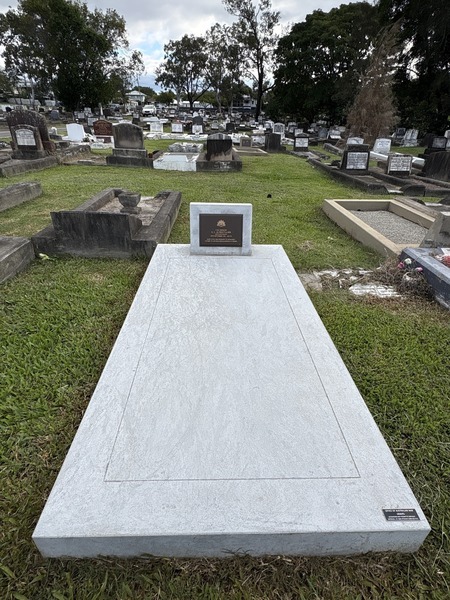
Arthur was buried at the age of 78 years, in the Monumental part of the Lutwyche Cemetery, Brisbane (Portion 14, Section 7, Grave 16).
Submitted 23 April 2015 by Gary Nugent
Biography contributed by Evan Evans
From Australian Remembrance Army
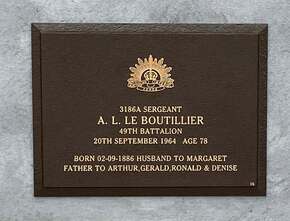
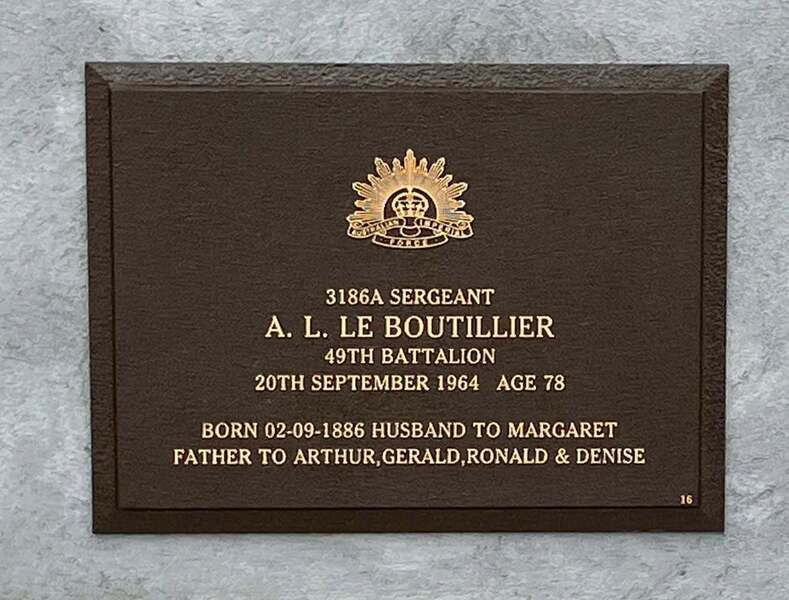
New Zealand born World War One veteran Sergeant Arthur Louis Le Boutillier (Service No. 3186A), is one of the previously unmarked WWI veterans’ graves in Lutwyche Cemetery that has been accepted as an Official Commemoration by the Office of Australian War Graves.
We unveiled his plaque in Lutwyche Cemetery on 16 May 2026, along with a further 185 plaques on the previously unmarked graves of Australian World War One veterans:
See Australian Remembrance Army Facebook page
Arthur Louis Le Boutillier was born in Masterton, New Zealand, on 2 September 1886. He enlisted in the Australian Imperial Force at Brisbane on 14 October 1916. At the time of enlistment, Arthur recorded his trade as carpenter and his wife, Margaret, as his next of kin. The family address was Daisy Road, Manly, Queensland.
He embarked from Sydney aboard HMAT Demosthenes on 23 December 1916, arrived in England in March 1917, and proceeded to France in June 1917. Arthur served first with the 52nd Battalion. After the 52nd Battalion was disbanded in May 1918, he was transferred to the 49th Battalion. During his service, he was hospitalised several times, including for influenza, an infected lymph gland, and severe dysentery. In August 1918, he was invalided to England and did not return to active service in France.
In 1919, Arthur was promoted to Temporary Sergeant and later held the rank of Honorary Sergeant. He returned to Australia in 1920 and was discharged from the AIF in July 1920.
After the war, Arthur applied to the Repatriation Department for assistance to obtain tools so he could resume work as a carpenter. The assistance was provided partly as a grant and partly as a loan. By 1921, he was living and working at Samarai, Papua, with the Public Works Department, but had fallen into arrears. He explained that irregular work, illness, the high cost of living in Papua, and family responsibilities had prevented him from making regular repayments.
In 1923 and 1924, the Repatriation Department pursued repayment of the outstanding loan. Arthur disputed the amount claimed, stating that he had wanted to buy cheaper second-hand tools but had been required to purchase new tools from a specified store, which left him with a larger debt. Departmental notes later indicated that further legal action would be costly and unlikely to be practical, and the debt was written off.
In September 1948, Arthur was arrested in Brisbane in relation to an alleged killing on Misima Island, in the Papuan Territory, said to have occurred in March 1942. The charge concerned the death of a native policeman or police bearer named Hala. Albert Edward Downey was also charged in connection with the same matter. Both men were committed for trial at the Supreme Court at Samarai. On 8 December 1948, the jury found Downey and Le Boutillier not guilty of the wilful murder of Hala, and both men were acquitted.
In 1962, Arthur lodged a Repatriation claim for emphysema and chronic bronchitis, which he believed were due to gas exposure in France. Medical notes from Greenslopes diagnosed bronchitis and assessed it at 10 percent incapacity, but the claim was rejected as not attributable to war service. His appeal was also disallowed in 1963.
Sergeant Arthur Louis Le Boutillier died on 20 September 1964, aged 78, and was buried in Monumental Portion 14, Lutwyche Cemetery, Brisbane. In September 2024, sixty years after his death, we received notification that our application for an official war graves commemoration had been accepted for War Graves purposes.
After six decades in an unmarked grave, his identity has now been restored.
Lest We Forget
ARA statement of intent:
Over the past six years we have submitted the service records and causes of death of hundreds of veterans to the Office of Australian War Graves for assessment for official commemoration. To date, more than 100 of these veterans interred at Lutwyche Cemetery have been accepted as Official Commemorations, and their graves are now being formally marked and will be maintained in perpetuity by the Office of Australian War Graves.
War graves, and their protection, are important because they help future generations understand the human cost and lasting consequences of conflict.
Click images to start slideshow.